Enhancing community safety: Effective wildfire mitigation and building practices
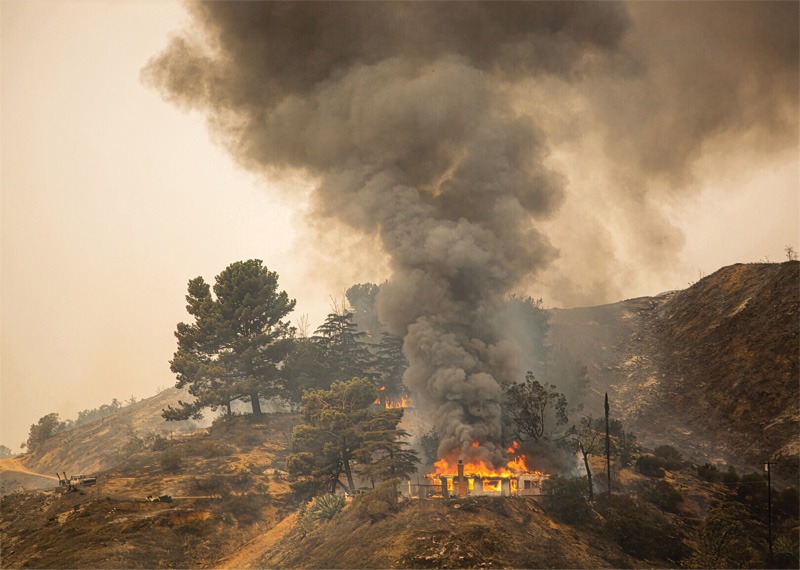
Part one of this article in The Construction Specifier’s December issue documented the growing exposure of Wildland Urban Interface (WUI) communities to high-intensity wildfire hazards and reviewed the mechanistic pathways by which structures ignite, notably ember and firebrand attack, direct flame impingement, and radiant heat. The technical discussion emphasized the vulnerability of roofs and exterior walls and evaluated building-level mitigations that demonstrably reduce ignition probability and damage severity—specifically, roof hardening (Class A coverings and cap sheets), ember-resistant venting, noncombustible claddings, and continuous noncombustible exterior insulation—while noting the limitations of minimum code compliance and single.
Part two builds on these findings and shifts the focus to parcel- and community-scale interventions, including the implementation of prescribed fire safe setbacks and parcel-level risk categorization, targeted retrofit strategies for existing stock, and the financing, insurance mechanisms, and policy instruments required to scale effective home hardening measures.
Implementing fire-safe setbacks
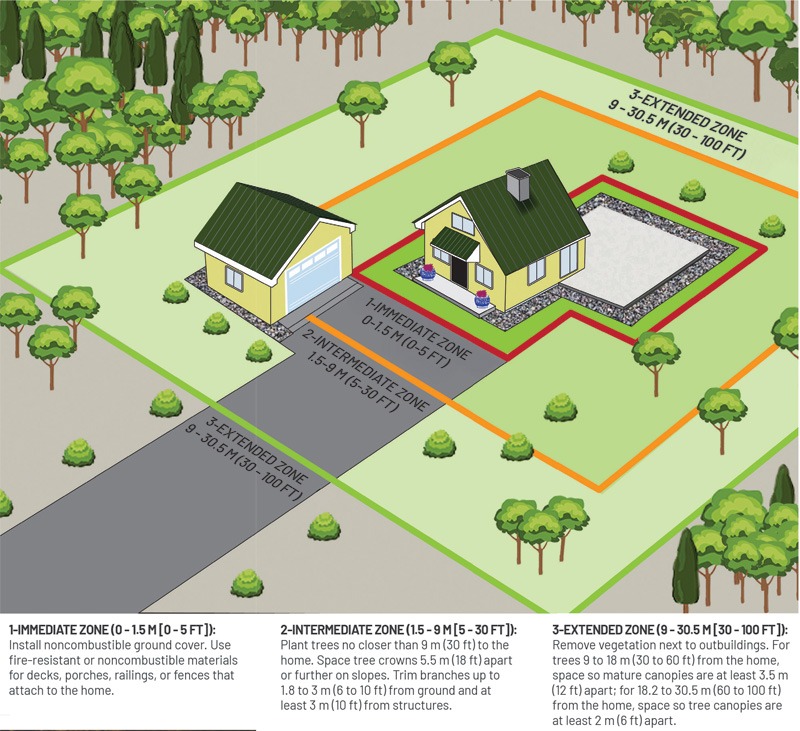
As stated previously, it is critical to ensure structures maintain a safe distance from potential external fuel sources. The primary purpose of building setbacks is to maintain fire separation distances from vegetation and other structures. In WUI areas, empirical evidence confirms that the required setback typically exceeds the setback requirements of zoning or building codes. In fact, “WUI Structure/Parcel/Community Fire Hazard Mitigation Methodology” from the National Institute of Standards and Technology (NIST), along with several other studies, have evaluated separation distances and support a minimum 9-m (30-ft) setback requirement.1,2
Recognizing the importance of setbacks, the Federal Emergency Management Agency (FEMA) recommends alternative strategies for homeowners when a 9-m (30-ft) setback to the property line is impractical due to factors such as parcel size, topography, or existing easements. In such cases, FEMA advises enhancing fire safety measures around the home to minimize the risk of fire spreading between structures. These recommendations are detailed in the 2023 Marshall Fire Mitigation Assessment Team: Homeowner’s Guide to Reducing Wildfire Risk Through Defensible Space.3
Further, traditional WUI categories (interface/intermix) describe general community classifications and hazard profiles. However, effective mitigation for building structures must be driven by specific property-level assessments and localized evaluation of potential fire exposures. This can be aided by identifying a parcel-level WUI categorization.
Currently, WUI area risks are primarily defined by spatial separation distance (SSD), with secondary consideration given to lot size. Even if structures are located on a large lot but are clustered together on the edge of the property with a small SSD, the hazard to adjacent structures would remain higher than the classification would indicate. Similarly, the proximity of vegetation to a structure poses the same hazard whether parcels are large or small. Specific parcel-level assessments need to be conducted if combustible materials are to be introduced within the building envelope.
As fires intensify and spread, homes can act as additional fuel sources, potentially sparking simultaneous ignitions. In many instances, burning homes may ignite nearby structures, exacerbating the situation. Firefighter response can be quickly overwhelmed by limited equipment, personnel, and water resources. When these resources are diverted to address structure fires, the overall effectiveness of fire protection is reduced, potentially leading to significant damage or destruction affecting dozens, or even hundreds, of homes.4
Upgrading existing homes
An important consideration for WUI building hardening and community resilience is addressing existing buildings. Existing homes or buildings present an excellent opportunity to introduce fire-hardening measures while simultaneously making energy efficiency improvements to enhance both fire and energy performance of exterior walls and roofs.
The 2008 FEMA Home Builder’s Guide to Construction in Wildfire Zones, “Technical Fact Sheet Series P-737,” offers a foundational set of recommendations for fire hardening.5 However, considering more recent and increasingly severe wildfire events, it is clear that additional and advanced building hardening strategies must be adopted. These newer measures could include the use of more ignition-resistant materials, noncombustible materials, the installation of ember-resistant vents, and the implementation of defensible space practices around homes and buildings. Replacing exterior wall coverings that are combustible, susceptible to melting, or can readily transmit heat can significantly enhance building safety.
Moreover, retrofitting existing structures with modern fire-resistant technologies not only mitigates the risk of fire damage but also provides an opportunity to improve overall building performance. Enhanced insulation, energy-efficient windows, and other sustainable building practices can reduce energy consumption, resulting in lower utility costs and contributing to the environmental sustainability of individual homes and communities.
Some examples of existing exterior envelope component replacements, or enhancements include:
Blowing insulation into exterior wall cavities
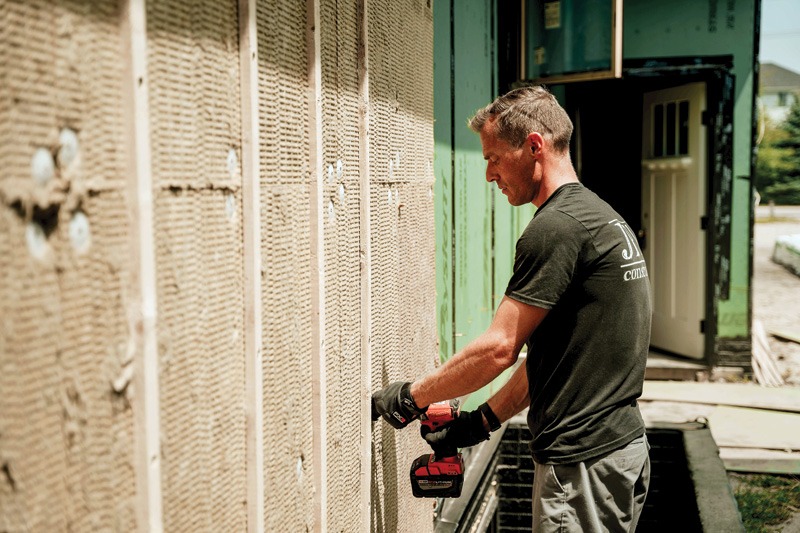
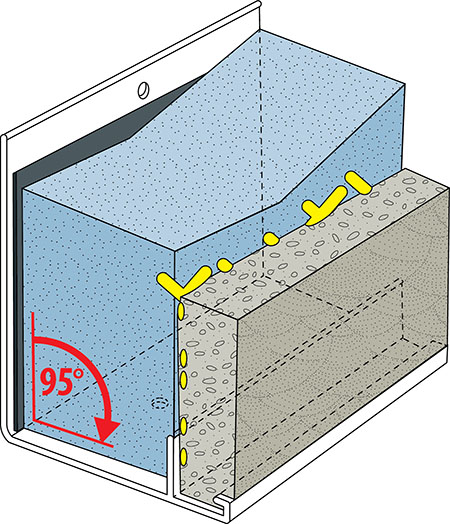
With the siding removed, the wall structural sheathing is exposed, allowing contractors to use the “drill and fill” method to blow insulation into the walls from the exterior. This is common practice in weatherization programs. Mineral fiber insulation, such as mineral wool, is particularly suitable for this application, as it effectively resists airflow and reduces air movement by filling wall cavities, thereby helping to decrease the fire risk by limiting the amount of oxygen available to sustain combustion. Improved thermal and acoustic performance, as well as fire protection, can be achieved in a single procedure.
Installation of a continuous air barrier
Installing a continuous exterior air barrier over the exposed wall sheathing prevents air from entering the wall assembly. This practice supports enhanced fire protection, energy efficiency, and contributes to improving indoor air quality and smoke control during a wildfire by preventing the infiltration of pollutants and harmful smoke into the building.
Adding noncombustible continuous exterior insulation
Adding noncombustible insulation, such as mineral wool board, as continuous exterior insulation on top of the air barrier, enhances the energy efficiency of the home or building and helps meet or exceed energy code requirements. Because this material is noncombustible, it also provides a layer of fireproofing, protecting both the combustible air barrier and the combustible structural sheathing. Finally, the addition of exterior insulation contributes to the building structure’s overall durability by elevating the surface temperature of the structural sheathing, reducing the risk of vapor diffusion or air leakage condensation.
Installing other noncombustible materials
Using noncombustible cladding and building materials provides a higher level of defense against wildfires. These materials resist ignition and prevent the spread of flames, thereby contributing to the protection of the structural integrity of the home.
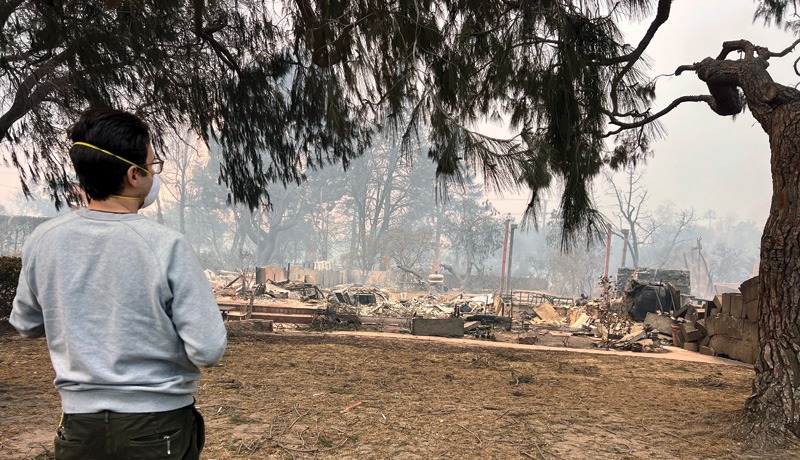
Removing and preventing accumulation of combustible debris
Removing combustible debris, such as vegetation and leaves, and avoiding combustible storage (e.g. firewood, garbage bins) near exterior walls and foundations reduces a building’s vulnerability to ignition during a wildfire.
Fire hardening accessory structures
Ensuring that accessory structures such as additional dwelling units, sheds, garages, barns, as well as fences and trellises, are also fire-hardened is critical to the overall system-wide performance of the property and can significantly reduce the risk of exposing the primary home or building to fire. The same fireproofing should be applied to these structures. For example, fences and trellises could be made of concrete or composite materials, which are more ignition-resistant than untreated wood.
As a testament to the effectiveness of hardening strategies, an impact analysis for the National Guide for Wildland-Urban Interface Fires, prepared by the Institute for Catastrophic Loss Reduction (ICLR) for the National Research Council of Canada, examined the 2018 Camp Fire in California. The analysis found that 59.4 percent of buildings constructed in or after 2008, adhering to the 2008 California Building Code—which introduced advanced requirements for materials and construction methods to withstand exterior wildfire exposure—survived the fire.6 In stark contrast, only 21.0 percent of structures built before the adoption of this code survived the wildfire. This significant disparity underscores the critical importance of adopting more stringent building codes and standards designed to enhance the resilience of structures in wildfire-prone areas.
California’s wildfire insurance market
In recent years, many insurers have withdrawn from California’s high-risk home insurance market,7 significantly reducing the availability of wildfire insurance. Those that remain have often responded to major wildfire events by increasing premiums or escalating the number of non-renewals in high-risk areas, leading to an affordability and availability crisis for insurance in numerous communities, extending beyond those directly impacted by wildfires.
As a result, this imbalance between supply and demand is driving up consumer premiums and placing additional strain on government programs such as the California Fair Access to Insurance Requirements (FAIR) Plan. The FAIR Plan offers property insurance to individuals who are unable to obtain coverage through the standard insurance market due to high-risk factors, such as residing in areas prone to wildfires. Consequently, in California, it serves as the insurer of last resort.
As more insurers continue to exit or restrict their business in the state, the California FAIR Plan is experiencing an unprecedented influx of applications, approaching nearly 1,000 per day. This surge in demand has resulted in the number of FAIR Plan policies in California skyrocketing from approximately 127,000 in 2018 to an anticipated 400,000 or more by September 2024.8 This dramatic increase underlines the critical role the FAIR Plan plays in providing necessary insurance coverage to homeowners in high-risk areas, while highlighting the growing challenges faced by the insurance market in addressing wildfire risks.
The aforementioned study, conducted by Milliman and CoreLogic for the Town of Paradise, California, found that implementing mitigation strategies could significantly decrease wildfire losses by up to 75 percent and potentially lower insurance premiums by as much as 55 percent.9 These findings are among the first and most comprehensive to date, quantifying the aggregate risk and cost reduction benefits of various strategies that communities and individual property owners in the WUI can implement to mitigate wildfire risk. This research highlights the significant potential for well-planned mitigation efforts to not only enhance community resilience but also to make insurance more affordable and accessible in high-risk areas.
However, as of today, the existing regulatory and legislative framework for California homeowners’ insurance is not easily adaptable to providing quantifiable benefits to insurers from wildfire risk mitigation. Although the California Department of Insurance has recently enacted regulations intended to stabilize the insurance market and increase coverage in wildfire-prone areas of the state,10 significant disincentives remain for insurers. There is a need for a more flexible regulatory environment that can better accommodate wildfire risk and incentivize effective mitigation efforts.
Home hardening: A practical solution to mitigate wildfire risk
It is imperative for policymakers, builders, and homeowners to collaborate and prioritize home hardening and defensible space measures for both new and existing homes and buildings. Additionally, state laws, regulations, and policies should fund and incentivize these measures to encourage broader adoption by individuals and communities. By doing so, safer and more resilient communities that are better prepared to withstand the growing threat of wildfires can be created, which not only better protect public health and safety but also mitigate the devastating economic impacts of catastrophic wildfire events.
In February 2022, the California Department of Insurance, in partnership with the California Office of Emergency Services (Cal OES), California Department of Forestry and Fire Protection (CAL FIRE), the Governor’s Office of Planning and Research, and the California Public Utilities Commission, adopted the Safer from Wildfires regulations to provide insurance discounts to homeowners who implement recommended home hardening and defensible space measures to reduce wildfire risk to their homes and properties.11 These measures include Class-A fire-rated roofs; the creation of ember-resistant zones around homes and other defensible space measures; installation of ignition-resistant or noncombustible vents, enclosed eaves, and upgraded windows; and exterior walls that incorporate noncombustible materials at the bottom 152 mm (6 in.). The more of these measures a homeowner implements, the larger the potential insurance discount.
Critics of these incentive programs often voice concerns that the costs of implementing, in particular, these home hardening measures can often exceed the rate discount provided by insurers, rendering these programs ineffective. The 2022 report by Headwaters Economics and Insurance Institute for Business & Home Safety (IBHS), titled “Construction Costs for a Wildfire-Resistant Home: California Edition,” demonstrates, however, this may not necessarily be the case.12 Headwaters Economics and IBHS analyzed the cost differences in new home construction, comparing the costs of a baseline code-compliant home with those of “enhanced” and “optimum” homes, based on this initiative to reduce the vulnerability of homes to wildfires. It also differentiated the costs between northern and southern California. The report concluded:
- Wildfire-resistant construction increases the total cost of a new home by approximately 2 to 13 percent.
- Enhanced building materials add 2 to 8 percent to the cost, while optimum building materials add 4 to 13 percent over baseline materials.
- For northern and southern California, respectively, the difference in cost between baseline and enhanced construction ranged from $27,610 to $28,890, representing an
11 percent cost increase in both regions. In contrast, the additional cost for optimally enhanced homes was significantly higher, at 73 percent for northern California and 104 percent for southern California.
It is noteworthy that properly installed wildfire-resistant features can provide numerous advantages beyond fire protection. These benefits include greater durability, lower maintenance requirements, and potentially improved energy efficiency. Over the lifespan of a building, these advantages can help to justify the initial investment in higher-quality materials.
To help mitigate these additional costs, home and commercial property owners can also access various financial incentives to make energy-efficient and fire-hardening improvements. These incentives include federal tax credits, state and utility incentives, local tax abatements, and other financial supports. Notably, the Residential and Commercial Property Assessed Clean Energy (PACE) financing programs are a significant resource in this regard.
California law specifically permits fire hardening to be eligible for PACE financing. The PACE program, which began in Berkeley in 2007, has evolved through new state laws and federal guidance from the IRS and the Department of Housing and Urban Development (HUD). It offers a unique financing option for homeowners to fund various sustainability improvements—such as energy-efficient upgrades, water conservation projects, and home hardening against wildfires—through their property taxes.13
Moreover, Southern California lawmakers recently introduced two bills aimed at incentivizing homeowners to “harden” their properties against wildfires. The legislation, authored by state Sen. Steven Choi, proposes tax credits covering half the cost of fire-resistant upgrades, such as roofs, siding, vents, decks, and fences. Another bill focuses on grants to support these home-hardening efforts. These measures aim to reduce the risk and impact of wildfires on residential properties by encouraging the use of ignition-resistant and noncombustible building materials and landscaping.14
Conclusion
Wildfires pose a significant and persistent threat, necessitating strategic measures to enhance the resilience and safety of communities, particularly those in WUI areas. Recent catastrophic events underscore the urgent need for comprehensive and multifaceted mitigation strategies.
Innovative solutions in wildfire risk management must transcend traditional construction methods. The use of noncombustible, ignition-resistant materials, such as mineral wool insulation, in critical areas such as exterior walls, roofs, eaves, and attics is crucial. Equally vital is community engagement and education, with initiatives like defensible spaces, fire-resistant landscaping, and home-hardening measures collectively reducing wildfire risks.
Building codes are essential to community resilience, safeguarding life and property in high-risk areas. These codes must incorporate rigorous requirements tailored to WUI-specific challenges. Policymakers play a crucial role in promoting these practices by providing financial incentives, insurance discounts, and public awareness campaigns to encourage the widespread adoption of fire-resistant strategies. Legislative efforts, such as California’s Assembly Bill 1 (AB 1), aim to enhance fire safety in building construction, reducing structural vulnerability to wildfires. These initiatives emphasize the importance of robust fire safety regulations, reflecting a growing commitment to fortifying communities against such threats. Flexible regulatory frameworks are also crucial to supporting and incentivizing effective mitigation efforts.
In conclusion, ongoing legislative efforts should be recommended to further these goals, with an emphasis on flexibility to adapt to evolving needs. A holistic approach that integrates these strategies will not only mitigate wildfire risks but also enhance community resilience in high-risk areas. By prioritizing stringent building codes, innovative materials, proactive community engagement, and supportive policies, we can create safer environments equipped to withstand the growing threat of wildfires.
Notes
1 See NIST Technical Note 2205: WUI Structure / Parcel / Community Fire Hazard Mitigation Methodology.
2 Refer to FEMA’s Marshall Fire Mitigation Assessment Team: Best Practices for Wildfire-Resilient
Subdivision Planning.
3 Refer to FEMA’s Marshall Fire Mitigation Assessment Team: Homeowner’s Guide to Reducing Wildfire Risk Through Defensible Space.
4 The Firewise USA program provides simple, effective steps to help communities reduce the risk of destruction from wildfire.
5 See 2008 Home Builder’s Guide to Construction in Wildfire Zones, particularly Technical Fact Sheet Series FEMA P-737.
6 Refer to Figure 4A of “An impact analysis for the National Guide for Wildland-Urban Interface Fires.”
7 See “California insurance market rattled by withdrawal of major companies” on The Associated Press.
8 Refer to Insurance Business: Wildfire lessons for Canada: courtesy of California.
9 See the Milliman And CoreLogic Report. Town of Paradise California Resilience Challenge Task 1 to Task 4, Risk Reduction, Climate Change, and Insurance Premiums.
10 Refer to California Department of Insurance’s press release for December 13, 2024; and California Department of Insurance’s press release for December 30, 2024.
11 Refer to California Department of Insurance, Safer from Wildfires.
12 Learn more at Headwaters Economics, “Construction Costs for a Wildfire-Resistant Home – California Edition.”
13 Refer to State of California, Department of Financial Protection & Innovation. PACE: Property Assessed Clean Energy: What Homeowners Need to Know.
14 Visit SiliconValley.com, “California bills encourage fire home-hardening with grants, tax breaks.”
Authors

Tony Crimi, P.Eng., MASc., is the founder of A.C. Consulting Solutions Inc. (ACCS), a firm specializing in building and fire-related codes, standards, research, and product development in the U.S., Canada, and Europe. Before establishing ACCS in 2001, he spent more than 15 years at Underwriters Laboratories of Canada (ULC), where he served as vice president and chief engineer, focusing on codes and standards development, testing, and conformity assessment. With more than 30 years of experience, Crimi has been actively involved in the development of national and international codes and standards through organizations such as the International Code Council (ICC), the National Fire Protection Association (NFPA), ASTM, and other leading standards bodies. He has also authored numerous articles and papers on fire protection and facade fire safety.

Antoine Habellion, P.Eng., is the technical director at ROCKWOOL North America, leading the building science, technical services, codes and standards, and product development teams. He oversees a multidisciplinary group that translates research into practical solutions, enhancing the thermal, hygrothermal, fire, and acoustic performance of building envelopes. With over a decade of experience in residential and commercial enclosure design, he contributes to code and standards development, working with industry professionals to advance resilient and sustainable construction practices. Before joining ROCKWOOL North America, he was a building science engineer at ROCKWOOL France in Paris. Habellion holds a Master of Civil Engineering from Hautes Études d’Ingénieur (HEI), Lille, and an Advanced Master’s in Building Science from Arts et Métiers ParisTech and École Spéciale des Travaux Publics (ESTP) in Paris.
Key Takeaways
Setbacks are essential for wildfire safety, with National Institute of Standards and Technology (NIST) and Federal Emergency Management Agency (FEMA) recommending at least 9 m (30 ft) between structures and vegetation, though alternatives exist for smaller lots. Local risk assessments matter, since spacing—not just lot size—shapes hazard levels. Retrofitting buildings with fire-resistant materials, noncombustible cladding, continuous air barriers, and ember-resistant features greatly reduces vulnerability, as does strengthening accessory structures and removing debris. Financial tools like Commercial Property Assessed Clean Energy (PACE) programs, insurance discounts, and tax credits help support upgrades, while policy updates and modernized codes remain critical for mitigation and community safety.
Sign up for our weekly newsletter
Architectural materials and methods delivered right to your inbox

- CSI News and Notes: CSI Foundation’s construction camp; CSI spring exam; and more
- CSI News and Notes: CSI’s credentials; CSI conference theme; and more
- To be specific – CSI supports young AECO professionals
- CSI News and Notes: CSI’s foundation scholarships, national conference, and Crosswalk
- CSI News and Notes: AI’s impact; CSI 2024 conference, and more
Related Products
Read the Latest Issue