Post-fire structural steel evaluation
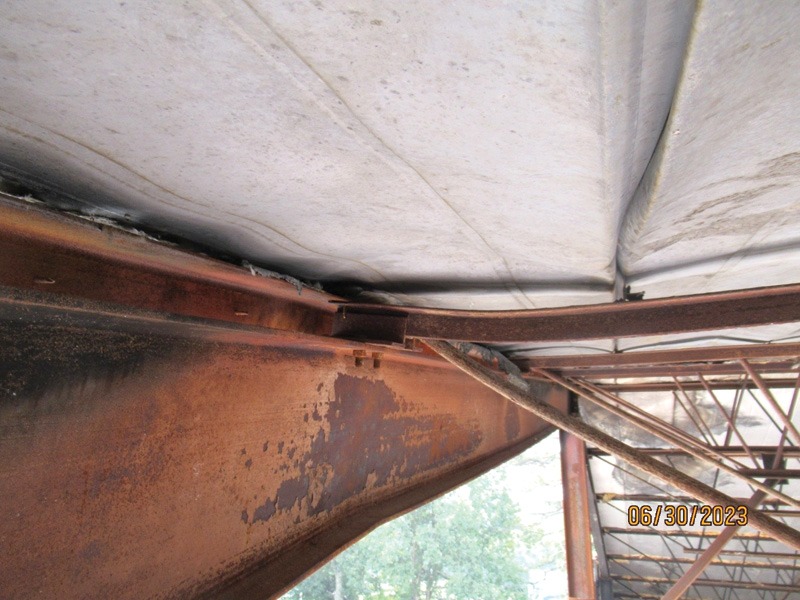
After a building fire, repair efforts typically begin by identifying the impacted structural components. Areas of structural damage are typically linked to regions exposed to the highest temperatures, often aligning with severe damage to interior finishes or contents. The type of structural material dictates the evaluation approach.
Building code requirements generally dictate the level of passive and/or active fire protection measures required. In steel buildings, passive fire protection often includes spray-applied fire-resistive material (SFRM) or other permanent, physical steel protection, such as concrete, concrete masonry, gypsum board, or intumescent coatings. Active fire protection includes the building’s sprinkler system and other components that activate only when a fire is detected. In localized, short-duration fires, damage in steel-framed buildings is often limited to nonstructural materials, as steel is a noncombustible building material and does not contribute fuel to a fire.
For more severe fires, evaluating fire-damaged structural steel requires a structural engineer experienced in assessing and repairing such conditions. A visual condition assessment can identify framing elements impacted by elevated temperatures. Depending on the extent of the damage, temporary shoring may be required to stabilize the structure.
Visual condition assessments typically include observations and measurements of deformed members as well as delineation of areas where structural steel has been exposed to significant heating. Damage is usually evident through plastic (permanent) deformations. While structural materials typically lose strength and stiffness during a fire, in steel (unlike wood or concrete), these properties are generally reversible upon cooling if temperatures remain below 538 C (1,000 F). However, it is still important to evaluate deformations in the geometry of steel members, as structural steel shapes are designed for a specific geometry that is key to the member’s strength and stiffness.
If a steel member remains straight after a fire, it is typically safe for continued use. Slightly deformed members should be evaluated through structural analysis that accounts for thermally induced residual stresses to evaluate suitability for continued use or the need for repair. This would include approximating restrained thermal expansion forces based on assumed heating and connection types. Deformed members can be structurally analyzed in their residual shape, considering second-order, nonlinear geometric effects. Reinforcement plates may be added to restore structural strength. Heat straightening may also be considered to restore the original member geometry, but requires careful consideration by a structural engineer and an experienced contractor. For severely deformed members, removal and in-kind replacement is often the most appropriate solution. Additional guidance on investigating and repairing steel-framed structures damaged in fires is available through publications and webinars from the American Society of Civil Engineers (ASCE) and the American Institute of Steel Construction (AISC).
Authors

Michael M. Drury, PhD, PE, is a professional engineer and associate III with the Princeton, N.J., office of Wiss, Janney, Elstner Associates, Inc. (WJE), specializing in the investigation and repair of building structures. He can be reached at mdrury@wje.com.
Alexandar J. Mlynarczyk, PE, is a professional engineer and associate principal with the Princeton, N.J., office of Wiss, Janney, Elstner Associates, Inc. (WJE), specializing in the investigation and repair of building structures. He can be reached at amlynarczyk@wje.com.
The opinions expressed in Failures are based on the authors’ experiences and do not necessarily reflect that of The Construction Specifier or CSI
Sign up for our weekly newsletter
Architectural materials and methods delivered right to your inbox

- CSI News and Notes: CSI Foundation’s construction camp; CSI spring exam; and more
- CSI News and Notes: CSI’s credentials; CSI conference theme; and more
- To be specific – CSI supports young AECO professionals
- CSI News and Notes: CSI’s foundation scholarships, national conference, and Crosswalk
- CSI News and Notes: AI’s impact; CSI 2024 conference, and more
Popular Articles
-
1
-
2
-
3
-
4
-
5
Read the Latest Issue