
Room to Grow
Like any building material exposed to changing ambient conditions, tile flooring assemblies need room to move. Movement joints (e.g., expansion, control, construction, etc.) relieve stress from thermal expansion in a floor or wall assembly and allow for differential movement between dissimilar materials. When proper movement joints are not provided, the flooring assembly can be damaged by the thermal expansion of the materials.
In the first project, marble floor tiles were used on an exterior covered porch and terrace of a building in Florida. The tiles were set in a mortar bed, and the narrow joints were filled with mortar. As the paving system expanded under full sun and in hot weather, individual tiles developed chips and spalls along their edges, where the stone was confined by the relatively hard mortar (Figure 1). Cyclical thermal expansion and contraction also caused cracking and the eventual failure of the mortar joints.
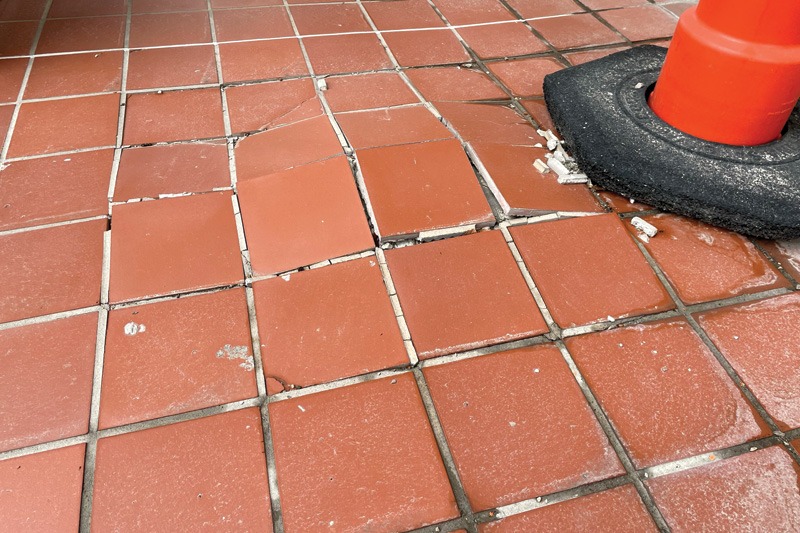
In the second project, red ceramic clay tiles were used as paving for an exterior terrace in the Midwest. The tiles were set in a mortar bed over a structural concrete floor slab, and the relatively wide joints were filled with mortar. Sealant was observed at occasional joints in the assembly, but these were not true expansion joints because they were not continuous through the assembly’s depth and did not extend across the entire width or length of the paved area. During hot weather, the materials expanded, causing several portions of the paving assembly to buckle and heave (Figure 2). With the pavement confined at all edges by the building walls and the parapet, it had nowhere to go but up.
Guidelines for the design of expansion in paving systems are provided by the Tile Council of North America, Inc. (TCNA), the American National Standards Institute (ANSI), and ASTM International:
- TCNA Handbook for Ceramic, Glass, and Stone
Tile Installation - EJ171 Movement Joint Guidelines for Ceramic, Glass,
and Stone - ANSI A108.01, General Requirements: Structures, Substrates, and Preparation for Tile
- ANSI A108.02, General Requirements: Workmanship for Tile Installation
- ASTM C1193, Standard Guide for Use of Joint Sealants

Generally, 12.7-mm (0.5-in) movement joints are required at intervals not exceeding 7.6 m (25 ft) on center in interior installations and not exceeding 3.7 m (12 ft) on center at exterior locations. More closely spaced or wider joints may be necessary for paving exposed to direct sunlight or subject to greater temperature extremes between winter nights and summer’s full sun. Additional joints may be required at transitions in the underlying structure, at changes in materials, at architectural geometry such as reentrant corners or columns, at penetrations, and at the perimeter of each paved area. Because of the need to coordinate among different trades and to align movement joints with architectural geometry, the designer should specify the locations, details, and material specifications of the joints in the project documents.
Authors

Kenneth Itle, AIA, is an architect and associate principal with Wiss, Janney, Elstner Associates, Inc. (WJE) in Northbrook, Ill., specializing in historic preservation. He can be reached at kitle@wje.com.

Katherine Augustine is an engineer and associate with Wiss, Janney, Elstner Associates, Inc. (WJE) in Northbrook, Ill., with experience in projects relating to the restoration of masonry structures and moisture leakage investigations. She can be reached at kjaugustine@wje.com
The opinions expressed in Failures are based on the authors’ experiences and do not necessarily reflect those of The Construction Specifier or CSI.
Sign up for our weekly newsletter
Architectural materials and methods delivered right to your inbox

- CSI News & Notes: CSI’s impact earns official recognition; celebrate leaders, mentors, and innovators; and more
- CSI News and Notes: CSI spring certification exams open; scholarships available; and more
- CSI News & Notes: CSI MSR heading to San Diego; spring certification exams open; and more
- To Be Specific: Why CDT Should Be Your First Move
- CSI News & Notes: CSI Fellows share member benefits; and a New Year’s Resolution to keep
Read the Latest Issue