Building up, not out: Columbia’s vision for resilient urban athletics
Designing large-scale athletic facilities in dense urban areas poses distinct challenges. Hemmed in by surrounding development and natural barriers, these structures must adapt to restricted footprints while still delivering safe, high-performance environments suited for intense physical activity. They must also incorporate resilient features that address environmental risks, while simultaneously complementing the culture and fabric of their host cities.
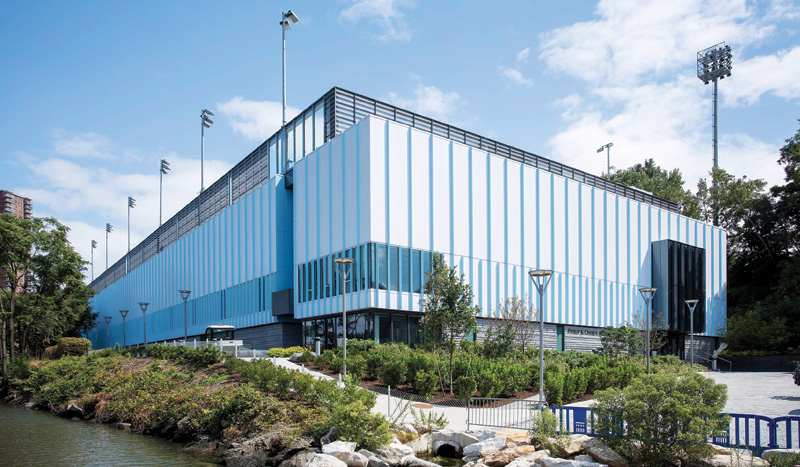
Columbia University’s Philip & Cheryl Milstein Family Tennis Center, designed by Perkins&Will, is located on the northern tip of Manhattan between the Hudson and Harlem rivers. This facility exemplifies how design can meet these demands. Built on a compact, flood-prone site, the National Collegiate Athletic Association (NCAA) compliant facility provides 12 courts—six indoors and six outdoors on the roof—alongside training, locker, and social spaces. Its design relies on a vertical building strategy supported by translucent curtain wall systems, which together enhance performance, sustainability and resilience.
Urban athletics and design challenges on constrained sites
Urban land scarcity is increasingly shaping development strategies, particularly for facilities that require expansive footprints such as athletics complexes. Population growth, zoning restrictions, and geographic limitations continue to intensify competition for space, with UNICEF projecting nearly 70 percent of the global population will live in cities by 2050.1 As urban congestion increases and land prices rise, design teams are being pushed to think vertically, maximizing every square metre of available space. Within this context, urban planning has shifted toward more space-efficient solutions, including stacked sports centers, rooftop gyms, and multilevel recreation facilities that can accommodate growing demand without expanding outward.2,3
The Philip & Cheryl Milstein Family Tennis Center reflects these pressures and responses. Designed to replace an aging facility within Columbia University’s Baker Athletics Complex, it occupies a compact site in the nation’s most densely populated county. Flanked by the Hudson and Harlem rivers, the location eliminated the possibility of outward expansion, requiring a vertical solution that would deliver a full NCAA-compliant program. Beyond the courts themselves, the project scope also included training areas, locker rooms, and gathering spaces for students, faculty, and visitors, that needed to be carefully integrated within the building’s limited footprint.
Simultaneously, the university prioritized maintaining visual and physical connections to the adjacent parkland and waterfront. The flood-prone nature of the site introduced another layer of complexity, necessitating resilience strategies that can withstand rising water. Meeting these diverse requirements necessitated an integrated architectural and engineering response—one that balanced programmatic performance, environmental resilience, and contextual design within the realities of a constrained urban site.
Vertical design and technical demands
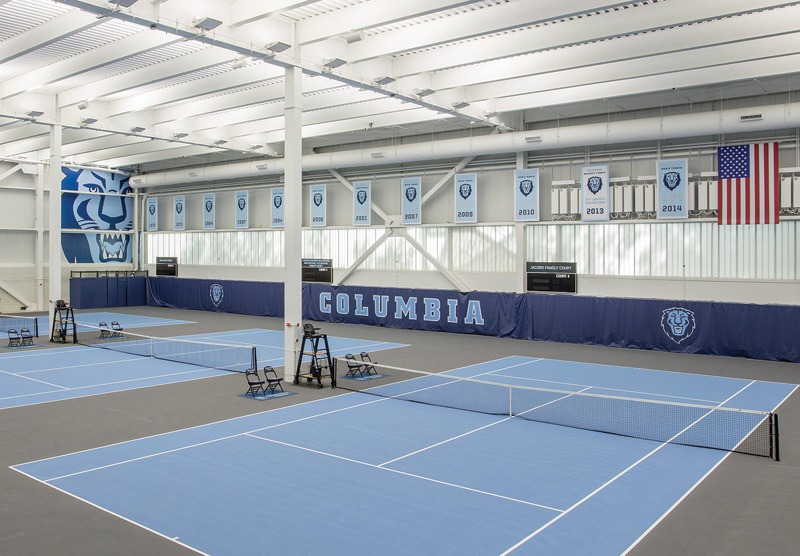
To resolve the challenges of a constrained, flood-prone site, the design team implemented a vertical building strategy. Six indoor courts were stacked above flood-resilient support spaces, while six additional courts were placed on the roof. This tiered arrangement enabled the delivery of a full NCAA-compliant facility, while remaining sensitive to both the surrounding landscape and the urban fabric of northern Manhattan.
Vertical stacking, however, presents unique engineering and operational demands. The foundation must be capable of distributing substantial loads evenly, while additional reinforcement is necessary to resist seismic and wind forces.3 Interior systems must also address the “stack effect,” where rising warm air alters comfort conditions at upper levels. For an athletic facility, these challenges are compounded by the need for floors that can support heavy equipment and absorb high-impact use, as well as acoustic treatments that minimize noise and vibration transfer. Taken together, these measures ensure athletes and spectators alike can experience a safe and comfortable environment.
Curtain wall systems as a design tool
While structural strategies enabled the Milstein Center to achieve its vertical program, the overall success of the facility relied on more than engineering alone. A holistic approach was needed to ensure the building not only functioned efficiently but also created an environment that supported visibility, comfort, and athlete performance.
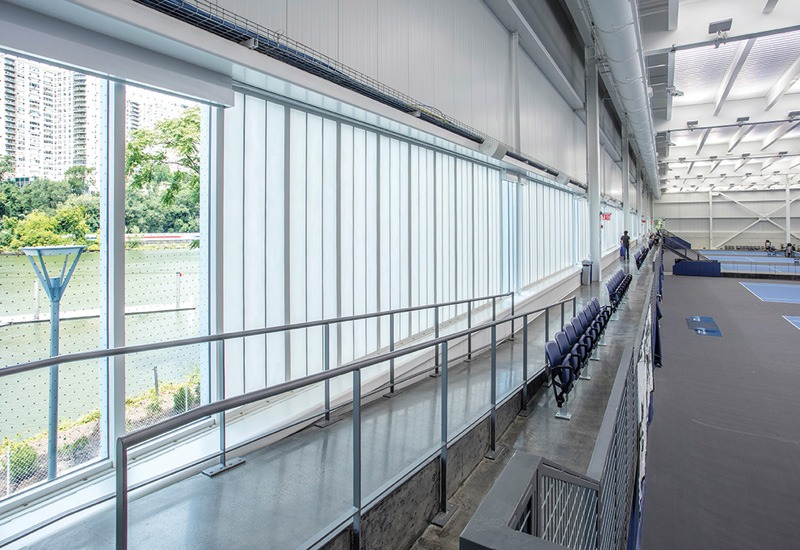
To achieve this, the design team incorporated translucent curtain wall systems with integrated windows to the indoor court level. Serving as both enclosure and design element, these assemblies provided a lightweight, resilient envelope that delivered consistent, diffused natural daylight, reduced energy demand, regulated interior thermal conditions, and clearly defined the facility’s architectural identity.
Daylighting and athlete performance
The decision to prioritize daylighting was rooted in data linking natural daylight to both health and human performance. Research from the National Institutes of Health suggests that exposure to daylight is associated with higher levels of physical activity among young adults.5 Additional studies from the Lighting Research Center suggest it also affects serotonin levels and alertness, reducing fatigue, and sharpening cognitive function—factors that are especially important in high-intensity environments such as athletic training and competition.6 Complementary research published in the Journal of Clinical Sleep Medicine found that individuals with greater exposure to daylight reported higher vitality, better sleep quality and longer rest duration than those in windowless settings.7 In athletic facilities, these findings underscore daylighting as a critical performance strategy, supporting sharper concentration, faster reaction times and improved overall well-being.
Building on this evidence, the Milstein Center incorporates translucent curtain wall systems that diffuse daylight evenly across the indoor courts. By minimizing glare and reducing localized hotspots, the assemblies provide consistent illumination that enhances visual comfort during play while allowing athletes to maintain focus without distraction.8 Tennis was created as an outdoor sport, and the athletes at the Milstein Center continue to reap the intended benefits of playing this outdoor sport.
Thermal comfort and energy efficiency
Daylighting strategies at the Milstein Family Tennis Center also support broader sustainability goals. By reducing reliance on electric lighting during peak daytime hours, the facility lowers overall energy consumption at times when occupancy is highest. Research has shown that electric lighting in commercial buildings can represent 35 to 50 percent of annual energy use.9 Reducing this demand lowers carbon emissions while generating long-term operational savings, a critical consideration for high-use facilities that still require electric lighting for evening activities.
Thermal comfort was an equally critical factor. The curtain wall assemblies admit natural daylight while reflecting a significant portion of solar radiation, preventing overheating during play. Their insulating properties limit heat transfer between interior and exterior spaces, reducing the load on mechanical heating, cooling and ventilation systems. This design approach can reduce cooling demand by approximately 15 percent, thereby enhancing both energy performance and occupant comfort.10 Supporting evidence from building performance research suggests that improved daylighting can produce measurable energy savings, with some facilities reporting reductions of up to 27 percent.11
Views and psychological well-being
In addition to managing light and temperature, the curtain wall assemblies enhance athlete well-being by incorporating carefully curated vision glass for views of the surrounding rivers and parkland. These carefully placed openings establish a visual connection to nature, creating a restorative environment that supports focus and reduces stress. Research cited by the National Library of Medicine has found proximity to nature can bolster psychological resilience and concentration, both of which directly influence athletic performance.12
Facade integration and urban contextualization
The design team aimed to create an exterior that was contemporary in appearance yet grounded in the cultural and historical context of Manhattan. This required carefully balancing modern architectural expression with references to the city’s existing fabric. The resulting facade employs a vertical rhythm of translucent wall panels, metal fins, and white cladding; a nod to the area’s maritime and industrial heritage while presenting a clean, modern aesthetic.
This outcome illustrates the design flexibility of modular facade systems. Capable of supporting minimalist compositions and geometric patterns, these assemblies offer uniformity and rhythm while allowing variation in texture, color, and form to respond to diverse architectural contexts.
Resilience and climate adaptation
Resilience was equally critical to the project’s success. Positioned between two rivers, the facility required flood protection strategies that would safeguard long-term structural integrity. Rather than relying on dry floodproofing, which involves sealing the exterior to keep water out, thereby risking structural failure at higher flood levels, the design team employed a wet floodproofing approach. Flood vents at the ground level permit water to flow into and out of the building, equalizing hydrostatic pressure and reducing the chance of wall or foundation failure. Mechanical and electrical systems were elevated above projected flood lines to avoid damage. These strategies, designed in accordance with Federal Emergency Management Agency (FEMA) guidelines and New York City building codes, minimize long-term material degradation and enable faster recovery following flood events.13,14
The Milstein Family Tennis Center’s climate-adaptive strategies illustrate a broader design lesson for athletic facilities in vulnerable areas. By integrating resilient facade materials, floodproofing methods and climate-responsive planning, the project demonstrates how design can simultaneously protect occupants, reduce potential damage and prepare for accelerated climate change. With the Environmental Protection Agency (EPA) projecting more frequent extreme weather events in the coming decades, such approaches will be increasingly relevant for urban development.
Results and broader impacts
The Philip & Cheryl Milstein Family Tennis Center achieved its functional, aesthetic, and environmental goals, resulting in a high-performance athletic facility that benefits both the university and its surrounding community. By integrating sustainable, resilient, and contextually sensitive strategies, the project provides visual connections to the waterfront, mitigates environmental factors, and reduces energy demand. With NCAA-compliant courts and year-round gathering spaces, the facility supports campus well-being while setting a precedent for athletic development in dense, flood-prone urban areas.
Equally important are the broader lessons the project offers to design professionals. As one of the region’s first vertically stacked tennis centers, the facility demonstrates:
- How curtain wall systems can maximize daylight while controlling glare and thermal loads
- How facades can reinforce cultural and historical context
- How resilient design strategies can mitigate the risks of climate change
These integrated approaches demonstrate a balanced methodology that addresses technical, environmental, and contextual imperatives within a single design solution.
Conclusion
The Milstein Family Tennis Center establishes a repeatable model for space-efficient, climate-adaptive facilities. The combination of vertical stacking, envelope-integrated daylighting, contextual facade design and resilient construction strategies extends well beyond athletics, offering practical guidance for educational, civic, and community projects navigating the complex realities of today’s urban environments.
Notes
Author

Neall Digert, Ph.D., MIES, vice president, innovation and market development, Solatube International and Kingspan Light + Air North America, has more than 30 years of consulting and education experience working in the energy/lighting/daylighting design and research fields, specializing in the design and application of advanced lighting and daylighting systems for commercial building applications.
Sign up for our weekly newsletter
Architectural materials and methods delivered right to your inbox

- CSI News & Notes: CSI’s impact earns official recognition; celebrate leaders, mentors, and innovators; and more
- CSI News and Notes: CSI spring certification exams open; scholarships available; and more
- CSI News & Notes: CSI MSR heading to San Diego; spring certification exams open; and more
- To Be Specific: Why CDT Should Be Your First Move
- CSI News & Notes: CSI Fellows share member benefits; and a New Year’s Resolution to keep
Products

Read the Latest Issue