
Impacts on roof loading due to snow drifting
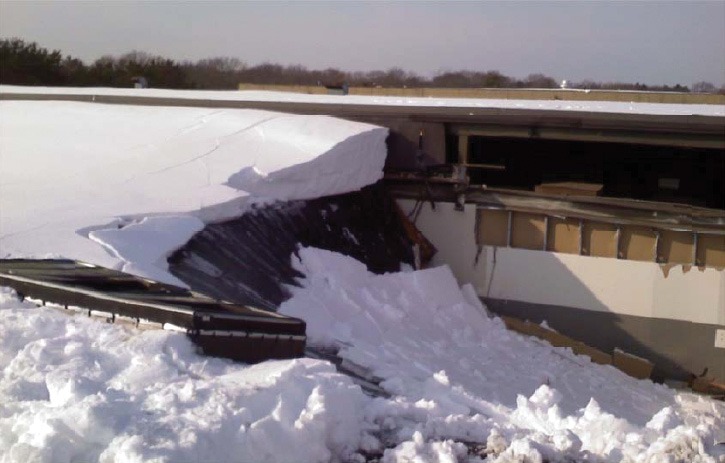
According to the International Building Code (IBC) and legacy codes, snow loads must be considered in the design of buildings in areas prone to snowfall. These model building codes refer to the American Society of Civil Engineers (ASCE) Standard 7, Minimum Design Loads and Associated Criteria for Buildings and Other Structures, for detailed requirements for designing building structures for snow loads.
New buildings are designed for evenly distributed flat or sloped roof snow loads, with additional consideration for snow drifting and unbalanced loads based on roof size and shape. Changes to roof geometry of existing buildings can alter snow load distribution, which is particularly relevant for structures built before the late 1970s, when snow drift load requirements were not explicitly included in standards, such as ASCE 7.
Snow drifting on roofs occurs when wind carries snow from one roof area to another, creating larger accumulations and higher loads than a typical uniformly distributed snow load. Snow can drift against obstacles such as parapet walls, rising walls, higher roof sections or steps, and rooftop mechanical equipment. The unobstructed horizontal roof area that contributes to a snow drift is known as the fetch; the longer the fetch, the more snow available to form the drift.
Unbalanced snow loads are an uneven distribution of snow on a roof caused by wind-driven redistribution. A common example is snow being blown from one slope of a gable roof to the opposite slope, causing an uneven loading condition.
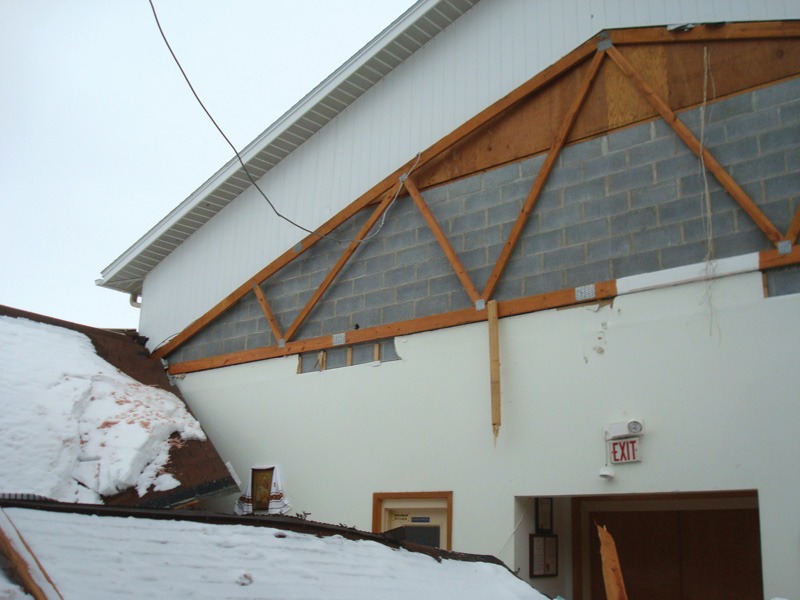
When additions or geometric modifications are made to an existing building, careful consideration must be given to how they may affect snow load distribution on the existing roof, including the potential for new or larger snow drifts and unbalanced snow loads. For example, an addition could create a longer fetch, allowing more snow to accumulate against an existing roof height transition, rising wall, or mechanical unit. Similarly, a new rooftop mechanical unit or rising wall for a higher roof can create a new obstruction where drifting may occur. If these changes increase roof snow loads, the existing structural system should be evaluated in accordance with the applicable provisions of the International Existing Building Code (IEBC) or local jurisdiction requirements, and existing structural elements should be strengthened or supplemented as necessary.
It should also be noted that more recent versions of ASCE 7 require snow drifting to be considered for adjacent buildings having a lower height than a nearby taller building when within a specified proximity of the taller building; this could have implications for the shorter of the buildings during the construction of a new building or addition.
Author

Alexandar J. Mlynarczyk, PE, is an associate principal with Wiss, Janney, Elstner Associates, Inc. (WJE) in Princeton, N.J., specializing in the investigation and repair of building structures. He can be reached at amlynarczyk@wje.com.
Sign up for our weekly newsletter
Architectural materials and methods delivered right to your inbox

- CSI News & Notes: CSI’s impact earns official recognition; celebrate leaders, mentors, and innovators; and more
- CSI News and Notes: CSI spring certification exams open; scholarships available; and more
- CSI News & Notes: CSI MSR heading to San Diego; spring certification exams open; and more
- To Be Specific: Why CDT Should Be Your First Move
- CSI News & Notes: CSI Fellows share member benefits; and a New Year’s Resolution to keep
Popular Articles
-
1
-
2
-
3
-
4
-
5
Read the Latest Issue
Demo-Casts