
Inside a perfect seam: The art and science of heat welding vinyl floors
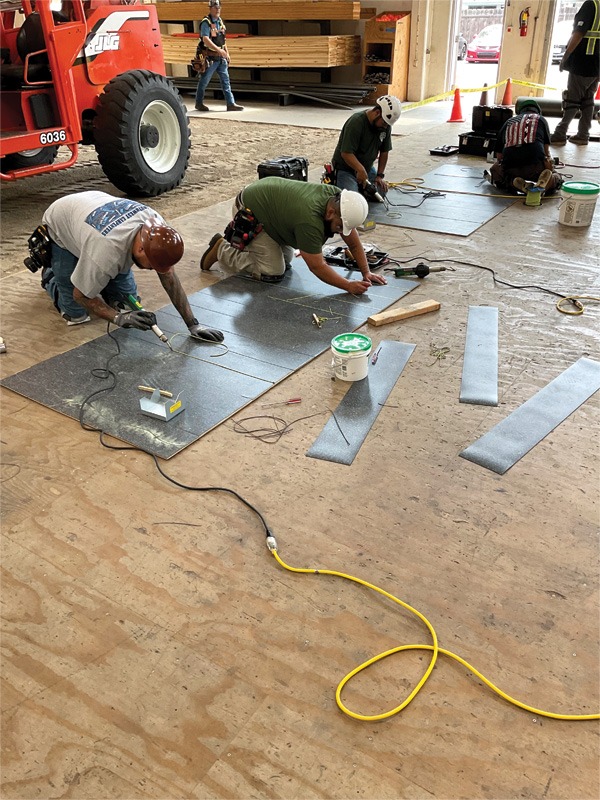
Heat welding resilient or vinyl flooring seams may appear to be a straightforward task that any installer can perform, but in a healthcare environment, this skill is anything but incidental.
Joining two sheets of flooring material with a perfect heat weld that is visually imperceptible and impervious to moisture and dirt collection requires a specialized set of practiced skills. From fresh-edge cutting, net-fit tolerances, and controlled grooving, to post-weld skiving and flash coving, every step critically impacts the integrity of the final seam and flooring performance and not just the aesthetics. Healthcare environments leave no room for errors.
For specifiers, understanding what it takes to properly execute heat-welded seams is essential to selecting a qualified installer. This overview helps specifiers understand key aspects of heat welding. It also highlights areas where installers might make mistakes or skip best practices. Specifiers need this knowledge to ensure their floors and installers meet the high standards required in healthcare.
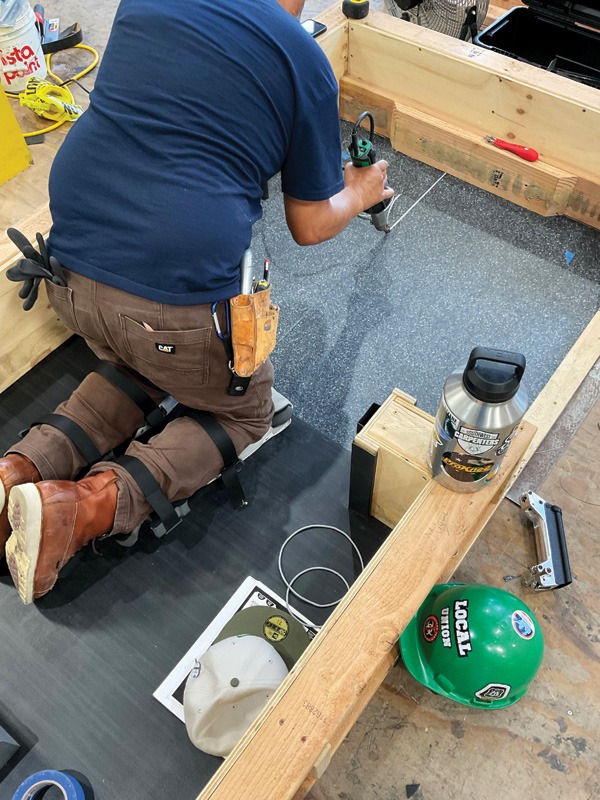
It starts with a fresh edge
The first step for an installer in achieving a successful heat-welded seam is cutting a fresh edge on the material before it is adhered to the floor. Sheet goods delivered to a jobsite typically arrive on a 1.83 m (6 ft) wide roll that can be up to 0.61 m (2 ft) in diameter, and the roll is commonly stored upright on its end rather than flat on the floor. A vinyl roll can weigh well over 113 kg (250 lb), depending on the product type. The weight can compress the edge of the roll in contact with the floor, causing damage and altering its shape. The material may be thinner along that edge or bowed in a concave or convex direction. The weight of a roll that size also affects structural loading, depending on the structural floor framing system.
To remove these irregularities, the best practice is to use a straight edge or edger tool to remove roughly 12.7 mm (0.5 in.) of material along this edge, giving it a clean, uniform shape and thickness. This first step in setting up the conditions for a strong, clean weld is also surprisingly often missed by installers who either do not know they should do it or skip it to save time on the job. In both instances, failing to cut a fresh edge puts the heat-welded seam at risk from the start, as the installer will then be attempting to join two unmatched edges.
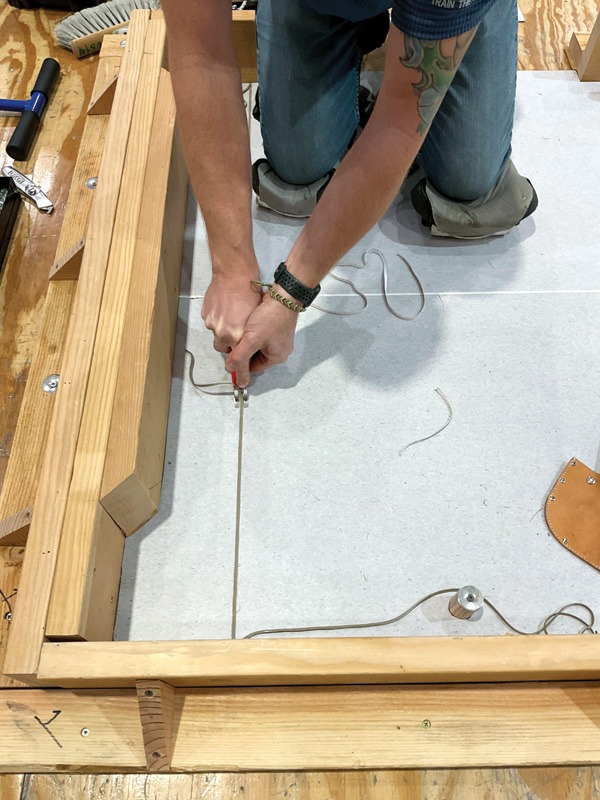
If one edge of the material is thicker than the other, or if it is bowing in places, this can lead to misalignment of the flooring material and create a cascading series of issues affecting subsequent grooving, welding, and skiving steps. Installers who take the time to cut a fresh, true edge (and know that this is best practice in the first place) set the material up for success from the start.
Minding the gap
After cutting a fresh edge and before grooving, the resilient or vinyl sheet flooring must be installed with a “true net fit” to ensure the weld rod makes optimal contact with the flooring material.
True net fit describes the actual fitting of the sheets so that their seam edges are freshly cut, aligned, and placed to the precise spacing specified by the manufacturer (typically around 1/32 of an inch). This controlled fit avoids both excessive gaps and overly tight joints. True net fit also ensures sufficient material remains after grooving, which is the next step taken to create the U-shaped channel to accept the weld rod. Most manufacturers specify a half to two-third deep groove centered to the adjoining sheets. Strict adherence to this tolerance is essential for the heat weld to create the structural integrity of the seam.
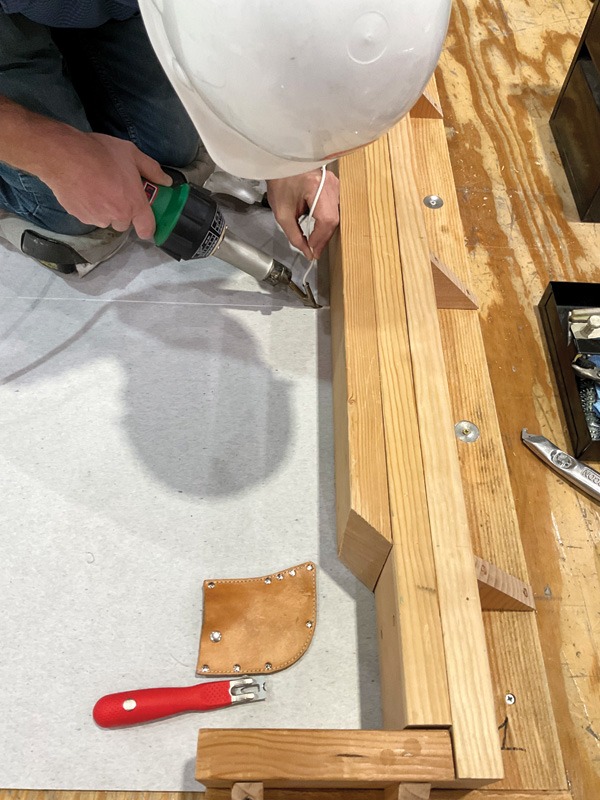
When seams are heat-welded across gaps that are too wide, the subsequent grooving operation is difficult to center, resulting in insufficient sidewall and bottom contact for the weld rod to properly fuse. In these cases, the weld lacks an adequate bonding area, significantly compromising seam strength and longevity, as well as aesthetics.
Conversely, seam edges that are too tight when the material edges are butted together introduce a different set of problems. Some untrained installers believe tight installation preserves material mass, but more often it produces peaked seams that make it difficult for mechanical groovers to maintain a consistent groove depth. The result increases the risk of tool runoff, uneven groove geometry, and damage to the surrounding seam edges, all of which negatively affect weld quality.
Beginning an installation with a true net fit that follows the manufacturer’s written specifications sets up all seams for more precise grooving, welding, and finishing.
Skiving: It takes two
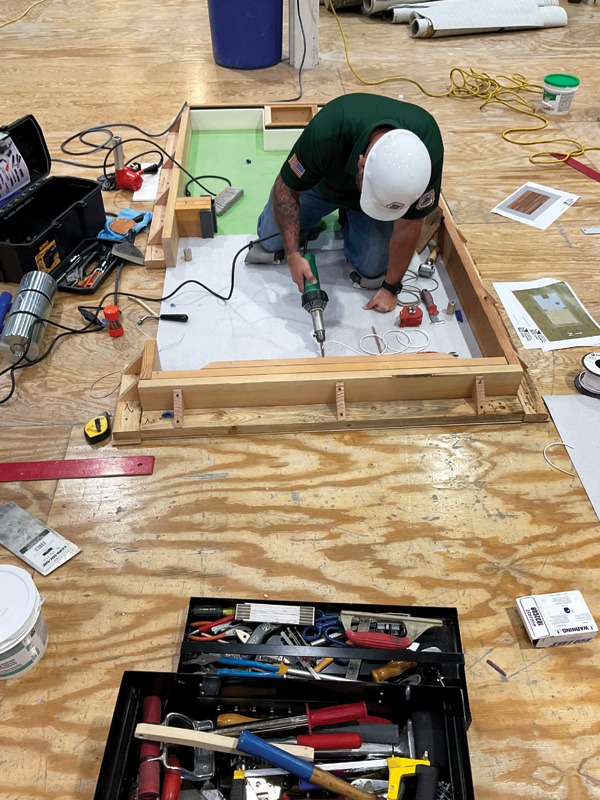
Once the flooring is properly cut and fitted, the installer grooves the seam to receive the weld rod, then melts and fuses it into the channel using a heat-welding gun. When seams are correctly fitted, uniformly grooved, and welded with proper heat and travel speed, the weld rod achieves a strong bond along the bottom and the sidewalls of the groove.
Since the weld rod is cylindrical, a portion of the rod remains above the sheet flooring surface after welding (Figure 1, page 21). This excess material is then skived, or trimmed down, so the weld rod becomes level with the two sheets that it is joining to create a flat and uniform finished surface.
Certified installers are taught that the best practice for skiving the weld rod is to perform it in two distinct passes, resulting in a weld “on-plane” with the flooring surface. During the first pass, installers attach a spacer to the skiving tool. This first pass removes approximately one-half to two-thirds of the excess weld material. Precision in this step is critical due to the volume and geometry of the material. Slicing the weld rod requires a measurable downward force, regardless of blade sharpness. This force inherently causes a slight upward deflection, or lift, in the seam, which the installer must accurately account for when performing the first pass.
After removing the bulk of the material in the first pass, the force required for the second pass will be significantly reduced. This lighter touch creates less lift during the final pass, leaving the weld rod flush with the flooring surface. The resulting seam should be visually imperceptible when the weld rod is properly coordinated with the installed material using the two-pass method, creating no visible distinction and no raised or recessed area at each seam executed this way.
Some installers without specialized heat-weld training shortcut the skiving step by performing only one pass with the skiving tool. To compensate for skipping a pass, installers often apply excessive pressure to the skiving tool and remove too much material at once, believing that a single pass is more efficient. The single pass method creates a seam with drastically more lift during cutting. When it settles back into place, the trimmed weld sits below the finished surface. The resultant concave seam profile readily traps dirt, contaminants, and moisture. Such seams typically fail visual acceptance criteria and result in difficult, if not impractical, repair scenarios that can disrupt the daily operations of the healthcare facility. In worst cases, poor skiving can go undetected and become a problem as the floor is used, with the seam collecting dirt and becoming difficult to clean.
Ironically, single-pass skiving does not yield meaningful time savings for the installer or the project as a whole. Any perceived efficiency is quickly negated by increased rejection risk, corrective labor, damage to reputation, and reduced client confidence.
Compared with following best practice and performing two-pass skiving, the time commitment is minimal, especially compared with rework time.
And then, flash coving
For a healthcare facility, flooring that fails due to inadequate knowledge and deficient skills in heat-welded seam construction can result in disruption of patient services and costly downtime. Heat welding is a common and critical component of a typical healthcare flooring installation.
Flash coving (also known as integral base installation) is even more demanding in terms of precision and technique than skiving, which requires its own set of highly specialized skills. Flash coving is a type of installation that uses the heat-welded seam principles of flat seams and applies them continuously along the flooring material up the wall for 102 mm (4 in.) or more. The resilient flooring is therefore serving not only as the flooring material but also as the on-cove base material.
Flash coving installations require a host of additional considerations, including maintaining a visually consistent, straight wall line termination, ensuring the material is firmly adhered to the radius at the floor-wall junction, addressing the special demands of inside and outside corners, and navigating floor or wall penetrations. It is highly visible, unforgiving of shortcuts, and notoriously difficult to repair. This type of installation is very common in the most sensitive and high-stakes healthcare spaces, such as operating rooms, ICUs, and laboratories where cleanability, durability, and long-term performance are critical.
The second article in this two-part series on heat welding will explore flash coving in greater detail.
Tips for specifying healthcare flooring contractors
Successful flooring outcomes for healthcare projects go well beyond selecting the right materials. Specifiers generally do not do the actual vetting, but they do control the criteria and standards installers must meet. General contractors are more generally the ones hiring the installers.
One of the most recognized and respected certifications for healthcare installers, in addition to flooring acumen, is Infection Control Risk Assessment (ICRA). ICRA training teaches installers how construction activities, even those as localized as flooring preparation and seam welding, can introduce contaminants and pathogens into healthcare environments. ICRA-certified installers understand how to classify risk areas, establish contaminant barriers, control airflow and dust, manage debris removal, and coordinate their work with infection prevention teams. ICRA training includes requirements and strategies to perform installations in occupied facilities without compromising adjacent patient care spaces, a skill that is essential amid the boom in expansion and renovation within our aging healthcare infrastructure.
Flooring installers who also possess specialized healthcare training bring a fundamentally different mindset to the jobsite. They recognize that a failed seam is not just an aesthetic or warranty issue but a potential infection reservoir. This awareness influences every step of their installation process, from substrate prep and seam geometry to heat welding and flash coving. Certified installers have taken the extra steps to demonstrate a commitment to industry’s established standards, and their certification acts as an insurance policy for the installation.
Ultimately, heat-welded seams that perform best in healthcare environments are the result of deliberate skill, proper training, and disciplined execution. By looking beyond product selection alone and establishing training and certification requirements in the “Quality Assurance” description, setting a facility type certification level, and clearly identifying healthcare-specific experience, specifiers can better align design intent with field execution. The reward is flooring that supports infection control goals, withstands rigorous cleaning, and delivers long-term performance without surprises after turnover.
Author’s note: This article is one of a two-part series on heat-welding techniques used in healthcare, resilient, and vinyl flooring installations. Part two will explore flash coving, providing specifiers with an introduction to best practices, cautions on where it can go wrong, and tips for selecting an installer with the right skills for success. For additional information, refer to manufacturer recommendations and/or ASTM F1516.
Author
David Gross is the executive director of INSTALL, the leading organization for floorcovering installation training and certification in North America at INSTALLFloors.org. Prior to this role, Gross was a full-time instructor for the Eastern Atlantic States Carpenter’s Apprenticeship Training Fund, where he achieved Level III Advanced Instructor Certification. He holds a bachelor’s degree in economics, an MBA, and is a BCSP Certified Safety Professional, with more than 30 years of hands-on floor installation experience.
Key Takeaways
Heat-welded seams in healthcare flooring demand specialized training, strict tolerances, and disciplined execution—from fresh-edge cutting and true net fitting to controlled grooving and two-pass skiving. Shortcuts compromise cleanability and durability, creating infection risks. Specifiers play a critical role by selecting certified, healthcare-trained installers who can meet the performance standards these environments require.
Sign up for our weekly newsletter
Architectural materials and methods delivered right to your inbox

- CSI News and Notes: CSI Foundation’s construction camp; CSI spring exam; and more
- CSI News and Notes: CSI’s credentials; CSI conference theme; and more
- To be specific – CSI supports young AECO professionals
- CSI News and Notes: CSI’s foundation scholarships, national conference, and Crosswalk
- CSI News and Notes: AI’s impact; CSI 2024 conference, and more
Read the Latest Issue