
Stepping towards silence: Flooring as a key acoustic solution
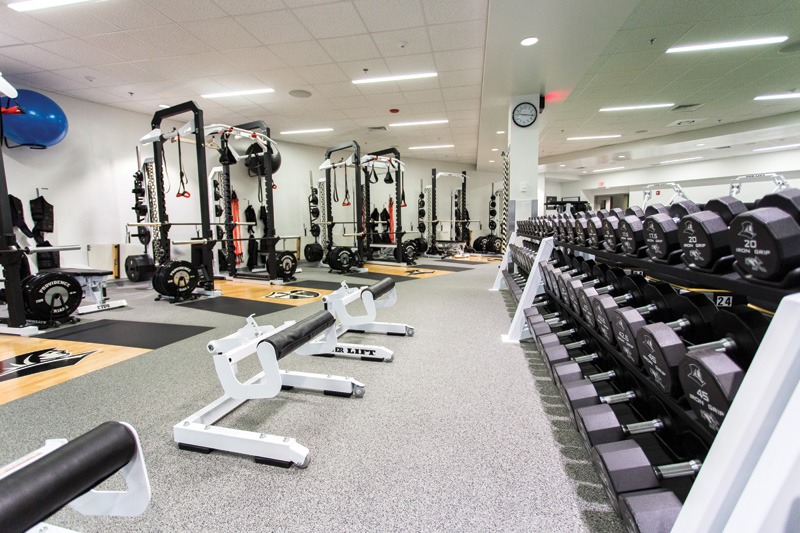
Occupant health and wellness are very important in buildings. Good acoustics help create spaces that support productivity, relaxation, and positive experiences. Whether in healthcare facilities, offices, hotels, multi-family residences, educational institutions or fitness centers, managing noise is essential to supporting both mental and physical well-being. One often overlooked element in the acoustic equation is flooring—a material choice that directly influences impact noise from footsteps, dropped objects, rolling carts, and even weight drops in gyms. The right flooring solution can play a transformative role in reducing noise levels and enhancing overall occupant satisfaction.
The challenge of noise across building types
Noise can be a disruptive factor in nearly every type of building. In healthcare settings, elevated and unexpected sounds can affect patient recovery by disrupting sleep, increasing the need for medication, and ultimately extending hospital stays. For staff such as nurses, excessive noise can lower speech intelligibility, impair decision-making, and contribute to fatigue.1
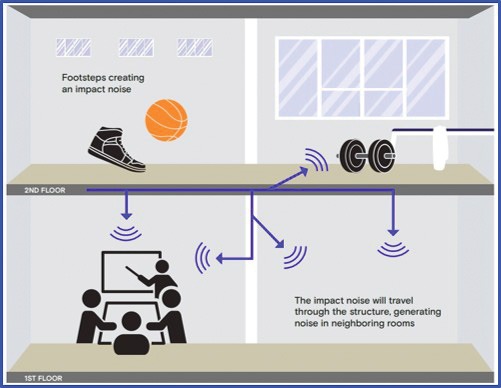
In commercial office environments, background noise from footsteps, conversations, and moving furniture can reduce concentration and productivity. Hotels and multi-family residences face challenges in maintaining restful spaces for occupants, especially when gyms, conference areas, or restaurants are located near sleeping areas.2
Educational settings require low noise levels for optimal learning, while fitness facilities must manage impact noise from heavy weights, cardio machines, and high-intensity workouts.
Managing impact energy to reduce noise
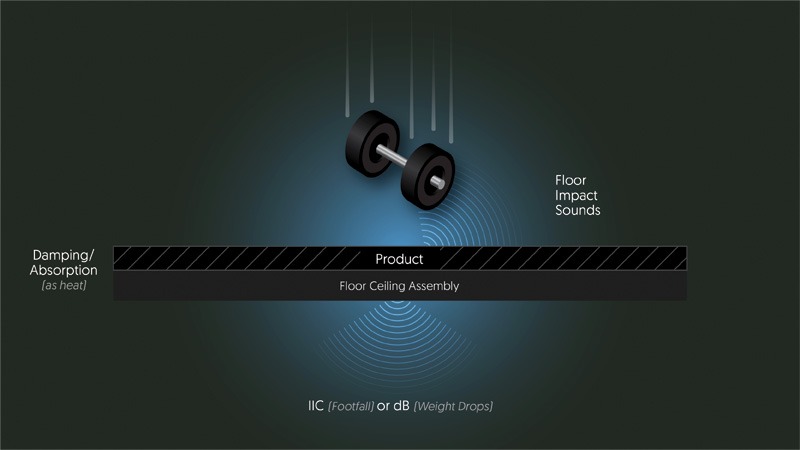
When an object—be it a shoe, a chair leg, or a dropped weight—lands on the floor, its kinetic energy is redirected in various ways. Part of this energy is returned to the object, causing it to bounce; some is converted into heat by the floor; and some is transmitted as noise into the surrounding room or adjacent spaces.
The amounts of heat and transmitted noise depend on the mass and damping characteristics of the floor-ceiling assembly, making the choice of building materials crucial. In simpler terms, the floor plays a significant role in managing how and where the energy is distributed.
In acoustical engineering, this transmission is often measured through metrics such as Impact Insulation Class (IIC) and High-frequency Impact Insulation Class (HIIC). IIC quantifies how well a floor-ceiling system attenuates low-frequency impact sounds, such as footsteps or dropped objects, while HIIC is more sensitive to sharper sounds, like the click of high heels. Both ratings are influenced by factors such as surface hardness, underlayment composition, and structural mass. For example, denser materials may reduce low-frequency “thuds” but allow higher-pitched sounds to pass through, whereas resilient underlayments can absorb and dissipate energy across a broader spectrum.
Carpet was once a popular choice for flooring in many types of buildings because it is comfortable and helps reduce noise. However, today’s design trends prefer hard-surface floors for better light and temperature control, appearance, durability, and easier maintenance.
Unfortunately, these hard surfaces can make noise problems worse, especially in mixed-use and multistory buildings, where sound can travel between floors and from one tenant to another. Designers can improve noise control by carefully choosing and combining different flooring materials, creating spaces that meet the needs of healthcare, education, residential, and commercial settings.
Flooring as a key acoustical solution
Performance flooring can greatly lessen sound from footfall, dropped objects, dragging furniture, and rolling carts. The effect can be orders of magnitude in terms of perceived noise. In hospitals, quieter flooring materials can reduce rolling and impact noise levels enough to encourage lower speaking volumes—a reverse of the ‘cocktail party effect,’ where everyone raises their voice to be heard. In fitness settings, specialized rubber flooring absorbs and isolates impact noise from dropped weights or fast-paced workouts, protecting noise-sensitive areas like offices, hotel rooms, or classrooms located nearby.
Evidence-based design and acoustical performance
Evidence-based design (EBD) is more than a philosophy—it is a disciplined approach that draws on scientific research and data to influence the built environment in ways that positively affect human health, behavior, and experience. EBD considers numerous factors, including visibility, circulation paths, ergonomics, and acoustics. It is especially relevant in facilities like hospitals, schools, and workplaces, where design decisions have measurable outcomes.
Loud or uncontrolled noise can cause stress in the environment, hinder sleep and healing, and decrease concentration or productivity. The ability to proactively address acoustical issues rather than retrofit solutions after problems arise is a hallmark of thoughtful, occupant-centered design.
Studies comparing hard-surface materials, such as vinyl composition tile (VCT) and luxury vinyl tile (LVT), with acoustically engineered flooring systems have shown significant differences in both decibel levels and IIC ratings, which measure how well a floor assembly reduces impact sound transmission.4
In multi-family housing, building codes require a minimum Impact Insulation Class (IIC) rating of 50 to reduce impact sound transmission between residential units. This minimum contributes to a baseline of acoustic comfort and privacy. Similar guidelines exist across other sectors, including hospitality, education, and healthcare.
Well-designed flooring aligns with EBD principles to meet and exceed minimum requirements. For example, a 3-mm (0.12 in.) LVT on a 152-mm (6-in.) concrete slab structural floor A typical floor might achieve an Impact Isolation Class (IIC) of 40 or less. In contrast, a Luxury Vinyl Tile (LVT) with rubber underlayment might reach an IIC of 50 or more. Additionally, a vinyl plank with a built-in rubber pad could achieve an IIC of 54.
Ultimately, EBD encourages architects, designers, and facility planners to assess the long-term impact of their decisions. Flooring that contributes to reduced noise transmission is a strategic investment in the health, satisfaction, and productivity of every person who walks through the space.

Real-world applications and testing
Engineered flooring systems sometimes include dissimilar materials factory-laminated to achieve otherwise impossible performance. Such technology can enhance force reduction and energy restitution characteristics and change the way sound is generated and transmitted to help control both in-room and transmitted impact noise. Independent testing has shown that some proprietary surfaces can achieve a notable reduction in perceived loudness compared to common hard-surface materials. For example, common VCT and LVT can generate a perceived increase of well more than 100 percent in in-room loudness relative to certain factory-laminated floor surfaces.5
Designing for acoustics in any building type
Selecting the right flooring for a space requires balancing multiple priorities: acoustics, durability, maintenance, hygiene, comfort, and aesthetics. In hospitals, this might mean choosing a surface that can withstand frequent cleaning while reducing noise from rolling equipment. In hotels, it might mean using flooring with sound-absorbing properties in hallways above guest rooms. In educational facilities, it could mean specifying impact-reducing materials in multipurpose rooms or gymnasiums to protect classrooms nearby.
Ultimately, good design is a balance of the project’s many performance goals. Flooring is one of the few elements that directly affects a range of outcomes, including impact noise in the room itself, transmitted noise to surrounding spaces, maintenance, and visual appeal—making it a critical piece of the acoustical design puzzle.
Conclusion
As the demand grows for healthier, more comfortable, and more productive indoor environments, acoustics continue to play a defining role in the built environment. From hospitals to hotels, offices to fitness centers, flooring choices can make a measurable difference in reducing noise, supporting wellness, and improving the overall experience for every occupant.
By incorporating evidence-based design principles and selecting materials engineered for acoustical performance, designers and facility managers create spaces that sound and feel better.
Notes
1 See.
2 Refer.
3 Read “Structureborne Sound Isolation” in Handbook of Acoustical Measurements and Noise Control.
4 Visit.
5 See.
Author

Justin Reidling is an acoustic engineer at Ecore, bringing years of multi-faceted experience as a product engineer and acoustical consultant. He holds a bachelor’s degree in mechanical engineering with a minor in acoustics from Kettering University in Flint, Mich.
Key Takeaways
Effective acoustics support occupant health, productivity, and comfort. Flooring plays a key role in managing impact noise, with material choice, underlayments, and engineered solutions influencing sound transmission. Evidence-based design and performance-focused flooring reduce noise, enhance wellness, and create more functional, satisfying spaces across healthcare, residential, educational, and commercial buildings.
Sign up for our weekly newsletter
Architectural materials and methods delivered right to your inbox

- CSI News and Notes: CSI Foundation’s construction camp; CSI spring exam; and more
- CSI News and Notes: CSI’s credentials; CSI conference theme; and more
- To be specific – CSI supports young AECO professionals
- CSI News and Notes: CSI’s foundation scholarships, national conference, and Crosswalk
- CSI News and Notes: AI’s impact; CSI 2024 conference, and more
Products




Read the Latest Issue