Assess the Access
In addition to accommodating the various loadings anticipated from surrounding exterior and interior environments, a functional exterior enclosure must not only be constructable under the anticipated installation sequencing for a project, but each system of the enclosure must also be designed for routine maintenance and/or its eventual replacement.
Integration of adjacent enclosure systems is typically established during design and refined throughout the submittal process. Optimally, coordination of final detailing and system integration is further refined through quality control (QC) procedures, pre-installation meetings, mock-ups (where appropriate), and, lastly, the actual installation of each component or system. Successful coordination requires open communication and ongoing dialogue among each project team responsible for the various components of the building enclosure.
However, as is often the case, when this coordination is not established early and maintained throughout construction, the potential for constructability or accessibility conflicts associated with the involvement of different trades increase significantly.
Additionally, even a well-developed construction process can be short-circuited by project schedule pressures or unanticipated lead times, resulting in improper sequencing of various systems. Once realized, integration and accessibility issues caused by improper sequencing and coordination can be costly and time-consuming to rectify, and thus be overlooked or addressed by compromising the installation.
A direct example was encountered on a recent project where a perimeter screen wall was designed to hide rooftop mechanical equipment from view. Detailing of this screen wall assembly was limited in the design drawings, and coordination of this work relied on a mere mention in an obscure note on the roof plan. The hollow structural section (HSS) support structure and metal panel cladding for the screen wall were installed by separate trades, as was the single-ply membrane roof assembly. Despite their proximity and direct interfaces, the installation of these building components was not properly coordinated.
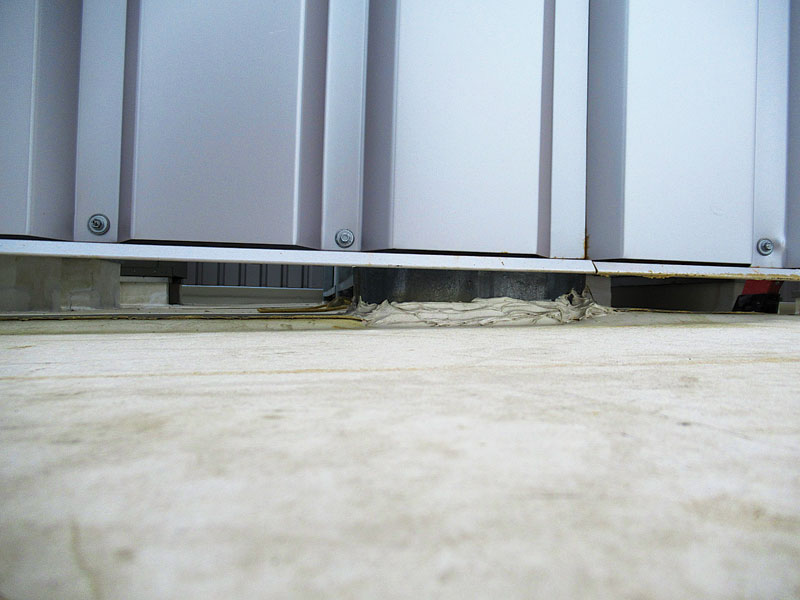
Consistent with typical industry practice, roof flashing was detailed to extend vertically and terminate 203.2 mm (8 in.) above the horizontal roof surface at penetrations of the vertical HSS support members. Due to sequencing issues and unanticipated material lead times, the metal panel cladding was installed prior to the roof assembly. Unfortunately, the metal panel installation did not account for the overall thickness of the tapered insulation at the screen wall, leading to the bottom of the metal panel system being installed at a consistent height relative to the level metal deck. This lack of coordination resulted in insufficient clearance to install the flashing in accordance with the specified roof design, and the roofing membrane being terminated at HSS penetrations using a bead of sealant due to limited height and access, creating a non-warrantable and unserviceable condition.
Ultimately, the screen wall cladding was removed, the HSS support structure was modified to accommodate proper flashing installation, and new metal cladding was installed, resulting in a costly and avoidable outcome.
The opinions expressed in Failures are based on the authors’ experiences and do not necessarily reflect those of The Construction Specifier or CSI.
Authors

Jeffrey Sutterlin, PE, is an architectural engineer and associate principal with Wiss, Janney, Elstner Associates (WJE) in the New York and Princeton offices. He specializes in the investigation and repair of building enclosures, as well as peer review and consulting for new enclosure design. He can be reached at jsutterlin@wje.com.

David S. Patterson, AIA, is an architect and senior principal with Wiss, Janney, Elstner Associates (WJE) in Princeton, N.J. He specializes in the investigation and repair of the building enclosure, as well as peer review and consulting for new enclosure design. He can be reached at dpatterson@wje.com.
Sign up for our weekly newsletter
Architectural materials and methods delivered right to your inbox

- CSI News & Notes: CSI’s impact earns official recognition; celebrate leaders, mentors, and innovators; and more
- CSI News and Notes: CSI spring certification exams open; scholarships available; and more
- CSI News & Notes: CSI MSR heading to San Diego; spring certification exams open; and more
- To Be Specific: Why CDT Should Be Your First Move
- CSI News & Notes: CSI Fellows share member benefits; and a New Year’s Resolution to keep
Popular Articles
-
1
-
2
-
3
-
4
-
5
Read the Latest Issue