
Avoiding compliance gaps in ceramic tile specifications

Ceramic tile is one of the most widely used finish materials in commercial construction. Architects, interior designers, contractors, distributors, and specifiers routinely evaluate products manufactured across North America, Europe, Asia, and South America for use in the United States. As global sourcing continues to expand, so does the challenge of verifying that tile products meet the specific standards and project specifications expected in the U.S. market.
One of the most common misconceptions in the tile industry is the assumption that ceramic tile tested to international standards automatically satisfies U.S. requirements. However, compliance with international tile standards, such as ISO 13006, does not necessarily demonstrate compliance with the American National Standards Institute (ANSI) A137.1, Standard Specifications For Ceramic Tile, the primary product standard referenced throughout the U.S. tile industry.
For specifiers, this distinction is critical. Misunderstanding the differences between the standards can lead to rejected submittals, installation performance concerns, liability exposure, disputes over product representation, and costly project delays. Understanding the differences between ISO and ANSI requirements and how to document compliance in specifications properly has become increasingly important as imported tile products continue to dominate portions of the U.S. market.
The role of ANSI A137.1 in the U.S. tile industry
ANSI A137.1 serves as the foundational product specification for ceramic tile used in the United States. The standard establishes performance requirements, product classifications, definitions, test methods, and acceptance criteria for ceramic tile products intended for floor, wall, countertop, and exterior applications.
The standard is deeply integrated into the U.S. tile industry ecosystem. It is referenced throughout installation standards, project specifications, and industry guidance documents. Tile installation methods published by the Tile Council of North America (TCNA) rely on compliance with ANSI product standards, while many architectural specifications reference them. The standard is directly cited as a minimum requirement for ceramic tile products.
In commercial construction, compliance with ANSI A137.1 often forms the basis for evaluating whether a product is suitable for its intended application. The standard addresses a range of performance characteristics that establish expectations for durability, safety, and long-term performance, including water absorption, breaking strength, bond strength, dimensional characteristics, surface abrasion resistance, chemical, frost, and crazing resistance, and dynamic coefficient of friction (DCOF). Together, these requirements provide a consistent framework for evaluating ceramic tile products within the U.S. and help ensure products are appropriate for their intended applications.
ISO 13006: A different standard system
Internationally, many ceramic tile manufacturers evaluate products using ISO 13006, the globally recognized ceramic tile standard. The standard categorizes ceramic tile products and establishes performance criteria using ISO test methods rather than ASTM procedures commonly referenced within ANSI A137.1.
Although the two standards appear similar at first glance, they represent separate standard systems. ANSI A137.1 and ISO 13006 were developed independently, use different testing methodologies, and establish different acceptance thresholds for several properties. As a result, compliance with one standard does not inherently demonstrate compliance with the other.
This distinction is often overlooked during product sourcing and submittal review. A manufacturer may provide a test report showing compliance with ISO 13006, while the project specification requires compliance with ANSI A137.1. Without careful review, project teams may mistakenly assume the provided documentation satisfies U.S. and project requirements.
The issue becomes particularly significant on projects involving imported tile products, where ISO documentation may be the primary or only compliance information initially provided.

Similar goals, different methodologies
Although ANSI A137.1 and ISO 13006 evaluate many of the same general performance characteristics, the standards are not directly interchangeable. While both systems assess properties such as strength, dimensional characteristics, and durability, they often use fundamentally different test methods and acceptance criteria. In some cases, the procedures differ so significantly that results cannot be directly compared or converted. As a result, compliance with ISO standards does not mean compliance with ANSI requirements.
For specifiers, the key takeaway is that a product cannot be assumed compliant simply because testing exists. The specific standard, test method, and acceptance criteria all matter.
Key areas where ANSI and ISO differ
Different test methods
One of the most significant distinctions between ANSI A137.1 and ISO 13006 is the use of different testing methodologies.
Even when evaluating similar product properties, the methods themselves may differ substantially in sample preparation, loading conditions, calculations, equipment configuration, or acceptance criteria.
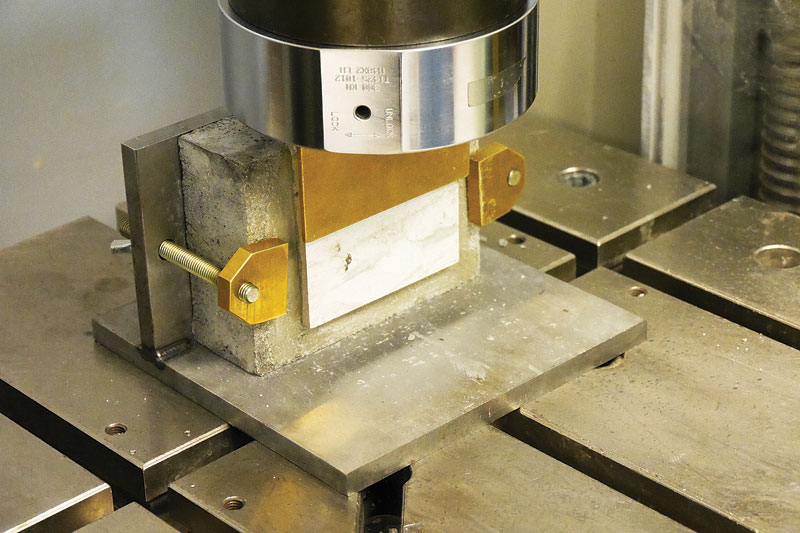
Breaking strength is one commonly cited example. ANSI A137.1 and ISO 13006 use different test methods to determine breaking strength. Consequently, results generated under one system cannot be directly converted or compared with those from the other.
This distinction is especially important when reviewing laboratory reports during submittal evaluation. A test report may appear technically complete while still failing to demonstrate compliance with the required U.S. standard.
Requirements included in ANSI but not ISO
Certain performance characteristics required under ANSI A137.1 are not addressed within ISO 13006.
Examples include:
- Bond strength—ANSI A137.1 specifies bond-strength requirements for ceramic tile. Bond strength performance is particularly relevant for evaluating how tile products interact with installation materials and contribute to long-term system performance and durability.
- Dynamic coefficient of friction (DCOF)—Slip resistance is a major consideration for commercial flooring applications. ANSI A137.1 references DCOF requirements through ANSI A326.3, Dynamic Coefficient of Friction (DCOF) of Hard Surface Flooring Materials. ISO 13006 does not include an equivalent DCOF requirement; ISO-only testing may not provide the slip-resistance data typically expected within U.S. specifications.
- Mosaic tile requirement—ANSI A137.1 includes specific criteria for mosaic tile products that ISO 13006 does not address. This can create compliance gaps when mosaic products are imported.
Different acceptance thresholds
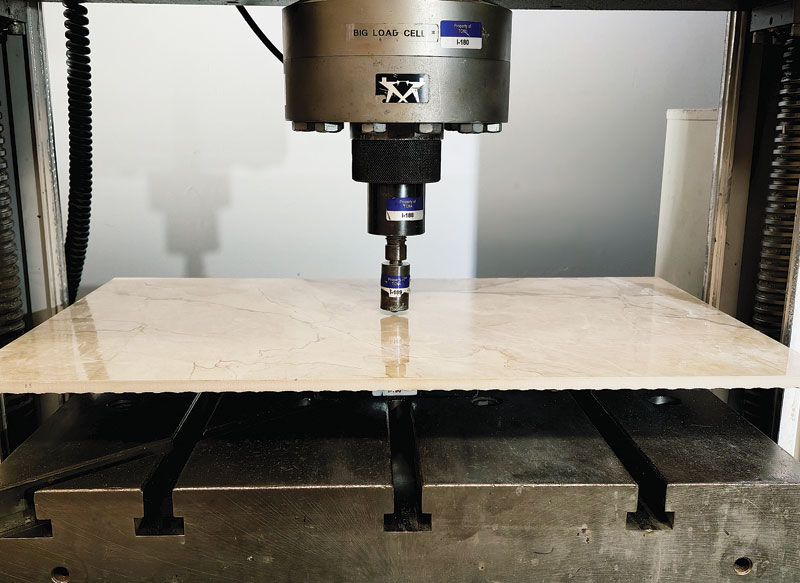
Even when ANSI and ISO evaluate the same property, the acceptance criteria may not align.
In some categories, ANSI A137.1 establishes more stringent thresholds than ISO 13006. A product that passes ISO requirements may not satisfy ANSI criteria for the same property.
This creates potential challenges for specifiers comparing products based on documentation generated under these different standards systems.
Implications for project specifications
For design professionals, these differences highlight the importance of clearly defining compliance requirements within construction documents.
Most commercial tile specifications already require compliance with ANSI A137.1. The challenge lies in verifying submitted products actually meet those requirements.
Imported tile products are frequently accompanied by ISO testing documentation and claims that ISO and ANSI standards are effectively equivalent. Without careful review, these assumptions can lead to approval of products that are not evaluated to the specific standards referenced in the project specifications. Substitutions and value-engineered alternatives can create similar concerns when supporting documentation is not thoroughly reviewed.
When ANSI A137.1 compliance is required, specifications should explicitly state:
- The required ANSI standard edition
- Applicable ASTM or ANSI test methods
- Product classifications
- Performance thresholds
- Slip resistance requirements where appropriate
- Required third-party testing or certification documentation
Clear language helps minimize ambiguity during bidding, procurement, and submittal review.
Evaluating submittals and test reports
Specifiers and design professionals reviewing tile submittals should carefully evaluate the basis of compliance presented within manufacturer documentation.
Several questions can help identify potential issues:
- Does the report specifically refer to ANSI A137.1?
- Are ASTM test methods identified?
- Is the testing current and representative of the submitted product?
- Was testing performed by an accredited laboratory?
- Are all required properties addressed?
- Are DCOF results included where required?
- Is the product classification appropriate for the intended application?
A laboratory report demonstrating ISO compliance alone may not be sufficient for U.S. commercial projects. In some cases, supplemental testing may be required to confirm products are compliant with ANSI requirements.
The importance of third-party verification
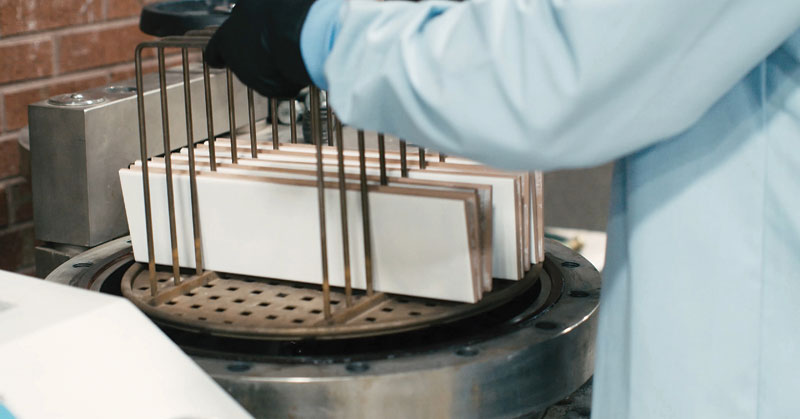
Independent third-party testing plays an important role in reducing uncertainty regarding the compliance of products.
Accredited laboratories provide objective verification that products meet specified requirements and help identify discrepancies between marketing claims and actual performance before materials reach the jobsite.
Third-party certification programs may provide additional assurance in specific areas. One example in the tile industry is the Porcelain Tile Certification Agency (PTCA), which verifies compliance with the water-absorption limit required for porcelain tile classification under ANSI A137.1. In this standard, porcelain tile is defined as ceramic tile with a water absorption of 0.5 percent or less, as tested in accordance with ASTM C373, Standard Test Methods for Determination of Water Absorption and Associated Properties by Vacuum Method for Pressed Ceramic Tiles and Glass Tiles and Boil Method for Extruded Ceramic Tiles and Non-tile Fired Ceramic Whiteware Products.
This is a key distinction because products marketed as “porcelain” do not always meet the technical definition established by ANSI A137.1. Independent certification in this context provides an additional layer of confirmation that test results align with the classification requirements embedded within the standard itself.
Together, accredited laboratory testing and targeted certification programs reinforce the same objective: confirming products meet the performance and classification criteria defined by the applicable ANSI or ISO standards before they are specified and installed.
Risk management through better project documentation practices
From a specification standpoint, clearly documenting compliance requirements can help reduce project risk.
Potential consequences associated with improper compliance assumptions include:
- Product rejection during submittal review
- Delayed procurement schedules
- Installation disputes
- Questions regarding slip resistance
- Warranty conflicts
- Liability concerns related to product representation
- Costly replacement or remediation work
These risks are amplified on large commercial projects, where imported materials are sourced from multiple parties in the supply chain.
By clearly defining standards and requiring appropriate supporting documentation, specifiers can achieve more predictable project outcomes.

The growing importance of industry standards knowledge
As tile products continue to evolve, understanding standards and testing procedures is becoming increasingly important for design professionals.
Modern tile products include large-format panels, gauged porcelain tile panels/slabs, specialty surface finishes, resin-backed products, and complex mosaics. These products often involve performance considerations extending beyond traditional ceramic tile evaluation.
At the same time, global sourcing is expanding the diversity of products entering the U.S. market. This increases the need for specifiers to distinguish between international product documentation and actual compliance with U.S. requirements.
Understanding the differences between ANSI and ISO standards is therefore not a technical issue. It is a critical component of managing risk, maintaining specification integrity, and ensuring installed performance.
Conclusion
Global tile manufacturing and international trade have created a marketplace where products are routinely evaluated under multiple standards systems. While ISO 13006 and ANSI A137.1 share similar goals, they are fundamentally different standards with distinct testing methodologies, performance requirements, and compliance criteria.
For specifiers, the assumption that ISO-tested tile automatically satisfies U.S. requirements can create significant project risk. Careful review of test documentation, explicit specification language, and appropriate third-party verification are essential to confirming compliance.
Ultimately, specifying ceramic tile for U.S. commercial projects requires more than simply requesting test reports. It requires understanding which standards apply, how they differ, and how compliance is properly verified.
Author

Katelyn Simpson is the director of laboratory services at IPA Laboratories, where she oversees third-party testing and certification programs for ceramic tile, installation materials, natural stone, and related products. With 20 years of experience in the tile and materials testing industry, she has a strong technical background in ceramic and materials engineering, earned through her degree from Clemson University. Simpson has been actively involved in the development and advancement of industry standards through her leadership roles as committee manager for the ANSI A108 Committee, the U.S. TAG to ISO TC189, and the TCNA Handbook Committee, and her active participation on numerous ASTM committees. She is recognized throughout the industry for her expertise in product performance standards, compliance testing, and technical education related to ceramic tile and installation materials.
Key takeaways
A common misconception in the tile industry is assuming that ceramic tiles tested to ISO 13006 standards automatically comply with American National Standards Institute (ANSI) A137.1 requirements. While both standard systems share similar goals, they were developed independently and use fundamentally different testing methodologies, sample preparations, and acceptance thresholds. Relying solely on ISO documentation for U.S. commercial projects can lead to significant compliance gaps, rejected submittals, and liability exposure, underscoring the importance of precise specification language and accredited third-party verification for risk management.
Sign up for our weekly newsletter
Architectural materials and methods delivered right to your inbox

- CSI News & Notes: CSI’s impact earns official recognition; celebrate leaders, mentors, and innovators; and more
- CSI News and Notes: CSI spring certification exams open; scholarships available; and more
- CSI News & Notes: CSI MSR heading to San Diego; spring certification exams open; and more
- To Be Specific: Why CDT Should Be Your First Move
- CSI News & Notes: CSI Fellows share member benefits; and a New Year’s Resolution to keep
Products


Read the Latest Issue