
Waterstops and penetration: Specifying for watertight performance in concrete
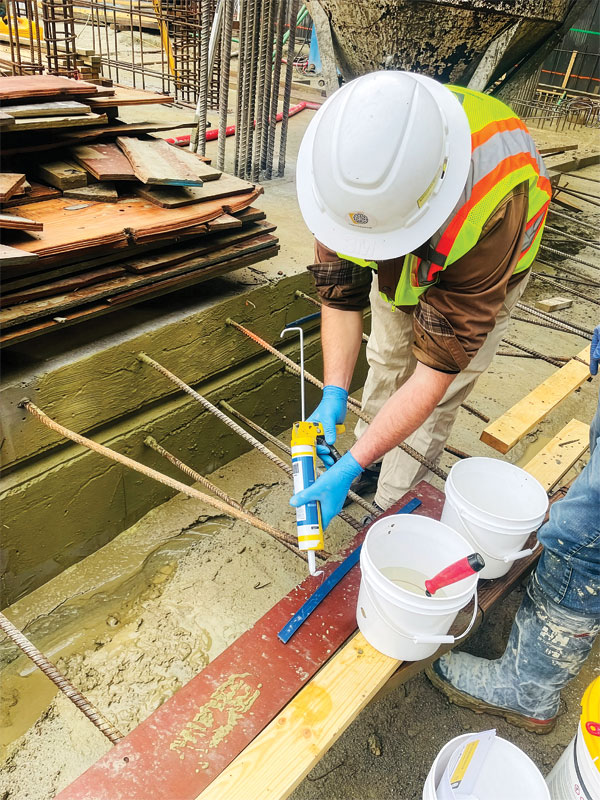
The most effective waterstop is the one that is not needed—an outcome rarely achievable given the complexity of modern concrete construction. Successful waterproofing depends on system alignment, not individual products. In concrete structures, water intrusion rarely occurs through the concrete itself. Instead, failure concentrates at discontinuities such as joints, transitions, intersections, interfaces, penetrations, and protrusions. These locations represent intentional interruptions in otherwise continuous concrete systems and require deliberate design, specification, and execution to achieve durable, watertight performance. Waterstops are a critical component in achieving this goal.
Field experience and industry guidance consistently point to the same root cause of failure: a lack of coordination among the detailed design intent, specification requirements, and field execution. Understanding this is the starting point for specifying systems that perform.
What waterstops do and why they matter
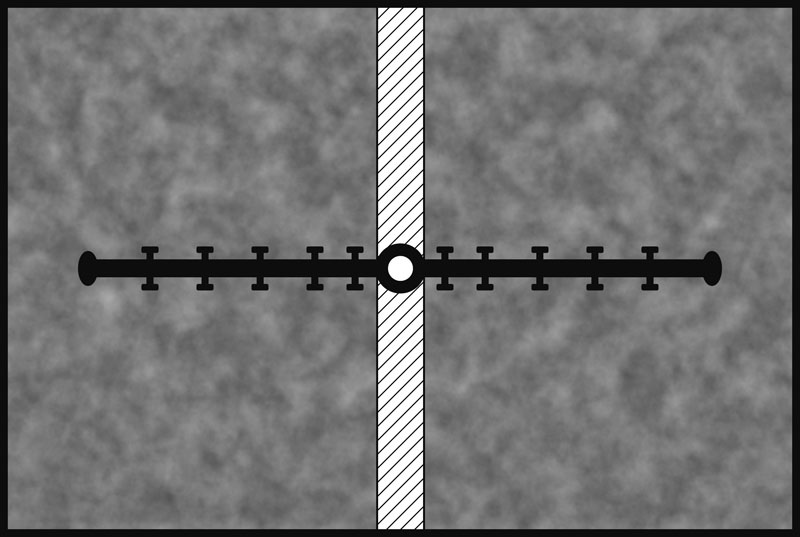
A waterstop is a preformed or applied component installed at a joint, penetration, or similar discontinuity in concrete, forming a continuous seal across that discontinuity that resists the passage of water under hydrostatic pressure. Pre-embedded in deformation or construction joints and integrated with the concrete during placement, a properly installed waterstop prevents water leakage at the joint while also serving as a cushion to absorb shocks and impacts. When overall waterproofing requirements are not included in the specifications, the waterstop can be evaluated in isolation rather than as one element of a system. Clearly stated system-performance requirements help prevent this isolated evaluation. When the performance target is defined and the assembly is installed correctly, the waterstop does its part to meet it.
Waterstops are used across a broad range of project types, including water conservancy and hydropower facilities, dams, culverts and sluice gates, tunnels, subways, civil defense structures, and below-grade commercial construction, including high-rise basements and parking structures. ACI 350, Code Requirements for Environmental Engineering Concrete Structures, published by the American Concrete Institute (ACI), requires waterstops in joints where watertightness is critical. Their performance, however, depends on the overall system.
Selecting for behavior, not familiarity
Several waterstop types are available, and product selection should be driven by joint behavior and site conditions rather than product habit or familiarity. Waterstops are classified by mechanism as barrier, swellable, injectable, adhesive (bonded strip), and crystalline.
They are further categorized by position: internal, fully embedded within the concrete section, or external, applied at the concrete surface. Each carries distinct installation requirements, and both categories include rubber and thermoplastic product options.
Barrier
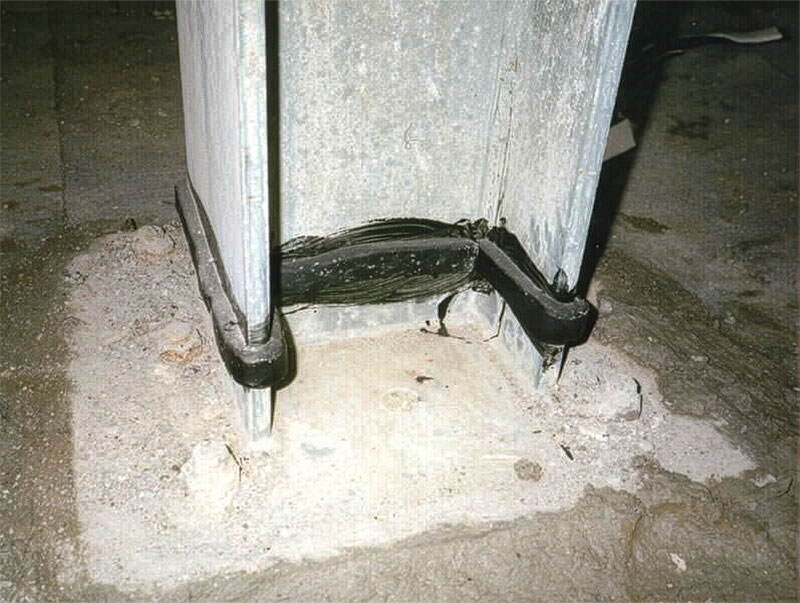
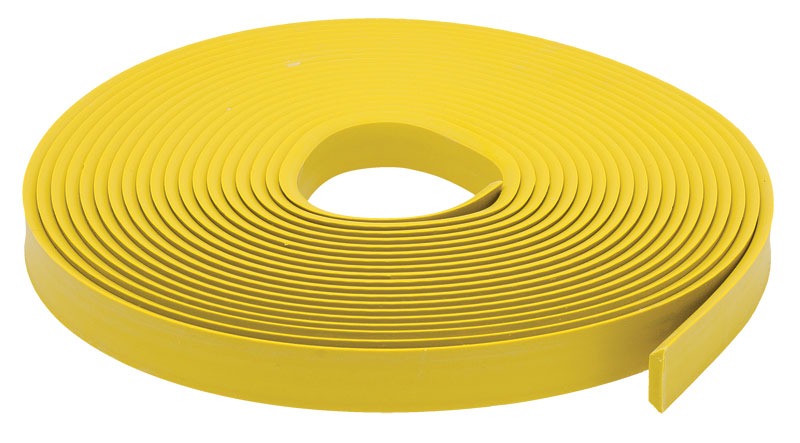
Embedded polyvinyl chloride (PVC) or other thermoplastic waterstops function as physical barriers across joints. They require continuous placement and proper field welding and are highly sensitive to both position within the concrete section and the quality of consolidation around them.
One subset, movement (bulb-type) waterstops, is designed specifically to accommodate expansion and contraction across the joint. Select them based on the magnitude and direction of anticipated movement; an undersized or mismatched product will not perform regardless of installation quality.
Swellable
Hydrophilic waterstops expand upon contact with water, sealing the joint. However, these products must be confined and protected from premature exposure to moisture before concrete placement—a common and costly installation error. Typical building conditions generally favor non-bentonite swellable products. Bentonite-based hydrophilic waterstops can perform extremely well in specific applications, but under repeated wetting and drying cycles and under lower hydrostatic head, they warrant careful evaluation before specifying.
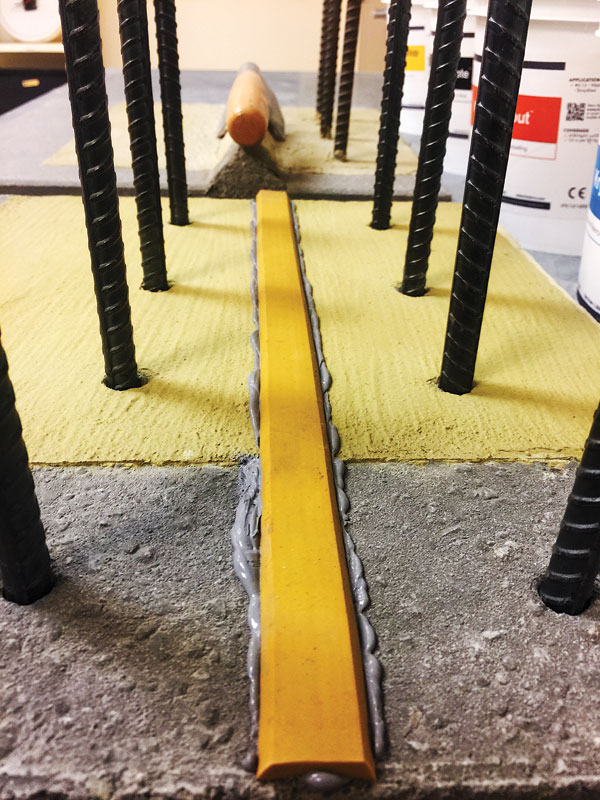
Swellable products include strips with a protected bentonite core, polymer strips for non-moving joints, and one-component polyurethane sealants that swell upon contact with water.
Injectable
Injectable joint systems use a perforated or valved hose cast into the joint and are injected with grout or resin after the concrete has cured. They are a specialized option, selected where the consequences of a leak justify the added cost—water-retaining structures, tunnels, and below-grade occupied space—either alone or as redundancy behind an embedded waterstop. The governing selection criterion is whether the system is re-injectable or single-use. Re-injectable systems allow ports to be reopened as settlement, thermal cycling, or long-term movement reopens pathways, which is the entire argument for the added cost; single-use systems offer one attempt. That distinction should be addressed early, while the owner, design team, and contractor are still discussing what happens if the joint leaks in year 15. Left unspoken, it defaults to whoever selects the product, usually on price, and usually toward single-use.
Adhesive (bonded strip)
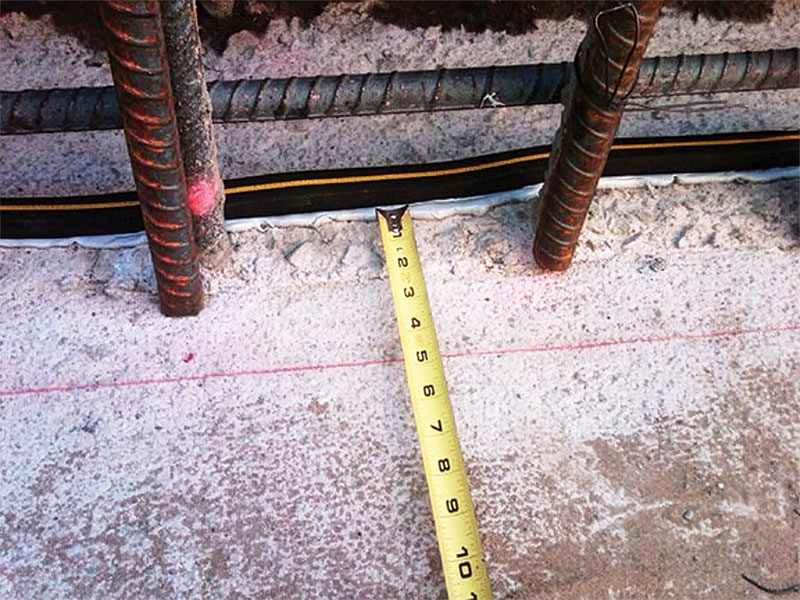
Adhesive waterstops are self-adhering butyl or modified-bitumen strips applied to the joint face of the first placement, bonding to the hardened concrete and then to the subsequent pour. They install without field welding, tolerate irregular geometry, and are often the most practical option at cold joints, at transitions between an embedded waterstop and sheet waterproofing, and in congested reinforcement where a rigid profile cannot be positioned or consolidated around. Their performance is governed almost entirely by bond, which means substrate condition and installation temperature carry the same weight as the manufacturer’s data sheet gives to material properties: a clean, dry, sound surface is a specification requirement, not a field courtesy. They are a non-movement solution—specify them where the joint is not expected to move and hydrostatic head is moderate, and pair them with a movement-rated product wherever it is.
Crystalline
Crystalline products are reactive chemistry rather than a physical barrier, supplied as a slurry, dry-shake, or integral admixture that reacts with moisture and available calcium hydroxide to grow insoluble crystals within the pore structure and fine cracks. Applied at the joint, they can reduce permeability through the adjacent concrete and self-seal microcracks up to a manufacturer-stated width, which is genuinely useful redundancy at construction joints and at the interface around penetrations. Two limits deserve specification attention. First, the reaction depends on available free lime, and high-SCM low-carbon mixes leave measurably less of it—an assumption worth verifying against the actual mix design rather than the product literature. Second, crystalline chemistry seals cracks that have stopped moving; it does not accommodate joints that are still working. Treat it as a supplement that improves the concrete’s own resistance, not as a substitute for a waterstop at a joint with anticipated movement.
Installation: Preparation and placement
Proper installation is as important as proper selection. Before concrete is placed, the construction joint must be clean and free of debris, laitance, form release, and standing water, and the waterstop must be positioned, spliced, and secured in accordance with the manufacturer’s written instructions. Surface moisture requirements vary by mechanism—adhesive strips and swellables need a dry, sound substrate to develop bond, while crystalline products are generally applied to a saturated surface-dry (SSD) substrate. In every case the objective is the same: full, intimate contact between the waterstop and the surrounding concrete.
Horizontal waterstops require careful placement sequencing, because fresh concrete must flow beneath the lower flange and displace the air trapped there. Assign a vibrator operator to consolidate the concrete under and around the waterstop as placement proceeds. Inadequate consolidation is among the most common waterstop failures. Voids adjacent to the waterstop create water pathways regardless of the product’s intrinsic performance.
Specifications should establish clear placement criteria, including minimum concrete cover requirements, alignment tolerances, and coordination with reinforcing steel to avoid conflicts that force the waterstop out of its intended position. Continuity across the full length of the joint is non-negotiable. Splices, transitions, and intersections—including changes in plane and jogs in otherwise straight runs—should be detailed explicitly in the construction and submittal documents, and factory- or shop-prefabricated intersections should be required wherever feasible. Field-fabricated splices are a common point of failure and should be minimized.
Penetrations: A primary source of leakage
Pipe penetrations, conduits, and embedded hardware introduce localized disruptions that are often more difficult to reliably seal than linear joints. These difficulties stem from differential movement between the concrete and the embedded element, interface shrinkage and cracking as the concrete cures, and limited access for installation, inspection, and future remediation.
Penetrations must be treated as systems, not isolated details. Specifications should address each of the following elements:
- Sleeves or formed openings should be the default approach wherever possible. A sleeve provides additional tolerance for differential movement and material shrinkage. It prevents rigid bonding of the penetrating element to the concrete—bonding that virtually guarantees interface cracking under thermal or structural movement.
- Annular space design deserves explicit specification attention. The space between the sleeve and the penetrating element must accommodate sealing materials and allow proper installation. Tight-fit conditions that restrict access to the annular space are a recurring cause of inadequate sealing.
- Multi-stage sealing systems provide redundancy and performance depth. A properly detailed penetration seal will typically incorporate backing material where applicable, a non-shrink grout or microfine cement fill, and a flexible or hydrophilic sealant as the final waterproofing layer. Each component addresses a different failure mode; eliminating any one of them increases risk.
- Surface preparation at penetrations is as important as material selection. The substrate must be clean, sound, and free of laitance and contaminants before sealing materials are applied. This requirement should be explicitly stated in specifications and verified in the field.
Specification strategy: From products to systems
The persistent lesson from field failures is that waterproofing specifications written around product selection alone will underperform. Specifications must address the complete system, from design intent through field verification.
It means clearly defining joint behavior—distinguishing movement joints from non-movement joints—and, where possible, quantifying expected movement to validate product selection. It means requiring continuity, with specific language addressing splicing, transitions, intersections, and changes in plane. It means establishing placement criteria beyond “install per manufacturer’s instructions” to include tolerances, cover requirements, and coordination with other trades.
Penetrations must be addressed with the same level of detail as joints, not with a generic note requiring watertight seals at all penetrations. Compatibility governs whether the assembly performs as a system: every material in contact with another—waterstops, sealing compounds, concrete admixtures, and adjacent waterproofing assemblies—should be confirmed chemically and physically compatible, and documented as such, before construction begins.
Lastly, specifications should include meaningful inspection and verification requirements: pre-placement inspection of waterstop systems, observation during concrete placement, and post-installation verification where conditions allow. Performance is achieved through coordination, not delegation.
Conclusion
Waterstops and penetration details are among the most consequential elements in the long-term performance of watertight concrete structures. Failures at these locations rarely stem solely from defective materials. Instead, they reflect a gap between design intent and field execution, an incomplete specification of system requirements, and an underestimation of the dynamic nature of concrete joints and interfaces.
A comprehensive approach—grounded in system thinking, informed product selection, proper detailing, and active field coordination—provides the most reliable foundation for durable, watertight construction. No single product can substitute for that alignment.
Authors

Christopher Bennett, CSI, CSC, is founder and CEO of Portland-based Bennett Build, a North American concrete consultancy that helps real estate owners deliver high-quality concrete and flooring systems with pronounced reductions in cost, embodied carbon, risk, and schedule.

Donald Koppy, AIA, CSI, CCS, NCARB, SCIP is a master construction specifier/architect with more than 40 years of experience. He is licensed in eight states, leading nationwide projects with expertise in coordination with BIM.

Kenneth Hercenberg, CCS, has more than 40 years of experience, specializing in project manuals, building envelopes, code reviews, and sustainability. Opinions expressed by Hercenberg are his own and do not reflect the thinking of current or past employers.
Key takeaways
Water intrusion in concrete structures rarely occurs through the material itself; rather, it concentrates at discontinuities such as joints, interfaces, and penetrations. Successful waterproofing depends entirely on comprehensive system alignment—bridging design intent, specification requirements, and strict field execution—rather than relying on individual products. To ensure durable, watertight performance, specifiers must select waterstops based on specific joint behavior and site conditions, detail factory-prefabricated intersections, enforce proper concrete consolidation to avoid voids, and treat pipe penetrations as multi-stage.
Sign up for our weekly newsletter
Architectural materials and methods delivered right to your inbox

- CSI News & Notes: CSI’s impact earns official recognition; celebrate leaders, mentors, and innovators; and more
- CSI News and Notes: CSI spring certification exams open; scholarships available; and more
- CSI News & Notes: CSI MSR heading to San Diego; spring certification exams open; and more
- To Be Specific: Why CDT Should Be Your First Move
- CSI News & Notes: CSI Fellows share member benefits; and a New Year’s Resolution to keep
Related Products

Read the Latest Issue