
Building Innovative Campuses
The educational landscape is changing as new technologies emerge. Teachers are trying to keep their students engaged, even as AI has started to make classroom participation feel optional. While the AI boom continues to take us by storm, general contractors are adapting to new ways of building educational facilities. This interview with David Amundson, project executive at C.W. Driver Companies, explores how projects are changing.
CS: What is an immersive education environment?
DA: Immersive educational environments go beyond the conventional classroom box by incorporating space into the learning process. From having science on display to intertwining a campus with its natural surroundings, students are actively participating in hands-on learning environments built to support their learning development and overall well-being.
What does building these learning spaces entail, and how are they different from conventional classroom settings?
While conventional classrooms have been designed to support learning with features such as natural light, basic acoustics, and a teacher-centered layout, immersive learning spaces take that a step further by shaping the environment to be flexible and centered on how students learn. These places allow students to observe and explore their surroundings, rather than just listening to the professor in front of them.
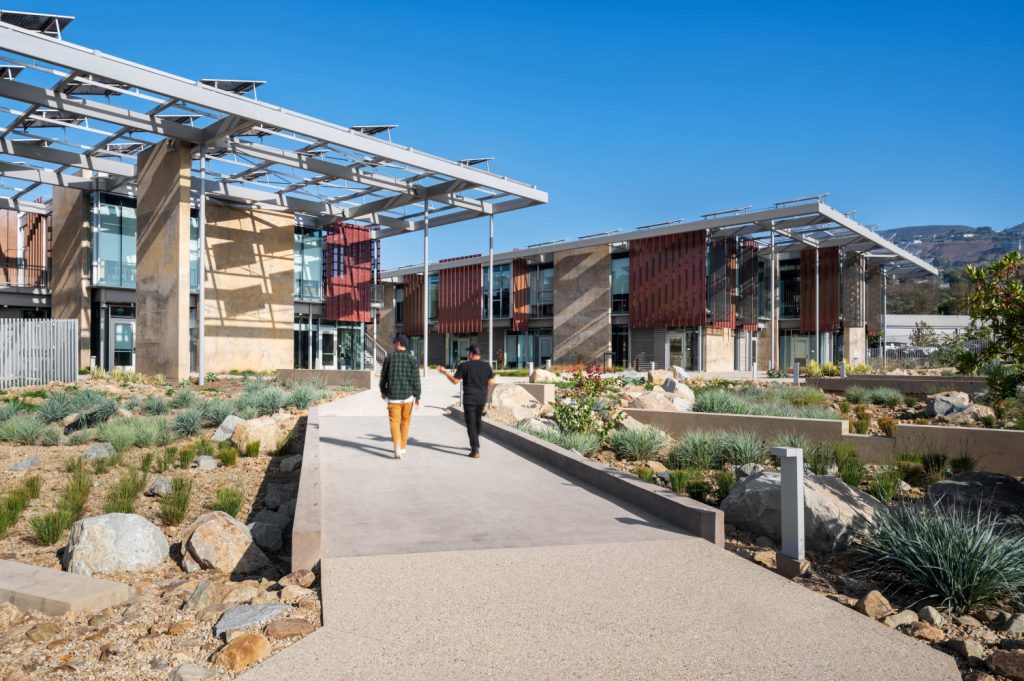
This is what’s being executed for the new Malibu Middle and High School project, which is bringing an experiential learning environment to a rural area. As the campus is located on a hill and overlooks the Pacific Ocean, C.W. Driver coordinated with the Santa Monica-Malibu Unified School District to incorporate the campus’s rustic surroundings into the classroom experience.
Phase I of the project introduced Malibu High School’s new interdisciplinary building. The 6,503 m2 (70,000 sf) structure was designed to emulate a “hillside laboratory,” offering a progressive, hands-on learning environment across all subjects.
Classrooms were strategically placed with courtyard connections and near large windows, allowing teachers to easily integrate the Malibu landscape into the learning experience. The building also incorporates connectivity pathways that give students visibility into other learning spaces, allowing them to engage with different subjects even when they aren’t in those classrooms.
Every material used on the project draws inspiration from its local environment. Weathered copper was used to remind students of their rustic surroundings. In contrast, a concrete mix using materials from the Santa Monica Mountains demonstrated that the learning experience is present in every part of the building.

How do immersive learning experiences go beyond the classroom setting?
Immersive learning environments go beyond the classroom setting by connecting students to their surroundings throughout the school day. Malibu High School incorporated a double-height commons, an indoor-outdoor student gathering space for dining and socializing that also showcases student work, demonstrating that curiosity can flow beyond the classroom.
We are seeing more immersive environments appear in higher education projects as well. The MiraCosta College Oceanside Chemistry and Biotechnology Building also integrates indoor-outdoor areas to support students working towards careers in science, technology, engineering, and mathematics (STEM). The building was designed with a “science on display” approach that allows students, professors, and visitors to be part of the STEM environment. This extends beyond the classroom, with outdoor learning and study areas all covered by a cantilevered roof spanning 2,160 m2 (23,256 sf), approximately twice the building footprint. The building was intentionally constructed this way so that students can feel connected to real-world working environments while fostering connections to the broader STEM quad and campus. The roof also provides space for a multi-use events center that can host a wide range of hands-on learning events.
What is the future of education environments?
The future of educational environments will be centered on flexibility, connection, and experiential learning, with open spaces that connect to outdoor learning environments. Students still value being on campus with their peers, but the spaces need to support different ways of learning, collaborating, and preparing for careers.
Sign up for our weekly newsletter
Architectural materials and methods delivered right to your inbox

- CSI News & Notes: CSI’s impact earns official recognition; celebrate leaders, mentors, and innovators; and more
- CSI News and Notes: CSI spring certification exams open; scholarships available; and more
- CSI News & Notes: CSI MSR heading to San Diego; spring certification exams open; and more
- To Be Specific: Why CDT Should Be Your First Move
- CSI News & Notes: CSI Fellows share member benefits; and a New Year’s Resolution to keep
Read the Latest Issue