A practical checklist: Exposure conditions impacting metal coatings
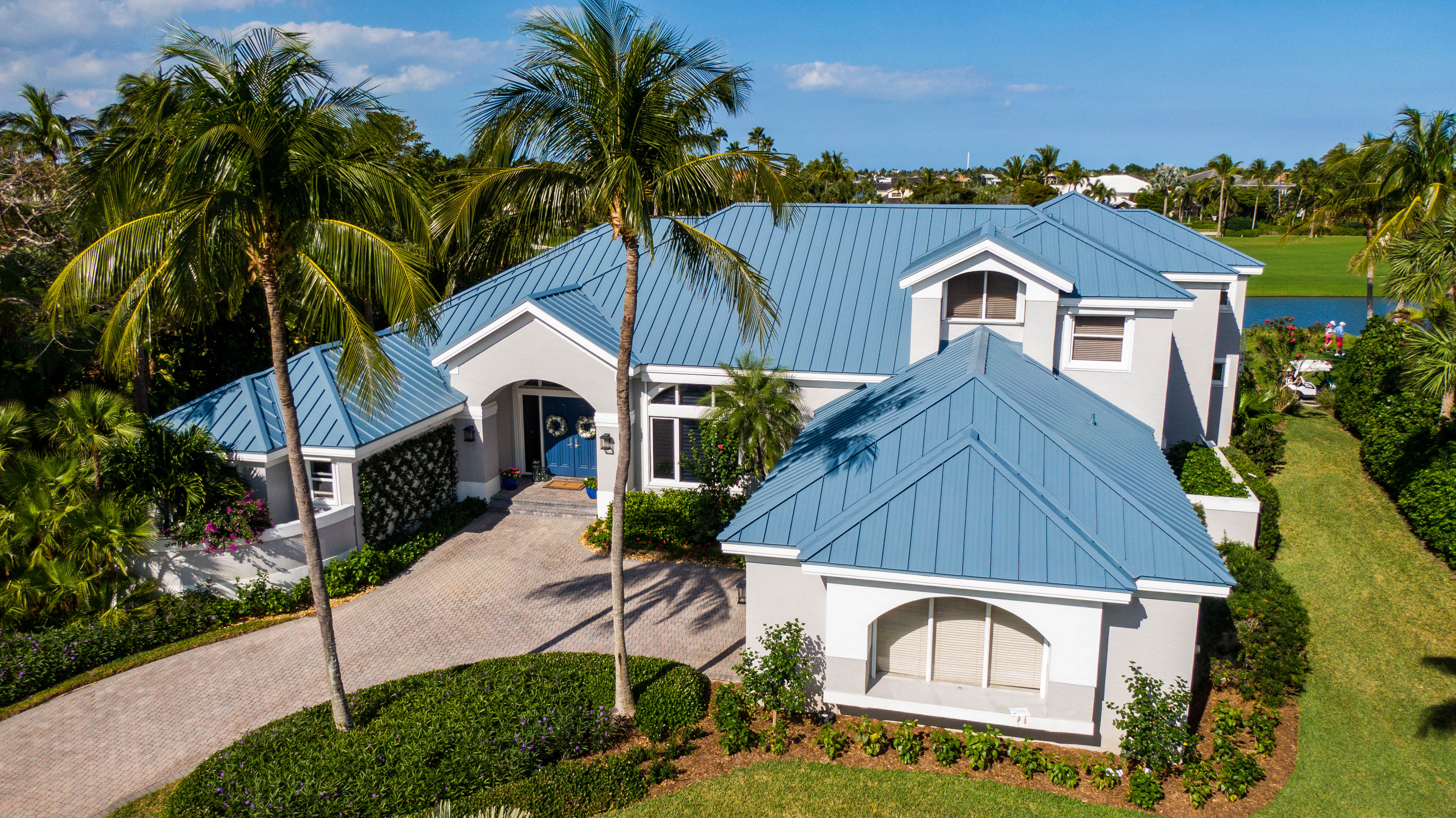
Metal structures are at risk of premature deterioration due to environmental conditions, which can degrade a building’s exterior and the client’s investment. A properly selected coating can help avoid this.
Specifiers have many variables to consider when selecting materials. When specifying metal, including steel, stainless steel, aluminum, copper, etc., it is essential to take the long view: the material should last for decades and be safeguarded by the right protective film or coating to withstand the elements. To exceed the building design’s performance expectations and avoid costly remediation, it is important to understand the exposure conditions. A thorough evaluation is imperative for specifying the ideal protective coating or film for the metal substrate. While various metals can be used in the same project, the objective is a protective film that ensures the application’s longevity and provides benefits to building owners and users.
This article will help specifiers evaluate the exposures that threaten metal coatings and explore the benefits of polyvinyl fluoride (PVF) film compared with alternative options.
Causes of metal corrosion
Climate, humidity, and condensation
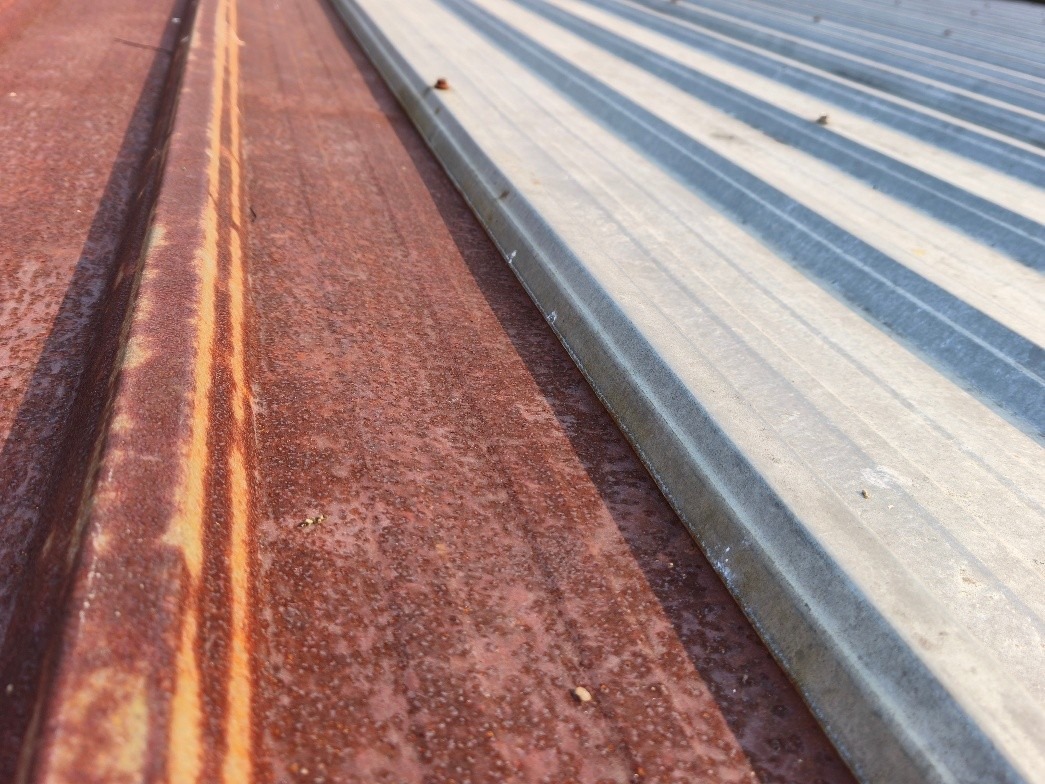
Moisture, whether as liquid water, water vapor, or frozen ice, is a primary cause of corrosion for most metals.
Coastline proximity and air salinity
Storm-heavy, hurricane-prone, and high-salt environments can take a significant toll on the building envelope. Sodium chloride (NaCl) and other dissolved minerals from seawater become suspended in the atmosphere near coastal areas, increasing air salinity, accelerating the oxidation of unprotected metals, and ultimately causing damage to certain protected metals that vulnerable to corrosion. Metal roofs and fixtures in coastal areas often lose 10–15 years of their expected lifespan, making it crucial that specified metal coatings have strong barrier properties to withstand the high level of salt spray without corroding.
Frequent storm damage, wind erosion, and wind load
Hurricanes and severe storms are a common threat to metal roofing and facades—as well as their coatings- and that threat is growing in intensity due to climate change. Damage from hail and wind is notable, as is gravel impact, abrasion, and high-pressure salt/storm spray. All of which can damage metal coatings—some can cause cracking—exposing the metal beneath to water damage, filiform corrosion, and potentially significant disruption. Substrate exposure can yield more pervasive corrosion and the need for repair.
Wind erosion is a natural process involving the removal and deposition of both fine and coarse particles by the wind, causing damage to metal structures and certain protective materials. Although wind erosion can occur in all climates, it is predominant in semi-arid and arid environments. Increased wind erosion is expected due to the changing climate.
Additionally, wind loads can compromise building integrity. Heavier metals such as steel can help prevent this, but at the risk of higher corrosion without proper protection. Roof edges, corners, and overhangs are the most susceptible.
Galvanic corrosion
Galvanic corrosion is another common cause of metal deterioration. It occurs when two dissimilar metals are brought into contact with an electrolyte, such as rain, condensation, or fog. Salt and certain pollutants exacerbate the electrolyte’s conductivity, escalating the corrosion rate. Anywhere a metal substrate’s protective coating is breached or absent, vulnerability arises.
Corrosion products can also stain a building’s exterior surface, so an inert coating that does not stain helps maintain the surface aesthetic throughout the building’s lifetime, despite some galvanic corrosion.
Solar/UV intensity and thermal cycling
It is common knowledge that UV radiation causes a metal colorant to fade; less well known is that it triggers photodegradation, which breaks down the material’s chemical bonds. Structural integrity can change at the molecular level over time. Another issue is thermal cycling, the repeated temperature fluctuations that cause the metal substrate-coating system to expand and contract daily. UV exposure weakens the material, and thermal cycling compounds the effect, hastening deterioration and causing many coating systems to chalk and become brittle.
Chemical exposures
Acid rain and other severe environmental pollutants also pose a costly risk by degrading material integrity, quality, and detail. Acid rain forms when sulfur dioxide (SO2) and nitrogen oxides (NOx) are released into the atmosphere and react with water, oxygen, and other substances.
Resistance to mold and mildew, dirt, and dust
When considering material specifications, the area’s humidity must also be taken into account. High-performing protective coatings should be inert and resistant to the organic buildup that supports growth of mold or mildew. This type of pervasive exposure occurs in humid environments, though even a heavily shaded area of a building’s facade can be susceptible after a severe storm.
A nutrient/organic source must be present on the metal or protective film for mold to grow, since it requires food, moisture, and the right temperature. On a metal building exterior, this comes from airborne organic material such as leaves, bird droppings, dirt, and other deposited debris that wouldn’t otherwise be there. Food sources can also come from plasticizers or other additives used in coating systems. Algae, lichen, and moss are biologically distinct from fungal mold and mildew but materialize and spread via the same combination of moisture, shade, and organic buildup.
An environment’s climate and airborne spores determine the baseline risk, putting warm, humid, and coastal regions at greater risk.
In addition, dust, dirt, and particulate deposition can compromise the longevity and aesthetics of the building design. Therefore, the right protective material should be non-sticking, hydrophobic, and highly inert, so it can be easily wiped clean and remain impervious to the elements. PVF film is made of 100 percent fluoropolymer without plasticizers, so it does not provide a food source for organic matter, and it wipes clean easily, removing stains ranging from dirt to moss to graffiti.
Flammability
Metals have exceptional fire resistance, which is increasingly important in high-risk areas such as dry desert climates and wildfire corridors. The proper coating should not adversely affect flammability.
Protection of metal from corrosion
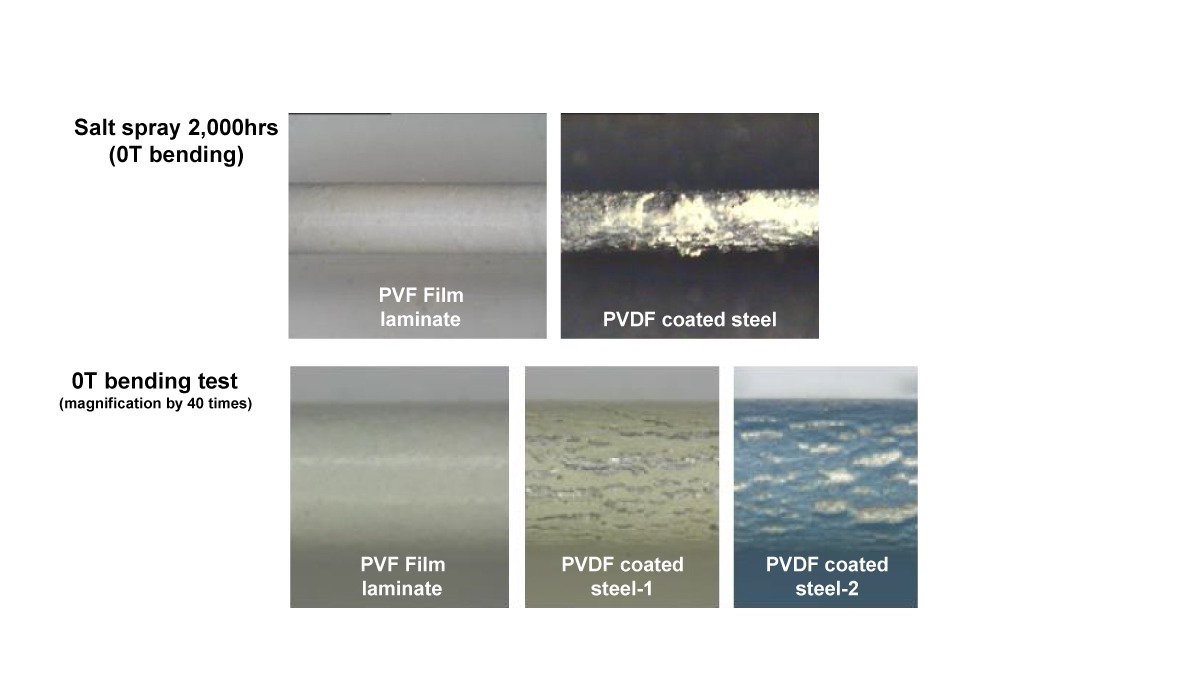
While there are many threats to metal integrity, PVF film and coatings such as polyvinylidene fluoride (PVDF), silicone-modified polyester (SMP), and others provide protection. PVF film is highly durable, long-lasting, and flexible, offering substantial resistance to weathering, UV radiation, chemicals, and staining. As a supportive, protective layer for metal laminates, it can significantly extend the product lifecycle. And it is inherently non-PFAS and made without the use of PFAS materials.
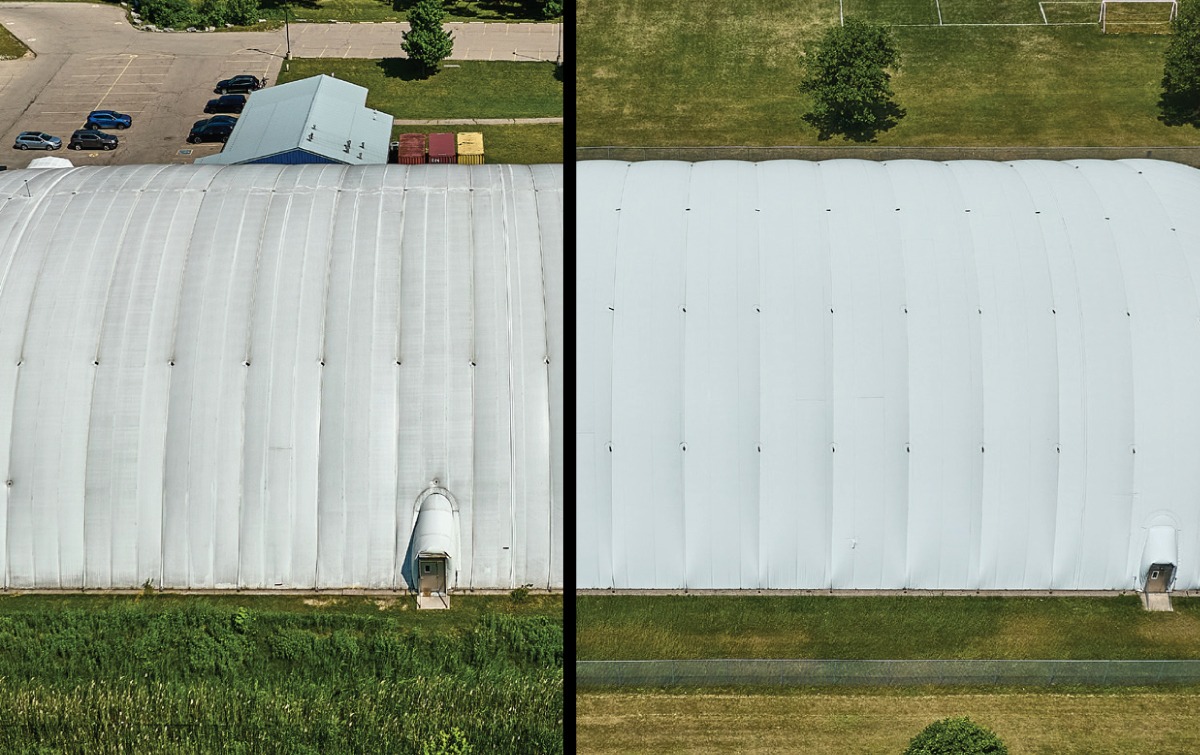
PVF film has excellent long-term resistance to fading, chalking, cracking, or blistering from even the harshest UV exposure. It is inert to harsh chemicals, so it does not fade in acid rain or stick to dirt. The film helps protect metal surfaces on buildings within 457 m (1,500 ft) of the ocean, including direct-oceanfront buildings, from the corrosive effects of seawater and salt spray. Its flexibility allows it to be formed around tight-radius bends without cracking, losing adhesion, or changing color, and to withstand hail and storm damage without cracking or exposing the underlying metal. The film also exhibits excellent chemical resistance due to the film structure and PVF polymer properties. Acting as a non-conductive barrier between dissimilar metals, it interrupts the electrochemical pathway necessary for galvanic corrosion. Because PVF is laminated rather than sprayed or brush-applied, it maintains consistent, continuous, pinhole-resistant coverage.
Flexibility and formability
Assessing a building’s exterior needs based on location, utility, and desired aesthetics is crucial, and these requirements should then be cross-referenced with the performance expectations of metal films or coatings. Learn how the film is developed and what tests monitor its mechanical properties for consistency and uniformity. If the project demands a protective material with immense endurance and long-term utility, selecting a film with a chemical composition that enables excellent formability offers major advantages. Seek one with no cracking or bent edges during fabrication and throughout the metal laminate’s lifetime, a strong T-bend rating regardless of the metal or substrate application, and the capacity to be formed into deep bends and complex shapes. All this planning will deliver a better return on investment and more satisfied customers.
Naturally, different protective film options yield varying levels of performance for metal substrates used on building exteriors. With careful planning, smart techniques, and the right protective laminates, buildings can look new and endure for the long haul.
Coating and performance on metal roofing
| Film/Coating Integrity | Color Retention | |
| PVF film | Up to 50 years | Up to 50 years, depending on color
|
| PVDF paint coating
(polyvinylidene fluoride) |
40 years | ~30 years, depending on color |
| SMP paint coating (silicone-modified polyester) |
40 years | ~30 years, depending on color |
| Service life prediction of metallic layer and roof as a whole | ||
| Galvalume metallic layer on steel (part of substrate) | Up to 60 years*, though shorter in severe coastal exposure differs | Bare Galvalume is a metallic finish with no color to retain |
Author note: Warranties cover film/coating integrity, color fade, chalking, and checking. Color fade warranties often depend on the paint color, as pigments vary.
Author note: *From the Journal of ASTM International Study unpainted, low-slope roofs
Non-PFAS, environmentally safer
Selecting PVF can help meet evolving material requirements, especially for sustainability-conscious building owners, architects navigating material specifications, or contractors and developers in regulated markets.
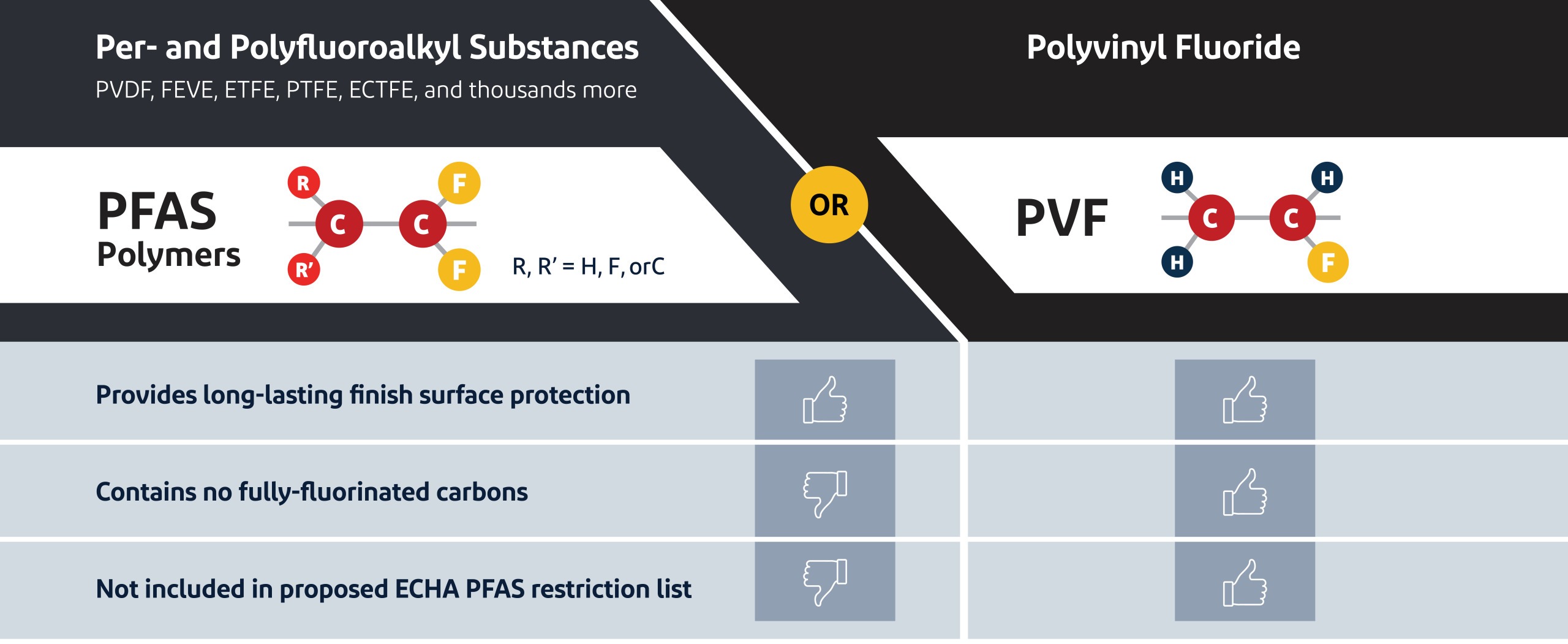
PFAS are a class of chemicals under increasing regulatory pressure. PFAS are fluorinated, containing at least one fully fluorinated methyl or methylene carbon atom. Any chemical with at least a perfluorinated methyl group (–CF3) or a perfluorinated methylene group (–CF2–) is a PFAS, with few exceptions.
PVF is a partially fluorinated fluoropolymer; therefore, it is not classified as PFAS by the Environmental Protection Agency (EPA), U.S. states, the European Chemicals Agency (ECHA), and the Organization for Economic Co-operation and Development (OECD).
Color stability and cleanability
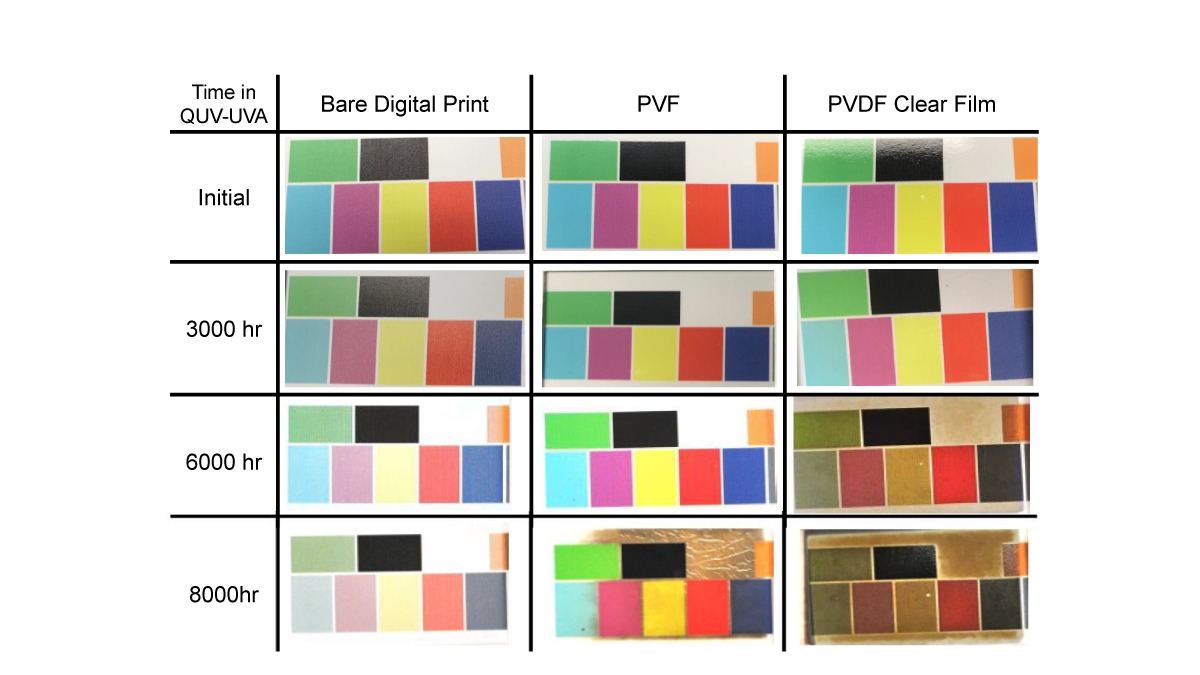
Further design considerations include offering a range of colors and finishes to help customers achieve their desired aesthetic without compromising performance. Specifiers should look to PVF for a build that requires minimal changes to gloss and color, maintaining ultra-low color differences over decades of exposure—yielding no unsightly yellowing, chalking, or fading.
When assessing chemical inertness, it is wise to avoid harsh solvents and pollution, which makes it easy to clean stains and graffiti and results in markedly reduced maintenance costs and desired longevity.
In summary
Metal laminates face daily threats that can undermine their performance over decades. The selection of a highly durable, weather-resistant, markedly flexible, non-fading, and easy-to-clean protective film safeguards the metal and building investment. Failure to properly specify coatings based on environmental exposures can lead to premature corrosion and costly rework.
Getting specific about potential hazards and understanding the myriad external factors that affect building material performance help support overall project success. PVF film offers many benefits, with the added, unique advantage of non-PFAS makeup. Use this checklist to proactively plan and understand what’s possible to develop a compelling specification for the next project.
References
Joseph “Cris” Crissinger, CCS, CCCA, International Institute of Building Envelope Consultants, “Considerations for Coastal Coatings, March 2007, https://iibec.org/wp-content/uploads/2007-03-crissinger.pdf
Peachtree Homes, “How Salt Impacts Building Materials,” November 21, 2025, https://peartreehomes.net/post/salt-air-impacts-building-materials/
Technical Assurance, “Façade Management: 5 Natural Threats, May 12, 2022, https://technicalassurance.com/knowledge-center/facade-management-natural-threats/
https://pjsroofing.com/uv-damage-to-roofs/
Ernest Orlando Lawrence Berkeley National Laboratory, “Soiling of building envelope surfaces
and its effect on solar reflectance – Part II: Development of an accelerated
aging method for roofing materials, November 2013, https://www.osti.gov/servlets/purl/1163272
U.S. Environmental Protection Agency (EPA, “Effects of Acid Rain,” February 19, 2026, https://www.epa.gov/acidrain/effects-acid-rain
London Window Cleaners, “How Urban Wind Patterns Affect Wall Dirt Buildup on Tall Buildings, July 8, 2025, https://www.london-window-cleaners.co.uk/2025/07/how-urban-wind-patterns-affect-window-dirt-buildup/
Corrosion Doctors, https://corrosion-doctors.org/Corrosion-Factors-Cells/corrosion-cells-aeration.htm
Quality Structures, “Banish Roof Grime: Easy Steps to Remove Organic Growth from Metal Roofing,” https://qualitystructures.com/banish-roof-grime-easy-steps-to-remove-organic-growth-from-metal-roofing/
Town and Country Roof Restorations, “How Long Does Roof Restoration Last in Coastal Areas?” December 15, 2025, https://www.townandcountryroofrestorations.com/resources/how-long-does-roof-restoration-last-in-coastal-areas
International Molybdenum Association (IMOA), “Avoiding Building & Structure Galvanic Corrosion,” https://www.imoa.info/molybdenum-uses/molybdenum-grade-stainless-steels/architecture/avoid-galvanic-corrosion.php
https://www.ampp.org/technical-research/impact/corrosion-basics/group-1/galvanic-corrosion
https://www.mdpi.com/2073-445X/12/8/1503
Jack Shaw, Metal Architecture, “The Science of Wind-Resistant Metal Roofs,” November 2025, https://www.metalarchitecture.com/articles/wind-resistant-metal-roofs/
Sparkle Wash International, “The Effects of Acid Rain on Home Exteriors and How Pressure Washing Can Help,” June 2, 2024, https://sparklewash.com/blog/the-effects-of-acid-rain-on-home-exteriors-and-how-pressure-washing-can-help/
Maple Plastics, https://mapeplastics.se/en/materials/pvdf/
Nick Gromicko and Kate Tarasenko, InterNACHI, “Acid Rain and Inspectors: Buildings at Risk,” https://www.nachi.org/acid-rain.htm
Specified Technologies Inc., “Mold & Mildew Resistance and Firestop Systems,” https://www.stifirestop.com/news/mold-mildew-resistance-and-firestop-systems
Alana Fossa, Construction Specifier, “Avoiding galvanic corrosion with dissimilar metals,” August 21, 2020, https://www.constructionspecifier.com/avoiding-galvanic-corrosion-with-dissimilar-metals
Dupont Tedlar, “Chemical Resistance of Tedlar PVF Films, https://www.dupont.com/content/dam/dupont/amer/us/en/tedlar-pvf- films/public/documents/chemical-resistance-of-tedlar-article.pdf
Dupont Tedlar, “Properties of Tedlar,” https://www.dupont.com/content/dam/dupont/amer/us/en/tedlar-pvf-films/public/documents/Tedlar-Properties-Overview.pdf
DuPont Tedlar, “DuPont™ Tedlar® Polyvinyl Fluoride (PVF) Films
General Properties,” https://www.dupont.com/content/dam/dupont/amer/us/en/photovoltaic/public/documents/DEC_Tedlar_GeneralProperties.pdf
DuPont Tedlar, “DuPont™ Tedlar® PVF film for metal roofing and facades,” https://www.dupont.com/content/dam/dupont/amer/us/en/mobility/public/documents/en/DuPont%20Tedlar_Metal%20Roofing%20Download.pdf
Sheffield Metals, “PVDF vs. SMP Paint Systems: Which Is Best For Your Metal Roof?” February 17, 2022, https://sheffieldmetals.com/learning-center/pvdf-vs-smp/
Aocheng Metal, “How to Choose Coating for Prepainted Metal? A 3-Minute Guide,” March 25, 2026, https://aochengmetal.com/prepainted-metal-coating-types/
My Chemical-Free House, “Laws Passed to Ban PFAS in Furniture/Furnishings,” November 28, 2023, https://www.mychemicalfreehouse.net/2023/11/laws-passed-to-ban-pfas-in-furniture-furnishings.html
Metal Construction Association, “Service Life Assessment of Low-Slope Metal Roof Systems,” https://metalconstruction.org/index.php/online-education/service-life-assessment-of-low-slope-unpainted-55-al-zn-alloy-coated-steel-standing-seam-metal-roof-systems—published-102018
Central States, “Storm Preparedness Starts at the Roof: How Metal Roofing Builds Long‑Term Resilience,” https://centralstatesco.com/news/storm-preparedness-starts-at-the-roof-how-metal-roofing-builds-long-term-resilience/
The Construction Specifier, “Corrosion resistance and environmental considerations for architectural metal coatings,” January 17, 2020, https://www.constructionspecifier.com/corrosion-resistance-and-environmental-considerations-for-architectural-metal-coatings/
ScienceDirect, “Implications of climate change on wind erosion of agricultural lands in the Columbia Plateau,” December 2015, https://www.sciencedirect.com/science/article/pii/S2212094715300025
Key takeaways
Selecting metal coatings or protective films starts with evaluating exposure conditions, including weather, salt, wind, UV radiation, pollutants, moisture, and biological growth. Matching the coating system to the project’s location, substrate, and design requirements can help protect the building envelope and support long-term performance.
PVF film is presented as an option for metal laminates where durability, formability, cleanability, and color retention are priorities. Specifiers should review product-specific test data, warranty terms, and applicable regulatory definitions when evaluating its suitability.
Author

Nathaniel (Nate) Schwartz is a BS/MS chemical engineer with more than 36 years of professional experience, including 23 years at DuPont. He has spent over 18 years supporting Tedlar® in research and development and technical service roles, bringing deep technical expertise and practical customer-focused experience to his work. As senior technical service leader for the Americas, Nate helps connect material science, application knowledge, and customer needs to deliver effective solutions. He is a member of the Metal Construction Association (MCA), the National Coil Coatings Association (NCCA), and the Association for Roll-to-Roll Converters (ARC) in the construction space.
Sign up for our weekly newsletter
Architectural materials and methods delivered right to your inbox

- CSI News & Notes: CSI’s impact earns official recognition; celebrate leaders, mentors, and innovators; and more
- CSI News and Notes: CSI spring certification exams open; scholarships available; and more
- CSI News & Notes: CSI MSR heading to San Diego; spring certification exams open; and more
- To Be Specific: Why CDT Should Be Your First Move
- CSI News & Notes: CSI Fellows share member benefits; and a New Year’s Resolution to keep
Products
Read the Latest Issue