
From vacancy to vitality: Adaptive reuse in education design
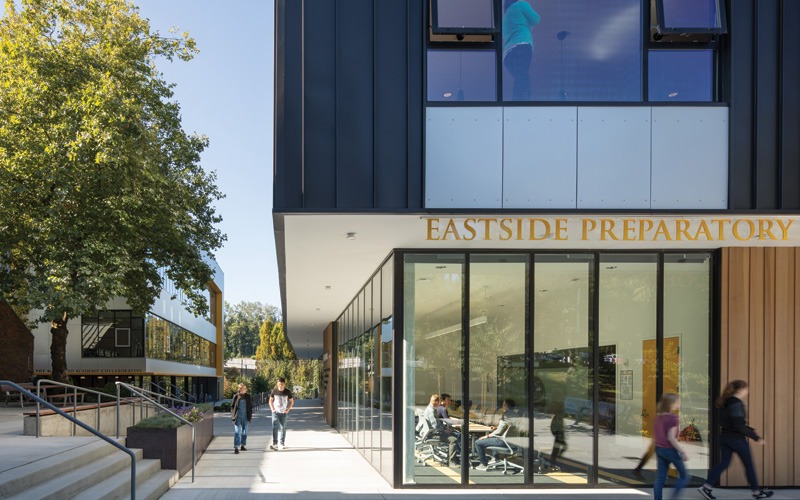
Over the past decade, PUBLIC47 Architects has worked with Eastside Preparatory School (EPS) in Kirkland, Wash., to transform a fragmented 1980s office park into a cohesive, pedestrian-focused educational campus. What began as a collection of two-story office buildings has evolved through a series of strategically phased projects. Each addressed unique physical constraints, performance goals, and construction challenges.
Rather than a single master plan, the campus grew through an evolving vision shaped by immediate needs and long-term adaptive reuse. Each project introduced new techniques for improving daylighting, accessibility, and circulation while creating durable, flexible spaces that could support the school’s growth over time.
Working within constraints
EPS occupies a property organized as a planned unit development (PUD), where each building sits on its own parcel with strict limitations on footprint and height. These constraints required precise coordination between architects, builders, and local jurisdictions.
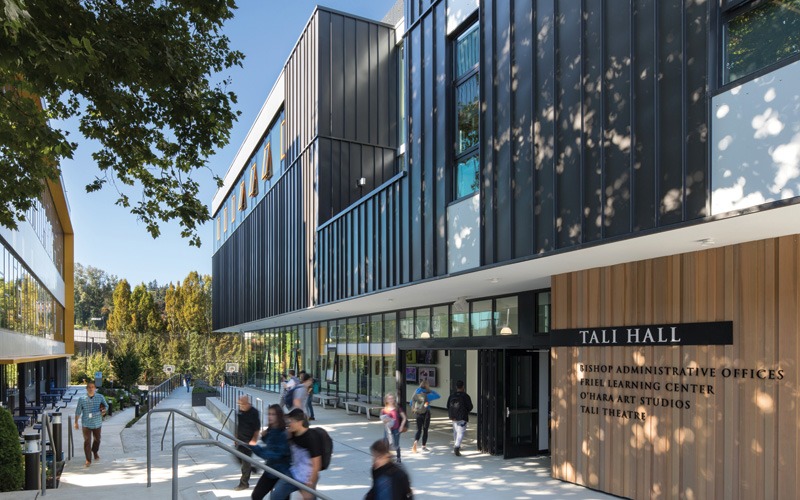
The design team approached these challenges by linking the campus horizontally and visually. Massing erosions, transparent ground-level connections, and a new central pedestrian plaza create a continuous experience between buildings. This plaza unites the campus, providing a clear pedestrian route from the main entry to the play courts and connecting the Levinger-Poole Commons, The Macaluso Academic Collaborative, and TALI Hall.
Managing the site’s 4-m (12-ft) grade change was a central technical challenge. PUBLIC47 used a series of stepped terraces, ramps, and covered gathering zones to ensure full accessibility while maintaining natural circulation flow. The plaza’s generous canopies and exterior seating areas now serve as an extension of indoor learning and gathering spaces, offering shelter during the Pacific Northwest’s wet months and becoming vital during the COVID-19 pandemic for outdoor dining and social interaction.
TMAC: Establishing a framework
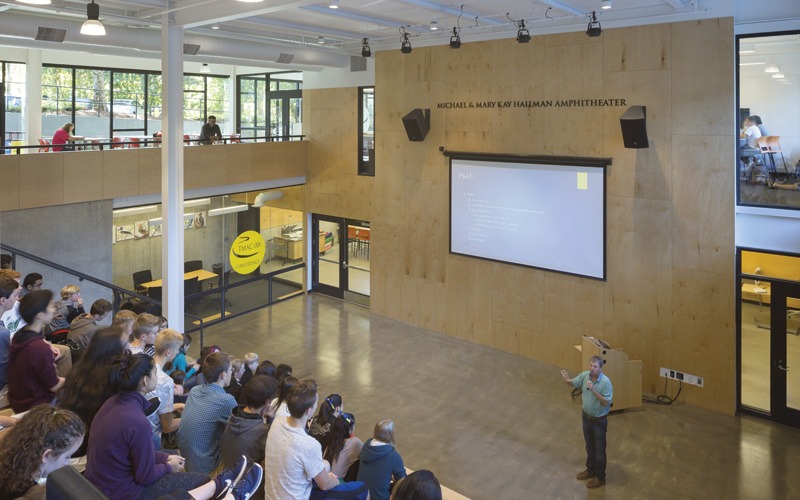
The Macaluso Academic Collaborative (TMAC) was the first major step in the transformation.
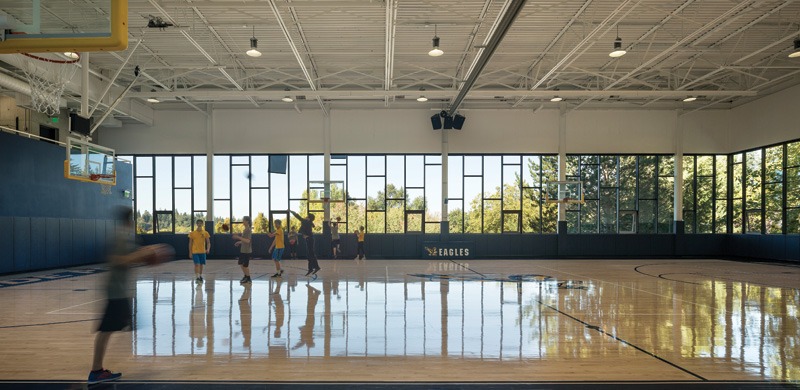
The 2,787-m2 (30,000-sf) building introduced a mix of program types: 1,858 m2 (20,000 sf) of classrooms, science labs, digital fabrication spaces, and a 929-m2 (10,000-sf) gym and fitness center.
Due to the limited footprint, the gym was positioned at the top of the building on an isolated floor system, an unusual approach for a K-12 facility that required careful structural and acoustic detailing. The floor assembly between the gym and the classrooms below required careful consideration to minimize noise transfer, especially footfall. The assembly consists of a sandwich of structural steel and a concrete floor, with a separate concrete slab on top that is raised on hundreds of spring isolators. Operable walls between classrooms allow flexible configurations for combined or divided classes and have since become a campus standard. An interior amphitheater features large slide-fold doors made of insulated glass with an acoustic rating of STC 43, extending the circulation path and serving as an assembly space.
TMAC was designed, permitted, and approved within seven months, a fast-track timeline that demanded close coordination between design and construction teams. The building opened just 18 months after design began, establishing a model for future phases of work both in process and adaptability.
TALI Hall: Connecting the Campus
TALI Hall was the pivotal project that physically and visually unified the Eastside Prep campus. The 8,919-m2 (96,000-sf) facility connects TMAC, the Levinger-Poole Commons, and the play courts through a new pedestrian plaza that resolves a 4-m (12-ft) grade difference across the site. The building itself bridges two parcels, with an atrium serving both the structural joint and the social heart of the campus.
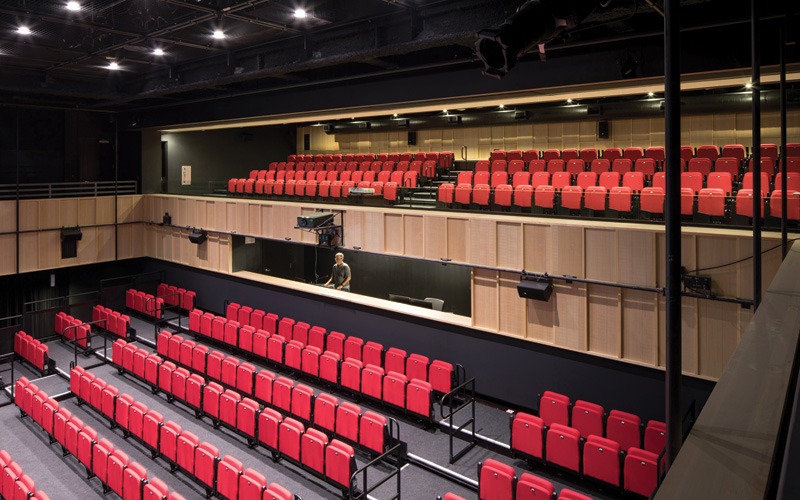
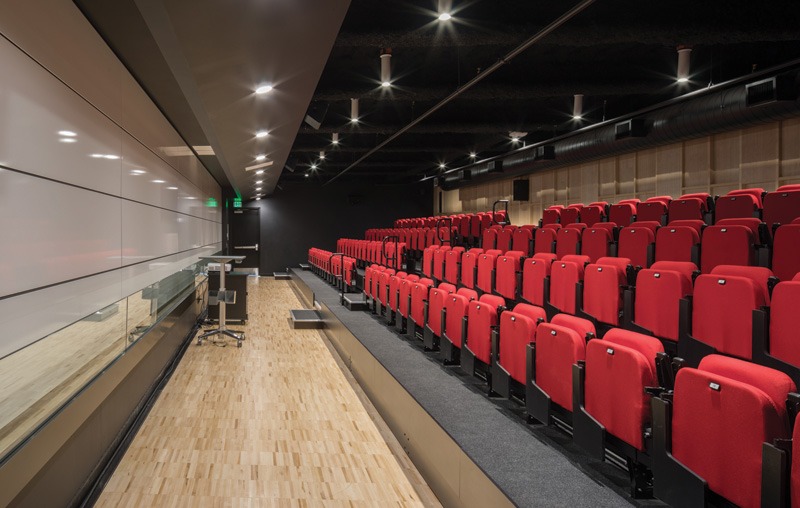
The project’s most complex element is the 1,393-m2 (15,000-sf) flexible theatre, which includes a set shop, dressing rooms, wardrobe storage, and a control booth. The space accommodates up to 650 people in multiple configurations, featuring retractable seating, operable acoustic glass doors, double blackout curtains, and an upward-folding partition that separates or joins the mezzanine.
By using retractable seating, the space can be arranged in different ways. It can be set up as a proscenium theater for maximum seating or for smaller, more intimate performances that need fewer seats. It can also be a flat space for events such as theater in the round, college fairs, parent-teacher conferences, or a fall festival.
For such community events, the operable acoustic wall could fold out of the way to provide a larger opening between the building atrium and the theater space, encouraging that connection. In addition, the blackout curtains can be tucked away, allowing the space to be open to daylight and views, and further transforming the black box theater into a more public and inviting community space.
An upward-folding acoustic partition separates the upper mezzanine of the theater, allowing that space to operate autonomously with its own retractable seats, a dance floor for dance or yoga classes, and its own AV system. The space can be used for separate lectures, test-taking, or, on rare occasions, can be opened up to the theater to accommodate a larger event, such as a school assembly.
The mezzanine itself is also adaptable, featuring retractable seating, integrated tablet desks, and a sprung dance floor, which enables the space to be used as a lecture hall or a performance area. To ensure high performance and low operational costs, the building envelope features high-quality glazing, over-insulated assemblies, and natural ventilation systems. The high-performing fiberglass windows feature laminated glazing, with a U-value of 0.25. The building perimeter is wrapped with rock-wool insulation to provide additional insulation and to minimize thermal bridging. The daylighting strategies reduce reliance on electric lighting, while professional-grade AV and lighting systems with a tension grid allow students to engage in hands-on theater technology.
Below the building, structured parking replaced surface parking, allowing for better land use and expanded pedestrian areas.
Middle School renovation and addition
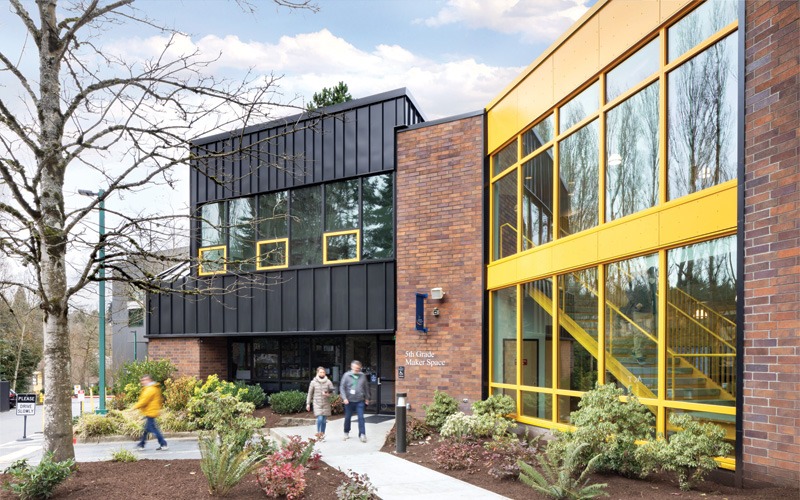
The Middle School renovation and addition transformed one of the original office buildings into a modern educational environment.
There was an unoccupied courtyard that was infilled and an awkward exterior stair removed, both of which separated the upper floor of the existing middle school into two autonomous buildings, making circulation and supervision awkward. By occupying the courtyard, additional commons space was provided for the cramped middle school, enabling more efficient circulation within the building. A two-story window wall also brings light into the new middle school commons.
The existing mansard roof resulted in a lack of perimeter windows for many classrooms. By inverting the pitch of the roof, higher ceilings and larger windows were introduced, improving natural ventilation. This alteration also increased the floor area in what was originally attic space. For instance, the upstairs science lab previously lacked natural light. Expanding into the mansard attic space allowed for additional space and the inclusion of windows.
Folding whiteboard walls between classrooms enable flexible teaching arrangements and accommodate larger gatherings. These are high-performing, acoustical partitions. The teachers and staff appreciate the paired classrooms because they offer flexibility for holding larger class meetings in those settings.
The design removed an exterior stair and sky bridge and infilled a courtyard to create additional interior space and better circulation. The result provides larger classrooms, improved light, and spaces for informal gathering.
Levinger-Poole Commons: Reinventing the heart of campus
At the center of the Eastside Prep campus, the Levinger-Poole Commons (LPC) functions as the primary dining and gathering space. Originally designed as a multipurpose theater, assembly, and cafeteria, the space was reimagined following the completion of TALI Hall.
The renovation expanded the kitchen, added an elevator, and included new classrooms, as well as private dining and teaching spaces. Visual connections between levels were improved with new openings and glass partitions. The function of the space was transformed into an all-day student union for meals, study, and meetings.
During the COVID-19 pandemic in 2020, PUBLIC47 added the LPC Dining Canopy, a heated and weather-protected outdoor dining area to address public health concerns. The space is still used as an expanded year-round exterior plaza.
Building for flexibility and longevity
A guiding principle across all Eastside Prep projects is adaptability over time. Standard elements include operable walls, exposed structural elements, and mechanical systems, as well as plug-and-play in-floor power systems that can be reconfigured by campus staff. This modular infrastructure supports changes in teaching layouts, technology use, and furniture arrangements.
Durable materials, simple detailing, and easy maintenance ensure that the buildings remain functional and efficient for decades. Much of the building’s structure, including its steel and concrete, is exposed, making it a key element of the design. This approach reduces the costs associated with adding additional cladding to hide the structure and means there are fewer finishing materials to maintain over time. These structural materials are built to last, featuring exposed concrete floors where suitable, minimal use of dropped ceilings, and accessible mechanical systems for straightforward maintenance.
These construction strategies not only reduce operating costs but also extend the lifespan of the compass infrastructure.
A connected and evolving campus
Ten years in, the Eastside Prep campus is an example of how careful planning, coordination, and technical detailing can transform a series of individual buildings into a unified academic environment. Through phased construction, each project addresses immediate needs while laying groundwork for future projects. The result is a pedestrian-oriented, flexible, and durable campus designed to adapt to the next generation of students and educators. The collaboration between Eastside Preparatory School and PUBLIC47 reflects how thoughtful construction can shape a learning environment built to evolve with its community.
Author

Jeff Boone, AIA, is a partner and co-founder of Seattle-based architecture firm PUBLIC47.
Key Takeaways
Eastside Prep’s decade-long, phased redevelopment transformed a fragmented office park into a unified, pedestrian-focused campus through adaptive reuse, flexible learning environments, and technical solutions to site constraints—prioritizing daylight, circulation, durability, and long-term adaptability across all buildings.
Sign up for our weekly newsletter
Architectural materials and methods delivered right to your inbox

- CSI News and Notes: CSI Foundation’s construction camp; CSI spring exam; and more
- CSI News and Notes: CSI’s credentials; CSI conference theme; and more
- To be specific – CSI supports young AECO professionals
- CSI News and Notes: CSI’s foundation scholarships, national conference, and Crosswalk
- CSI News and Notes: AI’s impact; CSI 2024 conference, and more
Products


Read the Latest Issue