
Smart door solutions for data centers: Critical specs for reliable protection

The rapid growth of cloud computing, artificial intelligence (AI), and digital infrastructure is driving a breakneck pace of data center construction. From multi-tenant colocation facilities to hyperscale campuses, these structures vary widely in size and scope but share basic functions focused on 24/7 operations and protecting equipment and personnel.
The operational goals of data centers demand precise specification of building envelope materials, to which commercial doors can make an important contribution. Effective door systems must address five core performance requirements: maintaining stable interior environments through thermal and air control; meeting the durability demands of equipment movement and high-cycle use; securing access between zones and controlling who and what moves through a facility; containing smoke and slowing the spread of fire during life-safety events; and integrating with building alarm and automation systems to respond automatically when conditions change. Together, these requirements ensure that servers, racks, and networking systems function predictably and reliably and that occupants and equipment are protected when it matters most. In data centers, commercial doors are more than basic building components; they are complex systems integral to operational success.
Common data center models
Data centers are often seen in a catchall manner, but their sizes, configurations, and occupancy patterns vary widely. A facility may serve one organization or multiple tenants, and it may be a single-level structure or a multi-story building. These variations affect access points, security requirements, and life-safety, determining door system placement and performance criteria.
Three of the most common data center models are colocation, enterprise, and hyperscale. Each has distinct functions, layouts, and levels of human occupancy, with important implications for door system specification.
Colocation facilities are operated by a single owner that maintains the building infrastructure while leasing secure suites to multiple tenants. Tenants in colocation facilities share systems such as power, cooling, and security while maintaining their own separate, access-controlled spaces. This model is common in urban locations and is often a multi-story structure that maximizes vertical real estate. Its multi-floor architecture, tenant separation requirements, and frequent equipment movement and servicing activities demand a wide range of door system solutions. These include securing individual tenant spaces and controlling access, as well as high-cycle durability required to handle recurring equipment movement, deliveries, and tenant access.
Enterprise data centers are owned and operated by a single organization to support its own internal IT infrastructure. Unlike multi-tenant colocation facilities, enterprise data centers do not lease space to outside tenants. The owner manages access, security, and operations, and these facilities are often integrated into larger occupied buildings such as corporate headquarters, hospitals, universities, or financial institutions. Enterprise facilities rely on internal staff, which results in more streamlined occupant circulation patterns. However, their proximity to other enterprise operations necessitates tight coordination with the building-wide life-safety system, making fire and smoke protection and alarm-integrated door operation especially critical performance requirements.
Hyperscale data centers are campus-style facilities designed to support massive computing workloads for cloud services, AI, and large-scale enterprise applications. Typically owned and operated by a single organization, these facilities feature high-density data halls with very low human occupancy, as operations are largely automated. Compared with colocation and enterprise models, hyperscale door system specification is more standardized, with the same assemblies repeated across multiple halls and zones. For specifiers, this consistency demands focused attention on thermal and air control performance and high-cycle durability, as any shortfall in either is multiplied across every repeated opening in the facility.
Shared needs of door systems and data centers
No matter the type of data center, nearly every model shares a core set of performance requirements informing door system specification. These requirements cut across all facility types and all zones: strong thermal resistance to protect tightly controlled interior climates; robust air infiltration management to limit humidity and airborne contaminants; high-cycle durability to withstand concentrated periods of use; reliable security and access control to protect people, equipment, and data; and fire and smoke protection integrated with building alarm systems to contain risk and support life-safety response. Viewing data centers through these common requirements and the zones where they apply makes it easier to identify door types that align with a facility’s needs and specify assemblies that deliver optimal performance.
Exterior access: Loading docks and equipment bays
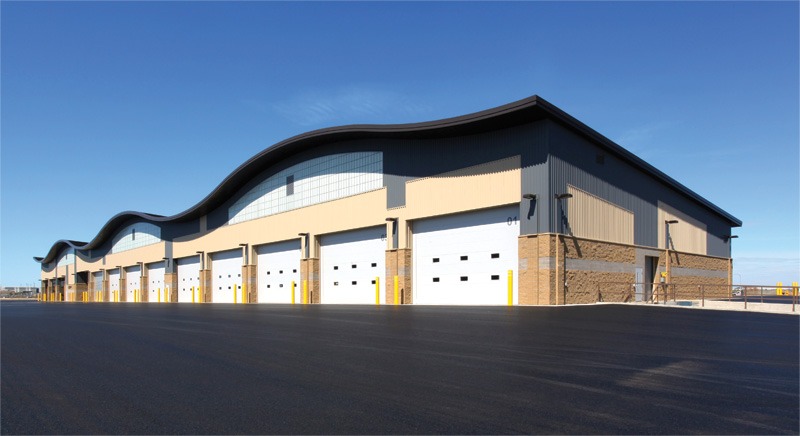
Loading docks and equipment bays accommodate the physical movement of server racks, cabinets, switchgear, uninterruptible power supply (UPS) systems, and large mechanical components. Crated shipments and palletized freight regularly move in and out of these openings, and during buildouts or equipment refresh cycles, activity is high.
A multi-story urban colocation center may employ a ground-level dock paired with freight elevators. An enterprise facility integrated into a hospital or corporate building may have a secured service entrance separate from public-facing space. Meanwhile, a hyperscale campus may feature numerous loading areas designed for repeated deliveries. Though configurations differ, the performance demands at exterior access points are among the most rigorous in the facility, where thermal control, air infiltration management, durability, and security must all perform simultaneously and reliably.
Two door types are specifically engineered to meet these demands at exterior access points: insulated overhead sectional doors and insulated rolling doors.
Insulated overhead sectional doors
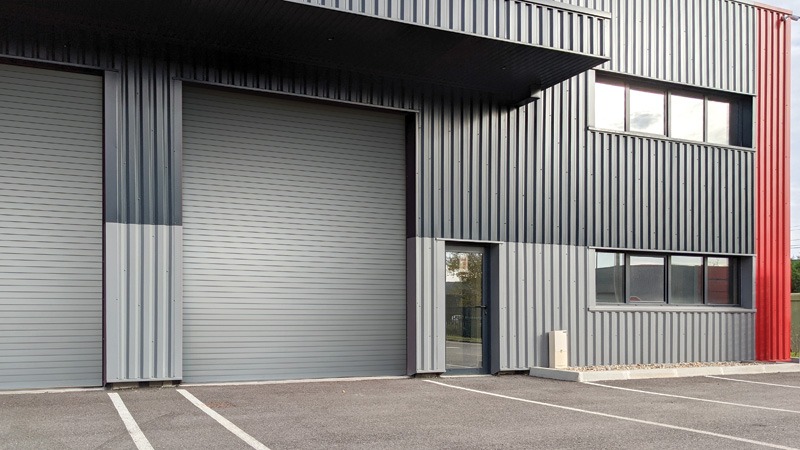
In data centers, insulated overhead sectional doors are the workhorse solution for exterior access. These engineered systems are where section construction, insulation, joint configuration, sealing, and reinforcement work together to meet the thermal, air infiltration, durability, and security demands of high-activity openings. Some of the latest advances available within this door category include:
Section construction and structural integrity
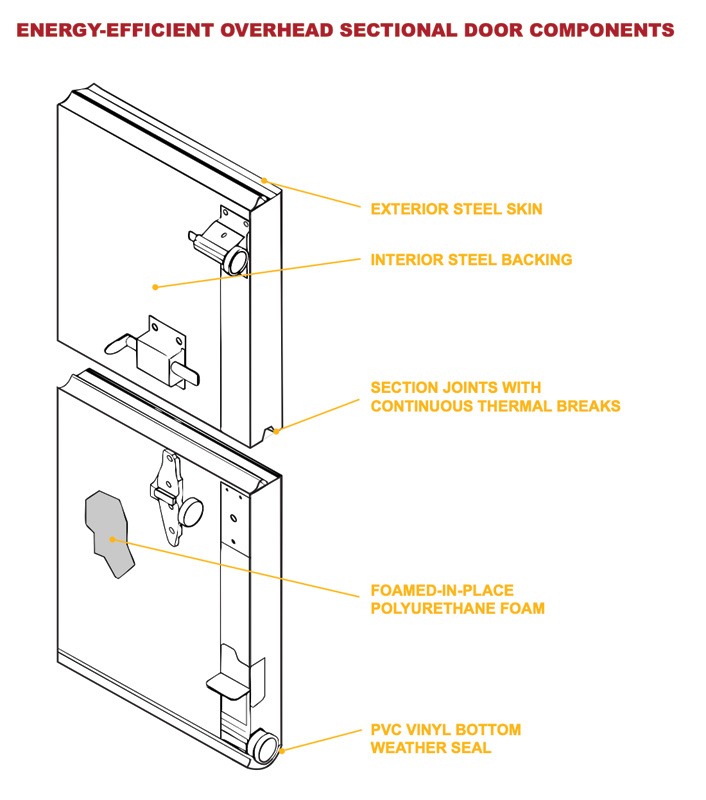
Insulated sectional doors should be specified with a 76.2-mm (3-in.), multi-layer section. This section typically uses a steel exterior and an interior steel backing. Reinforced end stiles and internal support elements enhance rigidity, helping to resist wind pressures and incidental impacts common in loading docks and equipment bays. Rugged section stiffness also preserves insulation continuity and long-term thermal resistance.
Polyurethane core insulation
Thermal efficiency begins at the section core. During manufacturing, polyurethane insulation is injected between the steel skins, where it expands and bonds to both interior and exterior surfaces. This foamed-in-place method minimizes gaps within the section and forms a continuous insulating layer. Depending on configuration and testing methodology, overhead sectional doors constructed this way can achieve R-values of up to 27 when evaluated according to the Door & Access Systems Manufacturers Association (DASMA) TDS-163, U-factor and R-value for Residential and Commercial Garage Door, thereby supporting stable interior conditions at critical openings.
Thermally controlled section joints
Section-to-section joints are a frequent source of heat loss. Advanced joint geometries, such as interlocking tongue-and-groove profiles, incorporate nonconductive separation between steel layers to limit thermal bridging. By interrupting metal-on-metal contact between sections, door systems maintain greater uniform insulation performance across the full door height.
Whole-assembly thermal performance
While the section R-value is often cited, overall door efficiency is better reflected by the U-factor, which accounts for the entire assembly. Through integrated insulation, thermally broken joint design, and precision section construction, high-performance sectional doors can now reach U-factors as low as 0.16 in testing under DASMA 105, Test Method For Thermal Transmittance and Air Infiltration of Garage Doors, indicating strong resistance to heat transfer across the entire system.
Air-sealing strategies
Air leakage directly affects humidity and temperature control in data centers, making perimeter sealing critical. Flexible PVC vinyl bottom perimeter seals conform to minor floor irregularities, while close-tolerance section construction and coordinated jamb and header seals reduce unintended airflow. Properly specified systems can limit air infiltration to 7.32 m³/h·m² (0.40 cfm/ft²) or lower, in accordance with the 2015 International Energy Conservation Code (IECC) (Section 402.5.2).
Wind-load reinforcement
Exterior bay doors are often subject to significant wind pressures. Reinforcement options, referred to in the industry as struts, can be integrated into the section assembly to help alignment and seal compression under load. Depending on configuration, overhead sectional doors can be engineered to meet pressures exceeding 2394 kPa (50 psf), supporting both structural integrity and building envelope performance.
Energy code alignment across climate zones
When all the preceding attributes are combined within a single assembly, overhead sectional doors can meet or exceed IECC thermal performance criteria, including U-factor thresholds of 0.37 or less across Climate Zones 1 through 8.
Insulated rolling doors
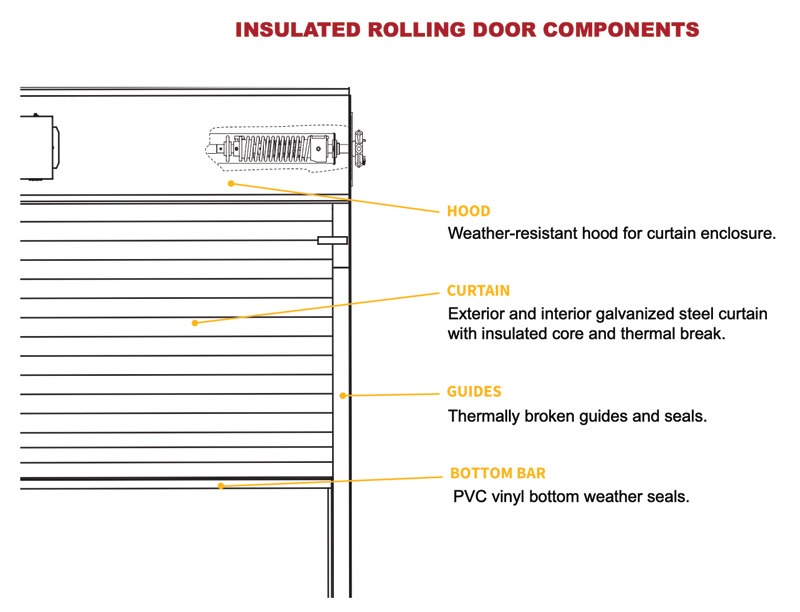
These doors are preferred when space constraints, opening size, or windload requirements demand a compact, vertically coiling system. In multi-story facilities, insulated rolling doors are often installed in upper-story loading bays, service entrances, and equipment transfer points where overhead space is limited. These locations demand a balance of durability, seamless operation, and environmental control. Insulated rolling door advantages that speak to the needs of data centers in this area include:
Compact footprint and operational reliability
Rolling doors preserve interior square footage and clearances by coiling vertically into a relatively small overhead space. They are particularly well-suited for upper-level loading bays and constrained service areas. At the same time, their heavy-duty construction supports reliable operation during demanding usage cycles, including equipment upgrades and infrastructure refresh cycles.
Double-wall insulated curtain construction
The rolling door curtain comprises interlocking steel slats that coil into a compact barrel above the opening. In insulated models, the slats feature a double-wall configuration with insulation between the interior and exterior steel layers. This design adds rigidity and thermal resistance, forming the foundation of the door’s energy performance.
Thermally broken curtain design
Traditional steel slat construction can create conductive pathways; therefore, advanced insulated rolling doors incorporate low-conductivity thermal breaks within the slat assembly. These components interrupt metal-on-metal contact and reduce thermal bridging across the curtain surface while preserving the structural strength necessary for large openings and frequent cycling.
Thermally enhanced guide construction
The vertical guides that anchor and align the rolling door curtain are common sources of conductive heat loss. Enhanced guide designs incorporate thermal breaks in the guide profile to reduce energy transfer at the jambs. When paired with integrated perimeter sealing systems, these thermally broken guides support tighter envelope control at the perimeter.
Engineered perimeter sealing systems
Air leakage through large service openings can undermine interior temperature stability and humidity control, two critical considerations in data center environments. Insulated rolling doors incorporate coordinated sealing along the guides, bottom bar, and hood interface to create continuous compression around the opening. Some models currently available feature independently tested assemblies that can achieve air infiltration rates below 5.48 m³/h·m² (0.3 cfm/ft²), aligning with the performance expectations of ASHRAE 90.1, IECC 2021, and California Title 24.
Insulated hood assemblies
The hood protects the curtain and operating mechanism from exposure to damage and dust. When insulated and properly sealed, it also reduces heat loss at the header, where warm air naturally accumulates, creating more consistent full-assembly performance.
Whole-assembly U-factor performance
An insulated rolling door’s overall assembly—curtain, guides, hood, and perimeter seals—determines how effectively the door limits heat transfer. With a properly coordinated design, some models achieve full-assembly U-factors as low as 0.53 when tested in accordance with DASMA 105. For specifiers, this provides a clearer indication of how the total assembly will perform within the building envelope.
Interior compartmentalization and fire protection
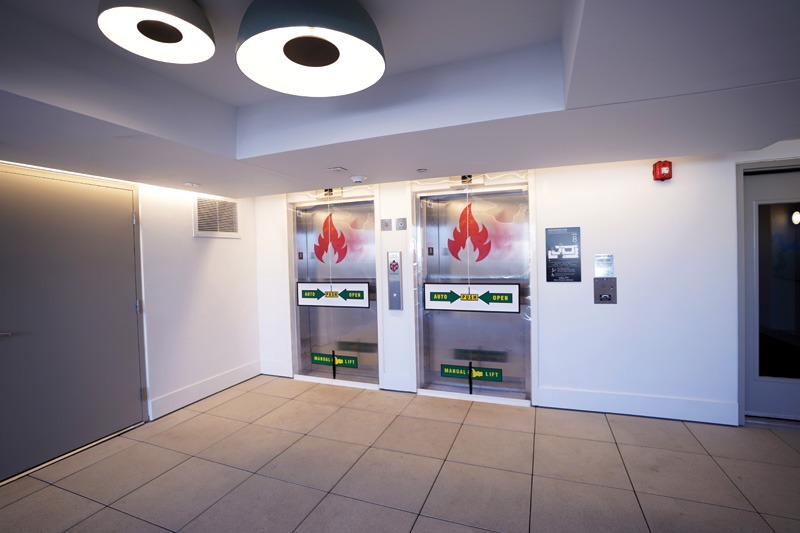
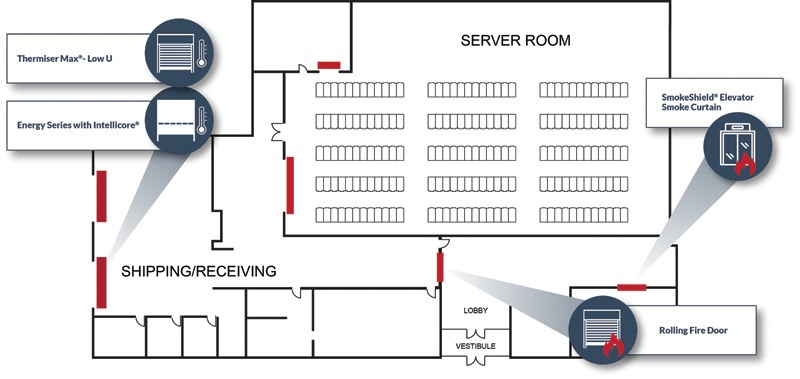
Inside a data center, designers compartmentalize operational activities and establish fire-rated boundaries around areas such as electrical and generator rooms, UPS and battery storage spaces, mechanical and cooling support areas, telecom closets, server corridors, and elevator shafts. In multi-story colocation facilities, these areas are frequently mirrored and stacked from floor to floor. Enterprise data centers may integrate them into the broader context of the occupied building, while hyperscale campuses use repeated patterns of compartmentalization and fire protection to mitigate risks across larger footprints.
Rolling fire doors, fire counter doors, and elevator smoke curtains help define and separate these compartments while preserving the necessary movement and safety of tenants, maintenance personnel, and IT technicians. While different in application, each solution is designed to mitigate the spread of smoke and slow the advance of fire while supporting other day-to-day operational needs.
Rolling fire doors
Rolling fire doors are the primary solution for data hall compartments and tenant suites where large openings require both reliable daily access and fire-rated protection. Advanced designs can integrate with a facility’s primary fire alarm system, allowing them to close automatically when an alarm is triggered or if power is lost. This active integration provides faster response than traditional thermally triggered doors, which rely on heat-sensitive fusible links and may not close until smoke or flames have already reached a damaging level. Specifiers can designate smoke and draft control features tested to Underwriters Laboratories (UL) 1784, Standard for Air Leakage Tests of Door Assemblies and Other Opening Protectives, that help prevent smoke migration into adjacent compartments and protect equipment throughout a facility. Rolling fire doors are available with fire ratings up to four hours, aligning with code requirements and design intent.
Fire counter doors
Fire counter doors are designed for smaller openings, such as storage areas or workrooms, providing the same passive fire protection as larger rolling fire doors in a more compact format. Like their counterparts, these doors can be specified with integrated alarm system connections, enabling automatic closure during fire events or power outages. Advanced motorized operators, including battery-backup designs, allow doors to close reliably even during temporary power loss, then reset automatically once the alarm clears. Fire counter doors combine structural integrity with durability, making them ideal for spaces with frequent access while still meeting UL fire ratings up to three hours. Optional smoke gasketing systems, such as perimeter seals integrated into the door guides, provide additional protection against smoke migration.
Elevator smoke curtains
Elevator smoke curtains protect the hoistway openings of elevators and service shafts that support staff movement, equipment transport, and building services in multi-story data centers. Curtains can also be transparent for visibility during evacuation and emergency response. Deployment can be triggered by fire alarm systems, smoke detectors, manual activation, or power loss, and battery-backed motorized models ensure reliable operation during outages. During an event, the curtain can also be manually raised in emergencies. Available compact profiles occupy minimal headroom, and all installations comply with relevant codes and standards, including International Building Code (IBC), UL 1784, and ICC-ES AC77, Acceptance Criteria for Fire-Resistive Smoke Curtains, ensuring safe and reliable operation without interfering with vertical circulation.
Aligning priorities without sacrificing door performance
From exterior loading docks and equipment bays to interior compartmentalization and fire safety, the right commercial door system must go beyond basic functionality to deliver on all five performance requirements: thermal and air control, durability, security, fire and smoke protection, and building system integration. By evaluating common data center layouts and recognizing shared requirements, specifiers can readily identify the advanced door systems that support the facility’s mission-critical objectives.
Key Takeaways
Data center door systems must deliver on five core performance requirements: thermal and air control, durability, security, fire and smoke protection, and building system integration. At exterior openings, insulated sectional and rolling doors address thermal resistance, air-sealing, and high-cycle durability. At interior boundaries, fire-rated rolling doors, counter doors, and elevator smoke curtains contain risk. Specified correctly, these systems safeguard sensitive equipment, protect occupants, and keep mission-critical operations running without interruption.
Author

Heather Bender leverages 17 years of experience in manufacturing and building materials as the director of commercial product marketing at Clopay Corporation. Excelling in product management, she handles product inception to commercialization. Her role involves finding unique solutions for building owners and designers, highlighting her strategic and innovative approach to complex industry challenges. She can be contacted at hbender@clopay.com.
Sign up for our weekly newsletter
Architectural materials and methods delivered right to your inbox

- CSI News & Notes: CSI’s impact earns official recognition; celebrate leaders, mentors, and innovators; and more
- CSI News and Notes: CSI spring certification exams open; scholarships available; and more
- CSI News & Notes: CSI MSR heading to San Diego; spring certification exams open; and more
- To Be Specific: Why CDT Should Be Your First Move
- CSI News & Notes: CSI Fellows share member benefits; and a New Year’s Resolution to keep
Products

Read the Latest Issue