
Historic building in Boston gets all-electric retrofit

CambridgeSeven has completed a five-year renovation of 26 Court St., Boston’s oldest continuously city-owned property. The retrofit converts the 16.26 m2 (175,000 sf), 11-story building into an all-electric, fossil fuel-free municipal workplace.
The city has owned the property since 1635. The current building dates to 1912 and was designed by Edward T. P. Graham as the City Hall Annex. It later housed the Boston School Department.
CambridgeSeven preserved 89 percent of the original limestone, brick, and cast stone structure while modernizing the building’s systems. The project followed National Park Service (NPS) guidelines and restored the Neoclassical Revival facade, including its cornices and stone ornamentation.
The team replaced the original windows with high-performance glazing and installed new insulation and mechanical systems. A new transformer vault replaced infrastructure associated with the building’s former coal-fired boilers.
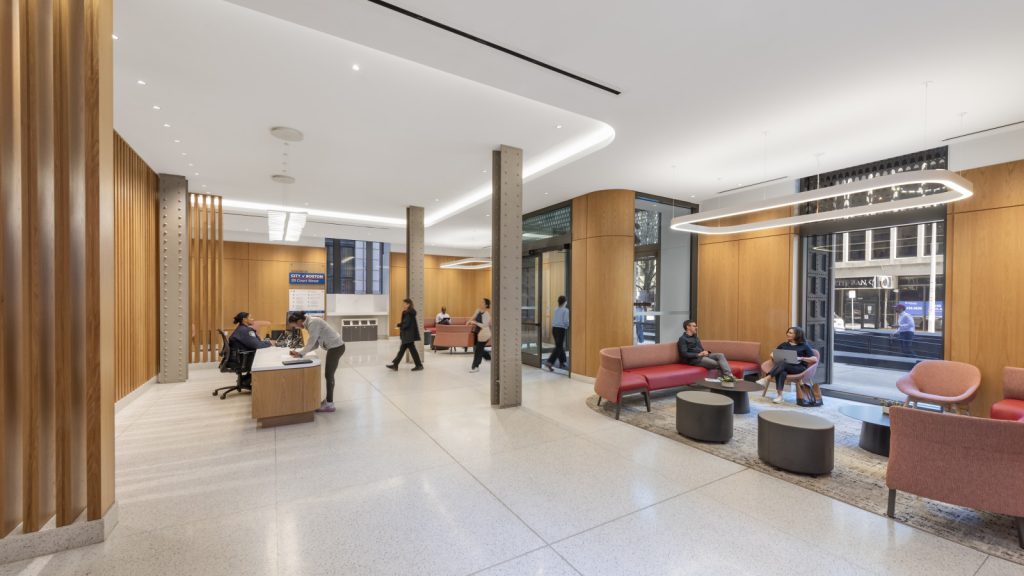
The renovation also redesigned the lobby and office floors. Designers exposed original riveted steel columns and added durable wood accents and terrazzo flooring. The ground floor now includes public spaces such as a gallery corridor, a public bid room, and a public meeting room.
Outside, the team widened the sidewalk to create a universally accessible plaza with EV charging stations, bike racks, flagpoles, historic granite slabs, and accessible ramps.
The project is on track for LEED Platinum certification. CambridgeSeven said the adaptive reuse reduced embodied carbon emissions by 70 percent compared with new construction.
Building Conservation Associates served as the preservation consultant. Stefanie Greenfield, a CambridgeSeven principal, led the project’s design effort.
Sign up for our weekly newsletter
Architectural materials and methods delivered right to your inbox

- CSI News & Notes: CSI’s impact earns official recognition; celebrate leaders, mentors, and innovators; and more
- CSI News and Notes: CSI spring certification exams open; scholarships available; and more
- CSI News & Notes: CSI MSR heading to San Diego; spring certification exams open; and more
- To Be Specific: Why CDT Should Be Your First Move
- CSI News & Notes: CSI Fellows share member benefits; and a New Year’s Resolution to keep
Popular Articles
-
1
-
2
-
3
-
4
-
5
Read the Latest Issue