Building community-wide fire resilience with concrete
In the aftermath of the 2025 Eaton and Palisades wildfires, California has a pivotal opportunity to redefine fire resilience, not just for single-family homes, but for the full spectrum of community structures. Construction specifiers can prioritize selecting fire-resistant products and materials, including concrete systems, which offer a proven, cost-effective path to holistic resilience and support density, affordability, and sustainability.
A new era of wildfire risk
In California and in communities around the nation, Americans are living in a new era of wildfire risk. Most dramatic recent examples are the Los Angeles-area Palisades and Eaton fires, which destroyed more than 16,000 structures in January 2025 and prompted projected insurance payouts of $35 to $45 billion. These incidents are hardly isolated in an era when extreme weather is increasingly the norm.1
In the aftermath of the Palisades and Eaton fires, most of the rebuilding discussion has focused on single-family homes. But while the loss of homes is deeply personal, commercial, multifamily, mixed-use buildings, and other infrastructure are also critical to the fabric and recovery of communities. People need schools, places to work, worship, shop, and gather. The destruction of those fires not only destroyed people’s homes—it disrupted schools, workplaces, healthcare facilities, retail centers, and essential services. This type of infrastructure accounted for 28 percent of structures lost in the blazes, and they must also be rebuilt with resiliency in mind. If the same level of care and foresight is not applied, it risks repeating the same disasters again.2
Community-wide fire resilience is not just about protecting individual homes; it is about ensuring the continuity of entire neighborhoods, economies, and social networks. Care must be taken to ensure buildings and their contents do not add additional fuel to these ravaging firestorms.
As the Greater Los Angeles Area continues to rebuild more than a year after the fires, California Senate Resolution 61 and recent executive orders explicitly support rebuilding with more resilient materials, recognizing the long-term benefits for communities.3 The imperative is clear: fire resilience must extend beyond the home, encompassing every building type that sustains community life.
As building codes evolve and communities rebuild, specifiers play a role in ensuring resiliency. The design and material choices made today affect the affordability, sustainability, and resiliency of projects in areas affected by disasters such as the Palisades and Eaton fires.
The technical benefits of concrete-based systems
Southern California’s residential landscape and other structures have historically been built with wood-frame and stucco construction, which are more vulnerable to wildfires. In recent years, the regulatory landscape has evolved toward stronger fire-resilience requirements, often through local overlays onto the California Building Code (CBC).4
These regulations prioritize fire-resilient construction by addressing materials, including roofing and exterior walls, vents and eaves, and defensible space and vegetation management, to ensure the use of noncombustible or ignition-resistant materials.5 Since cement and concrete masonry are classified as noncombustible materials under both the CBC and International Building Code (IBC), they are foundational for fire resilience. Rebuilding in the wake of the 2025 fires presents an opportunity to reconsider large-scale choices of building materials.
But as many rebuilding experts point out, while regulation updates are significant for improving future resiliency, minimum compliance should not be the goal. In many ways, the most dangerous buildings constructed are those that meet minimum code requirements, which often reflect the same construction practices that did not survive intense fire events.
“It’s a habit, people build with wood because that’s how it’s always been done,” says Kit Miyamoto, CEO of Miyamoto International, a global structural engineering and disaster risk reduction organization. “For single-family homes especially, cast-in-place concrete or panelized systems just are not part of the cultural norm, even though they perform better and, in many cases, don’t cost significantly more.”6
Concrete solutions not only meet but exceed code requirements for fire-resilience. The thermal mass of concrete delays heat transmission, protecting structural integrity and providing critical time for evacuation and fire response.7 For example, concrete masonry walls (e.g. 203 mm [8 in.] solid CMU) can achieve up to four-hour fire resistance ratings per American Concrete Institute (ACI) 216.1/TMS 216, Code Requirements for Determining Fire Resistance of Concrete and Masonry Construction Assemblies and ASTM E119, Standard Test Methods for Fire Tests of Building Construction and Materials.8,9
Resilience is the obvious benefit of building with concrete, but long-term sustainability should not be overlooked. The use of concrete in rebuilding supports density to enable taller, slimmer structures, mitigates embodied carbon, and offers compatibility with green certifications and sustainability requirements.10 Properly reinforced concrete buildings perform well during earthquakes and seismic events and require far less intervention over time.11
The sustainability and financial case for resilience investments
Increasingly, architects are taking a longer view of sustainability, particularly in high-fire risk areas such as Southern California. One such architect, Janek Dombrowa of JTD Architects, is supporting a community rebuilding project in Malibu’s Sunset Mesa that prioritizes concrete construction.
“There is also what I call ‘survival sustainability.’ It is not sustainable for places like Malibu to rebuild every five years after fires,” says Dombrowa. “If you assume a 30-year mortgage, you should not be rebuilding the same home two or three times during that period.”12
Dombrow adds that while concrete has historically suffered from misperceptions about affordability, concrete systems are not inherently more expensive than traditional materials such as wood framing, especially when reduced delays, increased durability, and insurance implications are considered.13 He also notes concrete is often produced locally, further reducing transportation and supply chain costs.14
“The longer reconstruction takes, the more expensive it becomes, and the harder it is for people and businesses to return,” Miyamoto adds. “Many residents desperately want to come back to places like Altadena or Topanga [communities impacted by the 2025 fires] because of the strong cultural and community ties. If rebuilding is delayed too long, those ties begin to unravel.”15
Recent testimonials from homeowners rebuilding with concrete systems have highlighted both the simplicity and speed of construction.
Each dollar not invested in disaster resilience today could cost up to $33 in lost future economic activity.16 Investing in resilient construction is not just a safety imperative; it is a cost-effective strategy for communities rebuilding or preparing for natural disasters. Concrete construction allows specifiers to build back more resiliently and more affordably, without sacrificing one for the other.
Multifamily case studies
The Continental (San Diego)
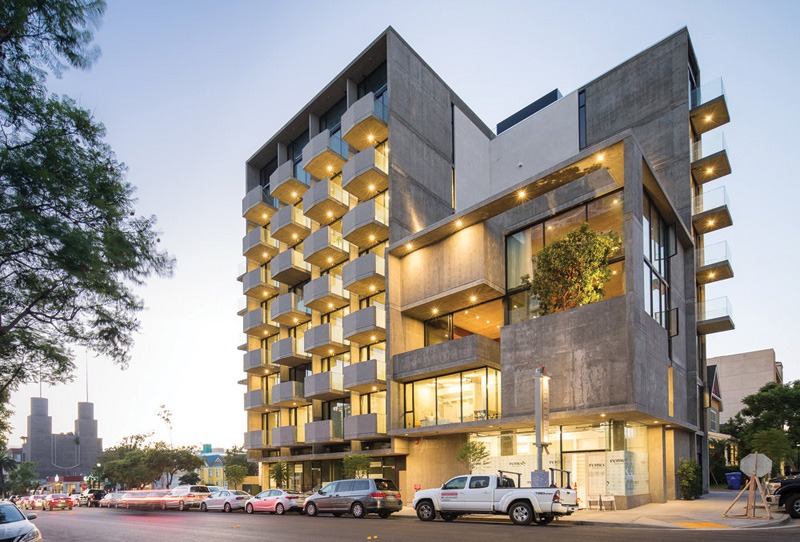
In San Diego’s Little Italy neighborhood, The Continental demonstrates what affordable, fire-resilient construction can look like in practice. This mixed-use development, named “Project of the Year” by Builder’s Choice & Custom Home Design Awards, comprises 42 studio units averaging roughly 35 m2 (377 sf) across 2,508 m2 (26,996 sf), offering workforce housing priced below competing properties in the area.
The project’s post-tensioned concrete structure simultaneously delivers on multiple priorities. In an earthquake-prone area, post-tensioning lightens the building, improving lateral stability and reducing foundation demands, which is less likely with wood or steel.17 The structure provides inherent fire resistance and durability with minimal long-term maintenance, lifecycle advantages that benefit both the developer and tenants.
Florida Street Affordable Family Housing (San Francisco)
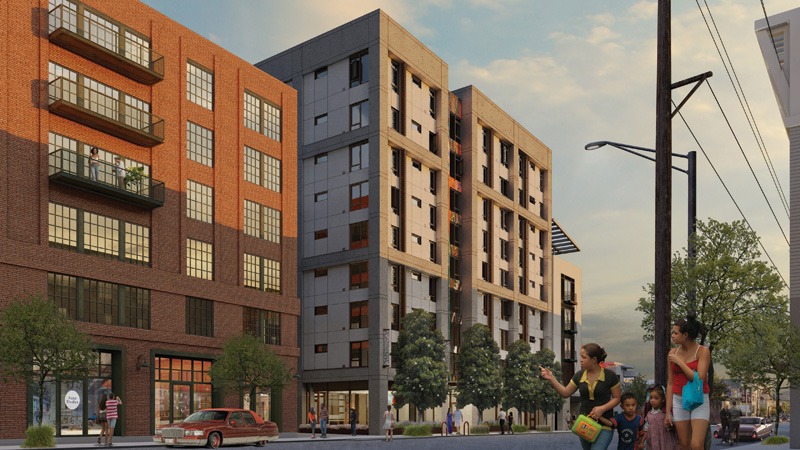
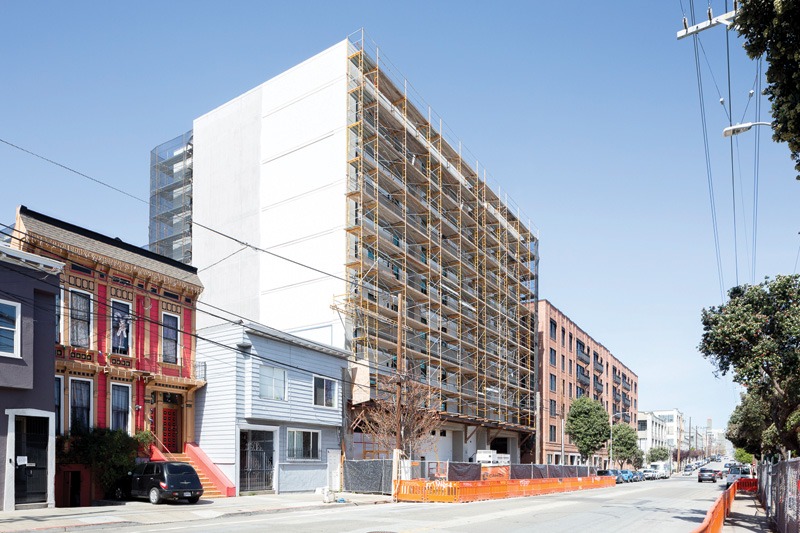
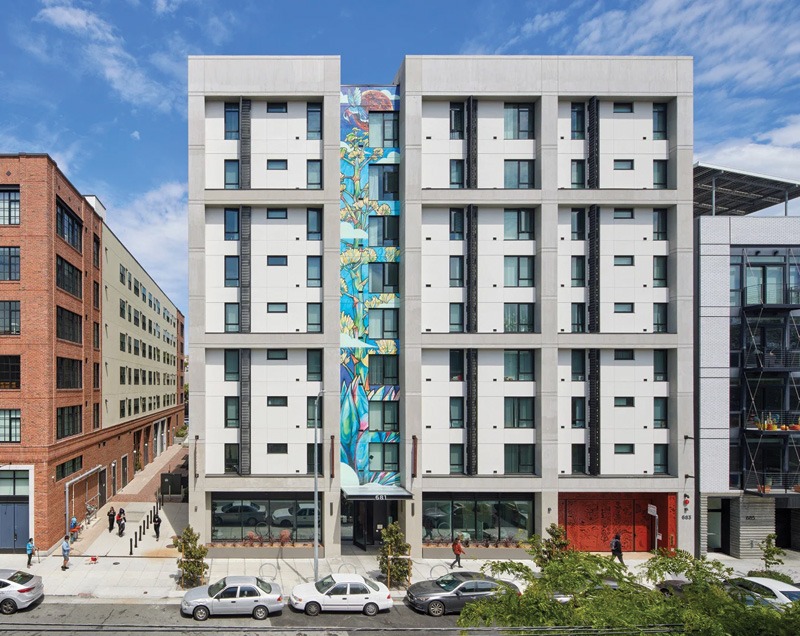
In the heart of San Francisco, the 681 Florida Street Affordable Family Housing project demonstrates how concrete construction can simultaneously advance resilience, affordability, and sustainability. The nine-story development provides 130 units for low-income families and has earned recognition as a new benchmark for affordable housing in the Bay Area. The project highlights that concrete construction simultaneously advances California’s building priorities of resilience, affordability, and urban density. The project also achieved a 36 percent reduction in concrete’s embodied carbon by strategically optimizing the use of Supplementary Cementitious Materials (SCMs).
The project’s post-tensioned concrete structure achieved its cost and design goals. Slim 203-mm (8-in.) post-tensioned floor slabs allowed the building to be under 23 m (75 ft), avoiding the costly high-rise classification that would have significantly increased project costs. This awareness of density, a significant consideration for multistory structures in fire-prone areas, allowed the project to maximize residential space while remaining cost-efficient. Other structural systems would not have achieved this level of cost efficiency, critical for affordable housing projects, where minimizing the cost per unit is essential to market competition.
Equally notable is the project’s sustainability performance. Achieving a 36 percent reduction in the embodied carbon of the concrete and a 23 percent reduction overall, the building operates without fossil fuels and meets the 2030 Challenge energy use intensity standards. It has earned Platinum GreenPoint Rated certification, Fitwel certification, and recognition under the International Living Future Institute’s (Living Future) Living Building Challenge.18
Fire-resilient concrete techniques for single-family construction
The fire-resilient construction techniques discussed in this article are also pertinent to single-family homes, which account for
70 percent of the losses in last year’s Palisades and Eaton fires.19 Incorporating fire-resistant concrete systems into single-family homes offers a transformative opportunity to rebuild for long-term safety, durability, and sustainability.
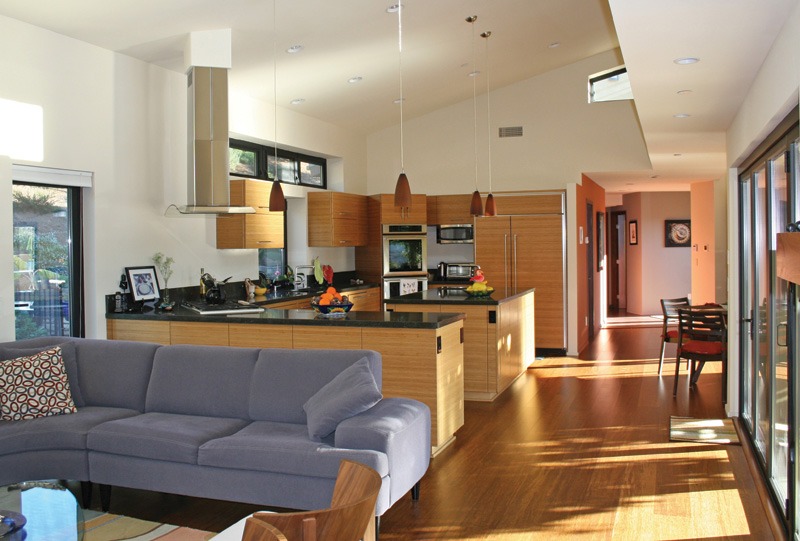
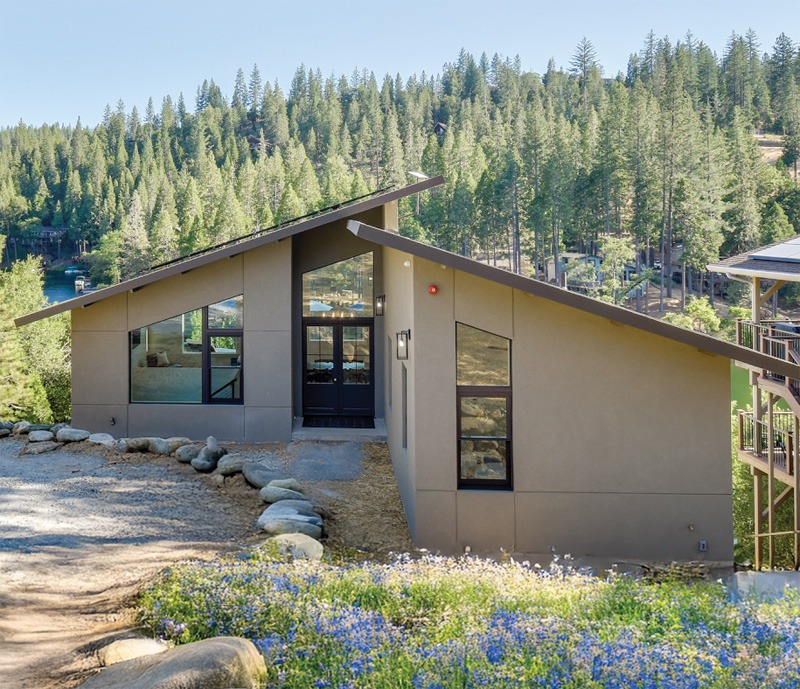
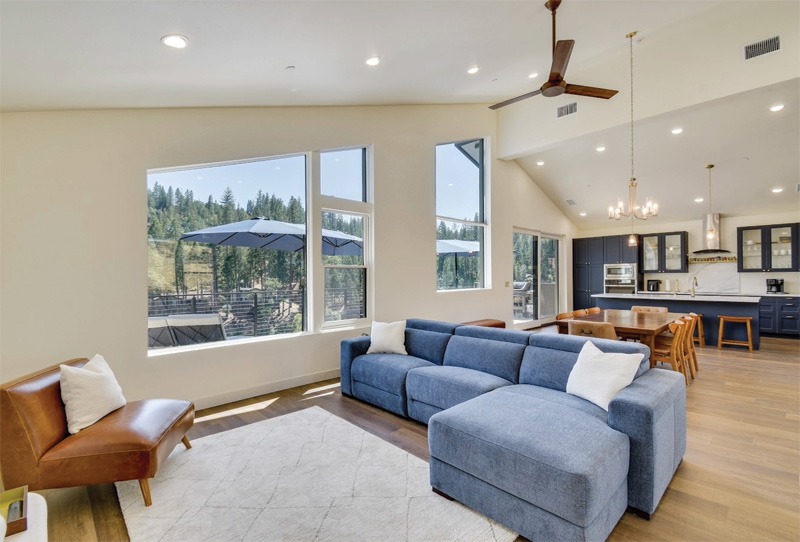
Concrete systems such as insulated concrete forms (ICFs) and insulated composite concrete forms (ICCFs) are ideal for single-family homes in wildfire-prone areas. Unlike traditional wood-frame construction, which ignites quickly under wildfire exposure, concrete’s non-combustible properties allow it to withstand temperatures of up to 1,200 C (2,192 F) without structural failure.
To achieve comprehensive fire resilience, single-family homes must be designed as systems. This includes fire-rated windows and doors, ember-resistant vents, roofing materials, and enclosed soffits, which prevent ember intrusion—a leading cause of home ignitions during wildfires. According to Brian Kite, managing principal, SRK Architects Inc., combining passive fire resistance with active measures, such as exterior sprinkler systems and localized water storage, can further enhance protection.20
By adopting these strategies, single-family homes can withstand future wildfires and serve as models for sustainable, disaster-resilient construction in California and beyond.
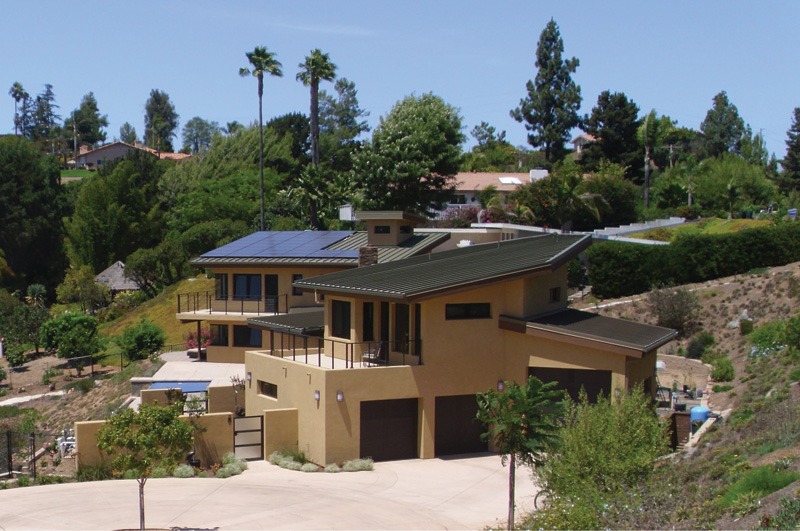
to stricter codes. Photo courtesy Hubbell & Hubbell Architects
Practical guidance for construction specifiers
For specifiers working in wildfire-prone regions, achieving meaningful fire resilience requires deliberate decisions across three areas: the material specifications and code benchmarks that define a project’s fire-performance floor, the structural systems that deliver noncombustible performance, and the design and construction process choices ensuring resilience does not come at the expense of affordability or sustainability.
Material specifications and codes
- Specify noncombustible/ignition-resistant exterior walls, Class A roofing, ember-resistant vents, and defensible space in Wildland Urban Interface (WUI) zones.21
- Move beyond minimum code, specify two-hour fire-rated assemblies in severe fire hazard zones.
- Address all components, including walls, windows, roofs, vents, eaves, and soffits, for comprehensive protection.22
System selection
- Consider wall systems such as ICFs, concrete masonry, ICCFs, and precast sandwich panels for superior fire resistance, speed, and cost-competitiveness with wood framing.
- Select concrete systems based on project needs, leveraging concrete’s design flexibility and performance.
Design and construction process
- Engage builders and designers early to optimize cost, sustainability, and resilience.
- Evaluate the total cost of ownership, not just the initial cost, accounting for maintenance, insurance, and avoided reconstruction.23
- Integrate both passive (fire-resistant assemblies) and active (suppression and automation) systems.24
The specifier’s moment to lead
From 2010 to 2020, the number of structures lost to wildfires in the western U.S. increased by 246 percent.25 The trends that led to the destructive Palisades and Eaton fires will continue to increase, making resilient building even more urgent.
Today, California stands at a crossroads. Updated Fire Hazard Severity Zone (FHSZ) maps now subject an additional 566,560 ha (1.4 million acres) to stricter codes, and future code cycles are likely to expand WUI-level requirements even further.26 Increasingly, insurance markets are factoring resilience into premiums and coverage.
Against this backdrop of climate realities and housing needs, this is a unique moment to shift from code compliance to genuine resilience. It is time for construction specifiers to embrace the responsibility and opportunity to help shape communities that are not only fire-resistant but also affordable, sustainable, and enduring.
Notes
1 Portland Cement Association, “Impact of the California Wildfires on Cement Consumption” (Skokie, IL: Portland Cement Association,
April 2025).
2 Portland Cement Association, “Impact of the California Wildfires on Cement Consumption.”
3 California State Senate, Senate Resolution 61, September 2024.
4 Brian Kite (managing principal, SRK Architects Inc.), interview, 2026.
5 California Building Standards Commission, California Building Code, Title 24, Part 2, Chapter 7 A: Materials
and Construction Methods for Exterior Wildfire Exposure (Sacramento, CA: 2025).
6 Kit Miyamoto (CEO, Miyamoto International),
interview, 2026.
7 Portland Cement Association, “Impact of the California Wildfires on Cement Consumption.”
8 American Concrete Institute and The Masonry Society, ACI 216.1/TMS 216: Code Requirements for Determining Fire Resistance of Concrete and Masonry Construction Assemblies (Farmington Hills, MI: ACI; Longmont, CO: TMS, 2014).
9 ASTM International, ASTM E119: Standard Test Methods for Fire Tests of Building Construction and Materials (West Conshohocken, PA: ASTM International, 2020).
10 National Ready Mixed Concrete Association, “681 Florida Street Affordable Family Housing,” Build with Strength case study (Silver Spring, MD: NRMCA, 2024).
11 Janek Dombrowa (owner and principal, JTD Architects),
interview, 2026.
12 Dombrowa, interview.
13 Dombrowa, interview.
14 Dombrowa, interview.
15 Miyamoto, interview.
16 U.S. Chamber of Commerce Foundation, Beyond the Payoff: How Investments in Resilience and Disaster Preparedness Protect Communities (Washington, DC: U.S. Chamber of Commerce Foundation, 2025).
17 National Ready Mixed Concrete Association, “The Continental,” Build with Strength case study (Silver Spring, MD: NRMCA, 2022).
18 National Ready Mixed Concrete Association, “681 Florida Street Affordable Family Housing.”
19 California Nevada Cement Association, Impact of the California Wildfires on Cement Consumption. April 2025.
20 Kite, interview.
21 California Building Standards Commission, California Building Code, Chapter 7A.
22 Kite, interview.
23 Dombrowa, interview.
24 Kite, interview.
25 Alexandra D. Syphard et al., “Increasing Structure Losses from Wildfires in the Western United States,” Proceedings of the National Academy of Sciences 117, no. 2 (2020): 911–917.
26 CAL FIRE, “Fire Hazard Severity Zone Maps and Home Hardening Initiatives” (Sacramento, CA: CAL FIRE, 2025).
Author

Tom Tietz is the executive director for the California Nevada Cement Association (CNCA),
a not-for-profit organization committed to developing sustainable and economical construction solutions for California and Nevada with an emphasis on the use of cement and concrete. He is involved in and oversees CNCA’s regulatory and legislative efforts focused on infrastructure and the environment. Tietz is also actively engaged in the association’s mission to be an established technical resource in the region. For more information, visit www.cncement.org.
Key Takeaways
Following devastating wildfires like the 2025 Palisades and Eaton fires, construction specifiers are shifting toward non-combustible concrete systems to protect entire communities. Concrete provides a cost-effective, durable solution for multifamily and commercial structures that balance fire resilience with sustainability, density, and significant insurance savings.
Sign up for our weekly newsletter
Architectural materials and methods delivered right to your inbox

- CSI News & Notes: CSI’s impact earns official recognition; celebrate leaders, mentors, and innovators; and more
- CSI News and Notes: CSI spring certification exams open; scholarships available; and more
- CSI News & Notes: CSI MSR heading to San Diego; spring certification exams open; and more
- To Be Specific: Why CDT Should Be Your First Move
- CSI News & Notes: CSI Fellows share member benefits; and a New Year’s Resolution to keep
Products

Read the Latest Issue