Building enclosure commissioning: Defining and specifying an effective BECx scope

Many building enclosure failures begin with small issues or coordination gaps during design or construction that go unnoticed and undermine long-term building performance. Identifying enclosure issues early in the design and construction process reduces complications and cost compared to addressing problems after concealed conditions begin to affect building systems and occupants. Complex building enclosure assemblies and material transitions require careful design, precise construction, and coordination among multiple trades and manufacturers. An expert third party to review and verify performance goals in each project phase can help mitigate risk and maintain the owner’s quality and performance expectations. Without this oversight, project teams may overlook issues in enclosure design, installation, and material interfaces that escalate into more significant problems.
Building enclosure commissioning (BECx) provides a structured, third-party quality assurance and risk management process verifying that the design, installation, and performance of enclosure systems meet the owner’s project requirements throughout the project. Although not a new concept, the formal BECx process has evolved significantly in the past two decades. What began in the shadow of the mechanical commissioning process has developed into its own segment of the building industry, shaped by expanding energy codes, sustainability programs, and industry guidelines. Despite this growth, many project teams still struggle to clearly define the BECx scope in their specifications. Unclear documentation leads to inconsistent implementation, gaps in responsibility, confusion around enclosure testing, and unrealized owner expectations.
History of industry guidelines
The complexity of building enclosure systems, more stringent energy code requirements, and owner expectations for durability and lifecycle cost have driven the need for a systematic approach to enclosure design, installation, and verification. The energy crisis of the 1970s prompted the building industry to reconsider its approach to energy efficiency, leading to BEPCx and a more structured approach to HVAC commissioning. The first industry commissioning standard was created by the American Society of Heating, Refrigerating, and Air-Conditioning Engineers (ASHRAE) with the ASHRAE Guideline 1-1989, Guideline for Commissioning of HVAC Systems. This introduced a systematic approach to verifying the testing and performance of mechanical systems as an energy-efficiency measure.
The industry has since refined and expanded this framework beyond HVAC to define a broader commissioning process (Cx) applicable to all building systems, as outlined in ASHRAE Guideline 0-2004, The Commissioning Process. This guideline influenced the development of commissioning practices for building enclosures. It led the National Institute of Building Sciences (NIBS) to publish Guideline 3-2006, Exterior Enclosure Technical Requirements for the Commissioning Process. While NIBS Guideline 3 established a comprehensive process, the industry sought clearer minimum performance requirements to support consistent application across projects. This need led to the current industry standard, ASTM E2813, Standard Practice for Building Enclosure Commissioning, and the accompanying ASTM E2947-21a, Standard Guide for Building Enclosure Commissioning. ASTM E2813 defines minimum requirements for fundamental and enhanced levels of BECx on a project, while ASTM E2947-21a provides detailed procedural guidance for implementation.
LEED
BECx gained traction over the past two decades, driven in part by the LEED sustainability certification program. LEED has consistently aimed to transform sustainability goals into standard industry practice by increasing baseline performance requirements with each version. LEED v3 (2009) first recognized BECx by allowing project teams to earn Innovation in Design (IDc1) credits for envelope commissioning.
In LEED v4 (2013) and v4.1 (2018), the program expanded commissioning requirements to include building enclosure commissioning within the Energy and Atmosphere (EA) Prerequisite for Fundamental Commissioning and the Enhanced Commissioning credit, which included an option for envelope commissioning. This shift reflected growing industry interest in BECx; however, the LEED v4 Reference Guide generally reflected a limited scope and retained terminology from mechanical commissioning that does not fully apply to enclosure systems, such as seasonal testing. LEED referenced ASHRAE Guideline 0, NIBS Guideline 3, and later ASTM E2947 (added in v4.1) for additional guidance, but provided limited direction on how to define the project-specific scope of BECx.
In LEED v5 (2025), the scope of both fundamental and enhanced commissioning has expanded significantly. Fundamental commissioning, a prerequisite for all enhanced commissioning options, now requires increased construction-phase oversight, including submittal reviews, QA/QC checklist tracking, participation in milestone meetings, and observation of testing. It also requires compliance with ANSI/ASHRAE/IES Standard 90.1 commissioning requirements rather than referencing them as guidance. The Enhanced Commissioning credit for building enclosures (1 point) requires compliance with ASTM E2947-21a and specific field-testing procedures, significantly increasing the scope of BECx services from LEED v4.1. By expanding commissioning requirements again in LEED v5, the program continues to drive higher expectations for enclosure performance and influence the evolution of industry practice.
Energy code
The 2021 and 2024 editions of the International Energy Conservation Code (IECC), ASHRAE 90.1 (2016 through 2024), and many state and local energy codes include requirements for performance testing and enclosure verification. Air barrier compliance provisions now require whole-building air leakage testing in some jurisdictions, with alternative compliance paths that include enclosure design review, installation verification, and final commissioning documentation. These requirements function as an abbreviated form of BECx, closely mirroring key steps in the commissioning process and signaling a broader shift toward performance verification of building enclosures.
Defining an effective BECx scope
Project initiation phase
While industry standards and guidelines have established a framework for building enclosure commissioning, they do not define a one-size-fits-all scope for every project. Project teams must interpret these requirements and translate them into a project-specific BECx scope that aligns with the owner’s goals, budget, and schedule. This process often begins during project initiation, where the content of proposal requests and provider qualifications can significantly influence the effectiveness of the BECx process.
RFPs and RFQs
The owner or the architect typically defines the BECx scope of work in a request for proposal (RFP) before engaging a building enclosure commissioning provider. However, they may not fully understand the nuances of the specific tasks, the needs of the building type or complexity, or the implications of certain scope items on the budget or schedule. Even when relying on current sustainability standards and commissioning guidelines, project teams may select a scope that exceeds the project’s needs or unintentionally limits the BECx process from delivering the intended value.
As a result, some owners issue requests for qualifications (RFQs) without a defined commissioning scope during the early planning stages of a project, often before predesign begins. This approach allows the BECxP to join the project team early, provide input on enclosure performance goals, and develop a project-specific commissioning scope that aligns with the owner’s objectives. Early collaboration also helps establish realistic expectations for scope, cost, and schedule, improving the overall effectiveness of the BECx process.
The BECxP
Industry guidelines have begun to provide measures for defining the BECxP’s level of experience and the timing of their onboarding to the project. The BECx process is typically conducted by a neutral third-party building enclosure consultant, engineer, or architect specializing in building science with extensive experience in design, construction, testing, performance, and maintenance of roof, exterior wall, fenestration, and waterproofing systems. The ASTM E2947 and E2813 standards detail the BECxP as being trained and experienced in the BECx process and having proficiency in the core competencies of building and material science, procurement and project delivery, contract documents and construction administration, and performance test standards and methodology. LEED v5 additionally requires that the commissioning provider has experience completing commissioning on at least two projects of equal or larger scope and complexity.
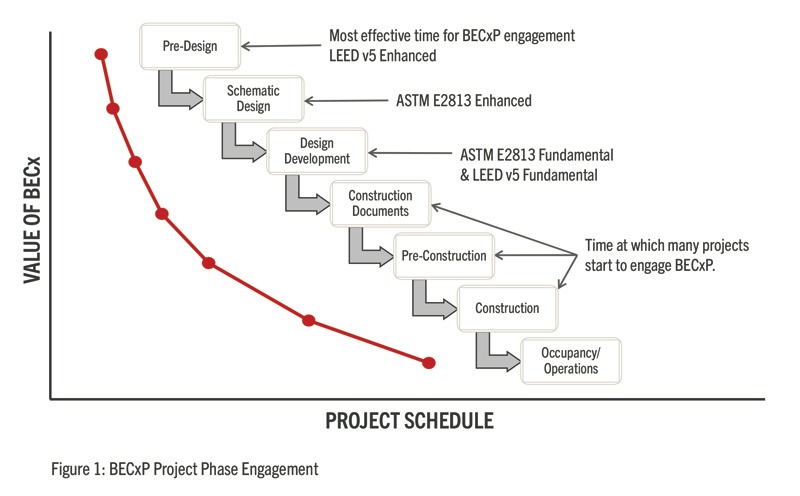
The BECxP is most effective when engaged early in the design phases, allowing the team to define and align enclosure performance goals with the building’s function, size, complexity, and long-term maintenance. Early involvement leads to a more clearly defined BECx scope, integrates commissioning requirements into the contract documents, and supports coordination of the process across all project phases. LEED v5 requires that the owner designate a commissioning provider by the end of design development for fundamental commissioning and by predesign for enhanced commissioning. (See Figure 1)
Design phase
In predesign, the process typically begins with the BECxP conducting a kickoff meeting with the design team and the owner to set expectations, clarify each party’s roles and responsibilities, and review the BECx scope and objectives for each phase. The BECxP creates or reviews the Owner’s Project Requirements (OPR) document, which includes measurable performance standards and long-term resilience factors for the building enclosure systems. This document becomes crucial during the process, as it establishes the baseline for design, installation, and verification requirements at each project phase. However, this document can be fluid and should be updated as the project progresses. Larger institutional building owners sometimes use a standard document as the OPR. In this case, the BECxP would review and make recommendations for changes or additions to the enclosure performance requirements. When the owner lacks a document and does not know how to create one, the BECxP assists the owner in developing the OPR. The BECxP reviews the architect’s basis of design (BOD) narrative against the OPR, creates an initial BECx plan, and develops the BECx specification section.
As the design progresses, the BECxP conducts a peer review of drawings and specifications at each design phase to verify compliance with the OPR’s standards and participates in design meetings. This review can include a design issues log with a back check of comments in subsequent reviews.

BECx specifications versus BECx plan
The BECx specification section is a critical document that defines the commissioning scope and deliverables during construction and occupancy. It establishes roles and responsibilities for project team members, outlines communication protocols, and provides a clear location to define enclosure testing requirements. While the BECx plan often contains similar information, the two documents serve different distinct purposes and follow different development timelines.
The BECx Plan is developed early in the design process and addresses commissioning activities from predesign through post-occupancy. The project team updates this document throughout each phase, and it may not be finalized until project closeout or after the post-occupancy site visit.
In contrast, the BECx specifications are developed during design and finalized in the construction documents. Since the design phase has already occurred, the specifications typically focus on commissioning activities from preconstruction through post-occupancy. They represent the primary location where BECx requirements become part of the contractor’s contractual obligations.
For this reason, the specifications should clearly define enclosure performance goals from the OPR and include detailed enclosure testing requirements. Clear documentation helps contractors understand the scope of work and plan for potential schedule and cost impacts associated with the BECx process.
BECx specification and BECx plan content
Commonalities
- BECx activities, scope, and deliverables
- BECx team roles and responsibilities
- Meetings, communication, and documentation protocol
- Project close-out requirements
Differences
BECx Plan
- Includes design, construction, and occupancy scope requirements
- Living document, updated at each phase
- Finalized at the close-out or post-occupancy of a project
BECx specifications
- Does not include project design scope requirements
- Part of contract documents, updated only minimally
- Finalized in construction documents
- Can contain an outline of the OPR
- Performance testing requirements
BECx specifications
It is recommended to include a dedicated BECx specification section in Division 01, typically Section 01 91 19—Building Enclosure Commissioning Requirements. This approach improves visibility in contract documents and enables clear cross-referencing in related enclosure specification sections. The BECx specification should clearly define performance expectations, scope, deliverables, and responsible parties to reduce coordination issues during construction.
BECx specification content
- Related sections—List all enclosure systems to be commissioned, and each of those sections needs to reference back to the BECx specification section.
- Reference standards—List the BECx industry standards that the project will be following.
- Definitions—Include any terms, roles, and acronyms specific to the BECx process.
- Project contacts—Include project team contacts involved in the BECx scope.
- Enclosure performance requirements—Include an outline or matrix exhibiting each enclosure system with the applicable building code minimum requirements and the project performance requirements.
- Documentation matrix—Include the documentation and deliverables along with who is responsible for creating, receiving, and approving them.
- Meetings—List all anticipated meetings, who is responsible for planning and distributing meeting minutes, and required attendees. These include the BECx construction kickoff meeting, pre-installation meetings, enclosure testing planning meeting, mockup meeting, and construction progress meetings.
- Enclosure testing requirements—List all required enclosure testing of related specification sections in the BECx specification to allow for ease of planning. Include detailed testing information to lessen the number of issues in the field, such as testing protocols for each enclosure system, including industry-standard numbers, test descriptions, test pressures, allowable reductions, and pass/fail criteria. Also include test frequency and location information: at what point in construction, how many tests (per system type, elevation, square footage), and who chooses testing locations (owner, architect).
- Responsibility—Who is performing and paying for the testing, hiring the testing agency, scheduling, and coordinating the testing site requirements (electricity, water, access).
- Repair and retesting procedures—Who is responsible for making repairs, creating a repair procedure, additional test locations after failure, and who pays for retesting and additional test locations.
- Parties to witness testing—Who needs to be present to witness testing, assist with repairs, and troubleshoot (BECxP, architect, installing contractor, general contractor, or manufacturer’s technical representative).
- Type of documentation required—Report from the testing agency, report and issues log from the BECxP, and repair protocol from the installing contractor.
Design phase scope considerations
- OPR—Consider who is responsible for creating the OPR, how it is documented, and what content needs to be included to successfully communicate the depth and breadth of goals to the BECxP and the project team.
- BOD—Consider what the basis of design documentation is (a design narrative or drawings) and what content needs to be included (building system types, assembly information, code, performance, and sustainability requirements for the project).
- Design reviews—Consider how many design reviews and what document sets will be included in the BECxP’s scope, how in-depth the reviews should be, and if comments need to be back checked. Will BECxP be involved in early design decisions, design assistance, or comparisons of enclosure systems?

Construction phase
As the project progresses into preconstruction, the BECxP shifts focus to constructability and design verification by reviewing contractor submittals and shop drawings, in conjunction with the architect, against the OPR and the construction documents. The BECxP should also participate in pre-installation meetings with installing contractors to review constructability, material compatibility, sequencing, QA/QC, and testing procedures for enclosure components. During this phase, the BECxP conducts site visits to observe the installation and testing of the enclosure mockup.
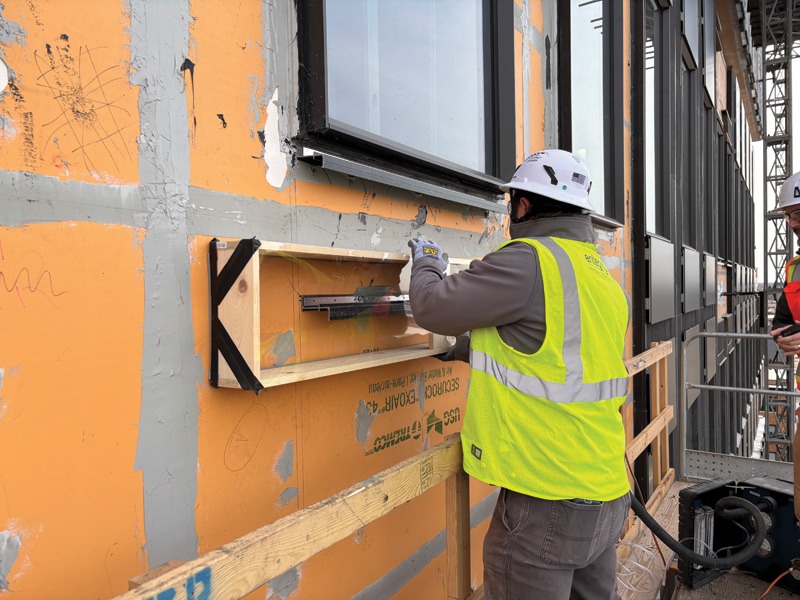
As construction of enclosure systems begins, the BECxP performs site visits to review installation, witness or perform field testing, document deficiencies in an issues log, and verify corrective work with the contractor.
Post-occupancy phase
The BECx process continues beyond construction. Approximately 10 months after occupancy, the BECxP returns for a post-occupancy inspection of the enclosure systems and reviews any ongoing issues with facility staff. The post-occupancy site visit should occur prior to the contractor’s workmanship warranty period (typically one year). The BECxP documents reported or observed deficiencies and develops an issues log for resolution by the contractor before the warranty period expires.
Construction phase scope considerations
- Submittal review—Which systems are to be reviewed, number of revisions included in the review, type of documentation required (PDF markups and/or issues log), order of review protocol (before, after, or concurrent with design team), and comment back check requirements.
- Enclosure mockups and testing—Type of mockup (stand-alone, on-site, lab, in situ), systems included, who needs to review and approve, field testing procedures, and type of documentation required (report and issues log).
- BECxP site visits—Number of site visits, systems to be reviewed, schedule inclusion, site protocols, type of documentation required (report and issues log), and issues back check requirements.
- Enclosure testing—The type of enclosure testing and amount of testing that is needed for the project-specific enclosure systems to verify the installation and meet the owner’s project goals.
Scope variables
The BECx scope can be expanded to include more in-depth design reviews, thermal modeling of detailed conditions, participation in enclosure pre-installation meetings, QA/QC plan reviews, mockup planning, field testing plans, performing enclosure testing, attending regular construction progress meetings, and creating systems training or maintenance plans.
The scope can vary greatly depending on:
- Owner’s project goals—A long-term building owner, such as a university, may care about a low-maintenance, energy-efficient building with low operating costs, resulting in greater involvement in system selection in design, participation in pre-installation QA/QC verification, and additional site visits for oversight.
- Building type—A more sensitive building type, such as a museum or library, may have a low tolerance for water infiltration and condensation, resulting in more in-depth design reviews, hygrothermal modeling of details, and additional field testing to verify performance.
- Building size and shape—A large complex building with many changes in plane may require more oversight and coordination than a small, simple structure.
- Number and complexity of enclosure systems—A building with multiple complex or custom enclosure systems and many material transitions may require more time spent understanding the manufacturer’s installation instructions and compatibility than a building with typical cladding systems.
- Budget—The budget can greatly affect the number and depth of design reviews, submittal reviews, meeting attendance, and field testing.
- Schedule and project delivery methods—Project duration and delivery method can influence BECx scope, objectives, and timing of engagement. For example, design-build projects often require a more proactive, integrated quality assurance approach, with earlier involvement of the BECxP and increased collaboration during design and constructability reviews.
- Project phase—The stage when the BECxP becomes involved can significantly affect the scope and may limit the ability to commission the enclosure fully. Some certification programs also require BECxP involvement at specific project phases to achieve compliance or earn credits. (See Figure 1)
- Sustainability certification or industry standard requirements—Applicable certification programs or industry standards may dictate the BECx scope, required tasks, and level of BECxP involvement.

Verification
The greatest benefit of the commissioning process is verification throughout the project and the accountability that comes with it. The BECxP verifies that the OPR is reflected in the early design phases through installation verification and creates accountability for the project team. Early intervention of design and construction issues can improve:
- Risk mitigation of enclosure failures
- Quality assurance improvement
- Improved energy efficiency, lower operating costs, and improved occupant comfort
- Enhanced durability, lower maintenance, and longer service life of enclosure systems
- Heightened local energy code compliance and sustainability goals
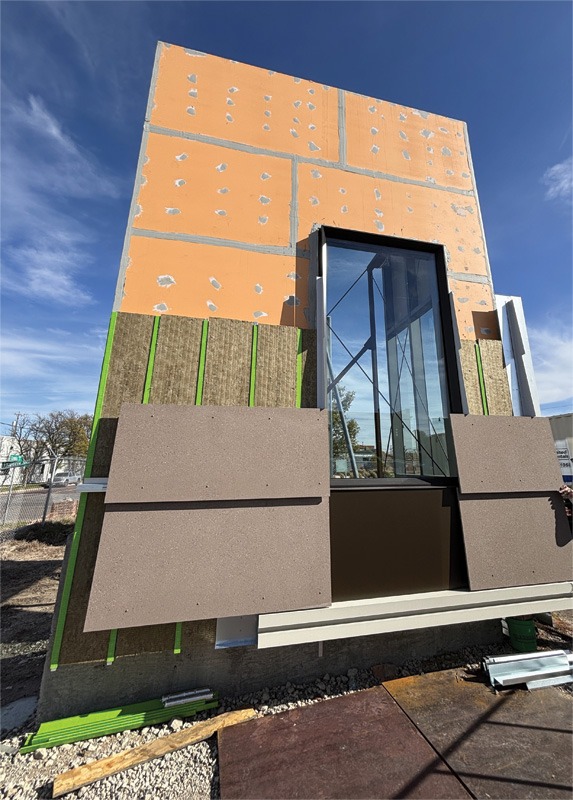
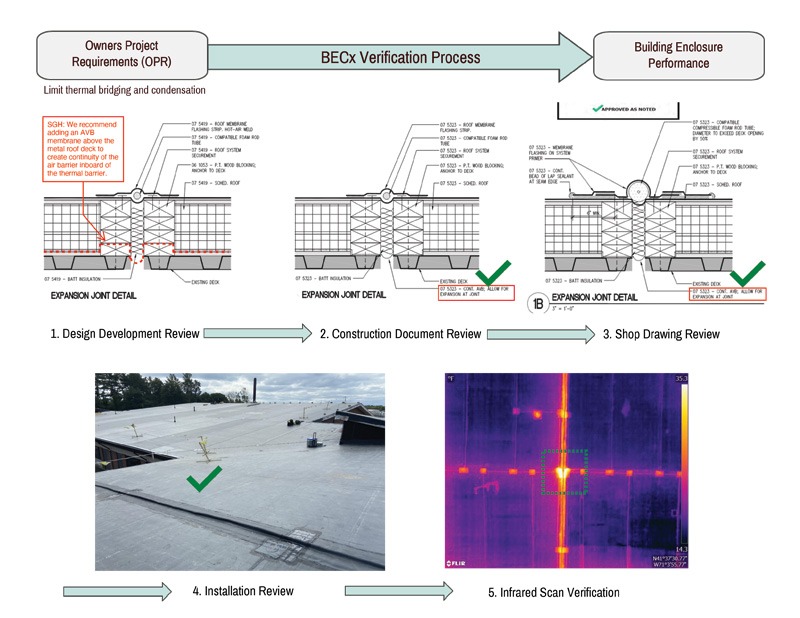
As illustrated in Figure 2, a long-term building owner who commissions their building because they care about a sustainable, low-maintenance building may want to limit thermal bridging and avoid condensation in the enclosure assemblies. This may include measurable performance goals in the OPR, hygrothermal modeling in the design process, and the BECxP reviews the documentation and installation at each phase through this lens:
- The design review would include verifying that the insulation and air/vapor barriers are continuous at transitions and are located appropriately within the assembly to avoid condensation, based on project conditions.
- This would include comments in the design documents and issues log, which would then be back-checked in the construction documents to verify if the recommendations were incorporated.
- The BECxP would then review the contractor’s shop drawings to verify that those elements are incorporated and remain constructable. Ideally, the BECxP would be included in preinstallation meetings to verify that the installing contractors understand the details and how that specific system is installed, that material compatibility has been reviewed, and that there are no sequencing issues that would prevent the assembly from being installed as intended.
- Site visits at initial installation of the roofing system verify if the air barrier and insulation are properly installed or if adjustments need to be made to subsequent installations.
- Verification through testing or infrared scanning can confirm if the installation was successful or help to identify continuity issues before they become a problem for the building owner.
Conclusion
The BECx process helps project teams prevent problems through proactive quality-control activities, such as peer review of design documents and contractor submittals. It also verifies enclosure performance through field testing and mock-up installations. The issues logs, reports, and documentation generated during the BECx process support long-term facility operation and maintenance. By connecting design review, construction oversight, and performance verification, the BECx process helps ensure the building enclosure meets the owner’s objectives and performs as intended throughout the building’s life.
As building enclosure systems grow more complex and energy performance requirements continue to expand, project teams must decide whether they will address enclosure performance proactively during design and construction or respond to failures after the building has been completed.
Considerations for the future of BECx
- Increased energy code airtightness requirements—Energy codes, including 2021 and 2024 IECC and local energy stretch codes, now require whole building air leakage testing or design and construction verification. This will likely push BECx teams to play a larger role in developing testing specifications for code compliance, coordinating air barrier systems, verifying continuity during construction, and preparing projects for air tightness testing.
- Thermal modeling and digital design—Future BECx processes may integrate digital modeling tools earlier in design to identify risks before construction. Hygrothermal modeling tools such as Wärme Und Feuchte Instationär (WUFI) and computational fluid dynamics (CFD), along with thermal bridge modeling tools such as THERM, enable project teams to evaluate potential enclosure performance issues early in the design phase. 3D modeling tools, such as building information modeling (BIM), improve design coordination of enclosure transitions and help construction teams better understand trade sequencing.
- Greater owner and industry awareness of commissioning—Large institutional owners, including healthcare systems, universities, and government agencies, increasingly require BECx in project specifications. Sustainability programs such as LEED and the WELL Building Standard reinforce their importance by incorporating commissioning credits. As adoption grows, BECx continues to shift from a best practice to an industry standard expectation.
- Standardization of BECx guidelines—Industry guidelines from organizations such as ASHRAE, NIBS, and ASTM continue to evolve and will likely drive more consistent BECx scope definitions and documentation requirements.
- Expanded role in long-term performance verification and resilience—Climate events, moisture risks, and durability concerns are driving owners to prioritize long-term building resilience and measurable performance outcomes. BECx will likely play a larger role in verifying water management, thermal continuity, and condensation risk, and may expand to include thermal performance validation, moisture monitoring, and long-term enclosure performance tracking.
Key Takeaways
Building enclosure commissioning (BECx) is a specialized third-party quality assurance process that verifies a building’s shell meets specific performance requirements. By identifying design gaps and installation errors early, BECx mitigates long-term risks associated with water penetration, thermal performance, and moisture management.
Author

Colleen Stuber, AIA, LEED AP, BECxP is a licensed architect and project director at Simpson, Gumpertz & Heger (SGH) with 16 years of experience in design, construction, and building envelope consulting. She draws on her past experience working on the architect’s side, the owner’s side, and in existing building repairs to bolster a specialization in building envelope commissioning (BECx).
Sign up for our weekly newsletter
Architectural materials and methods delivered right to your inbox

- CSI News & Notes: CSI’s impact earns official recognition; celebrate leaders, mentors, and innovators; and more
- CSI News and Notes: CSI spring certification exams open; scholarships available; and more
- CSI News & Notes: CSI MSR heading to San Diego; spring certification exams open; and more
- To Be Specific: Why CDT Should Be Your First Move
- CSI News & Notes: CSI Fellows share member benefits; and a New Year’s Resolution to keep
Products

Read the Latest Issue