Planes, trains, and glass: Using glazing in transit hubs
Despite being intermediate steps into a journey from one place to another, transit hubs, such as airports and metro stations, can drastically shape the first impression a traveler has of their destination. These hubs can also improve the experience with intuitive wayfinding and ample daylighting. Further, the design of these spaces can positively impact the mental well-being of many employees for many of the same reasons.
However, unlike other projects, these built environments are often subject to increased security and traffic control considerations. Additionally, for public transit hubs in densely populated cities, fire- and life-safety code requirements, such as the International Building Code (IBC), National Fire Protection Association’s (NFPA) Life Safety Code NFPA 101, and other local safety codes, may also influence the type of glass used in a project.
While there are several functional benefits from the extensive use of transparent glass in airports, train stations, and metro stops, advanced glazing assemblies also create aesthetically pleasing environments, elevating the experience of the thousands of visitors they serve every day.
More specifically, glass curtain walls can transform these high-traffic public spaces into light-filled, visually engaging, and passenger-friendly environments. Oklahoma City’s Will Rogers World Airport and New York City’s Fulton Transit Center offer prime examples of how both the glass and the framing components work together to marry form and function in transit hubs.
Airport uses transparent glazing throughout
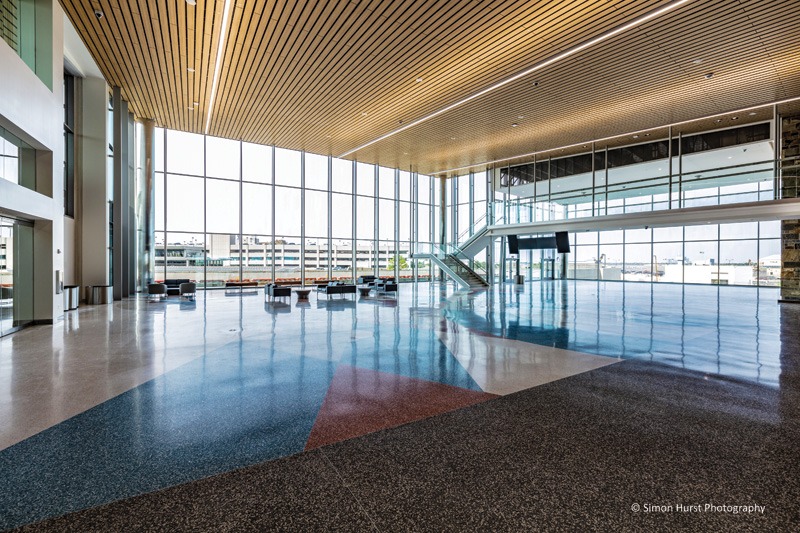
In 2021, Will Rogers World Airport officials sought to improve security checkpoints, create several new retail experiences, and enhance the airport’s visual appeal by expanding its east concourse. Central to many of these goals were three massive glass curtain walls spanning heights of more than 10.1 m (33 ft). These four-sided, structurally glazed curtain wall assemblies were specified along the facade and within the building. They allow intuitive, secure movement from passenger drop-off areas to the gates while facilitating a flat, monolithic, and continuous glass appearance.
They also allow substantial daylight to stream into the airport through their wide expanses of uninterrupted glass, with some lights measuring more than 2.1 m (7 ft) wide and nearly 3.6 m (12 ft) tall.
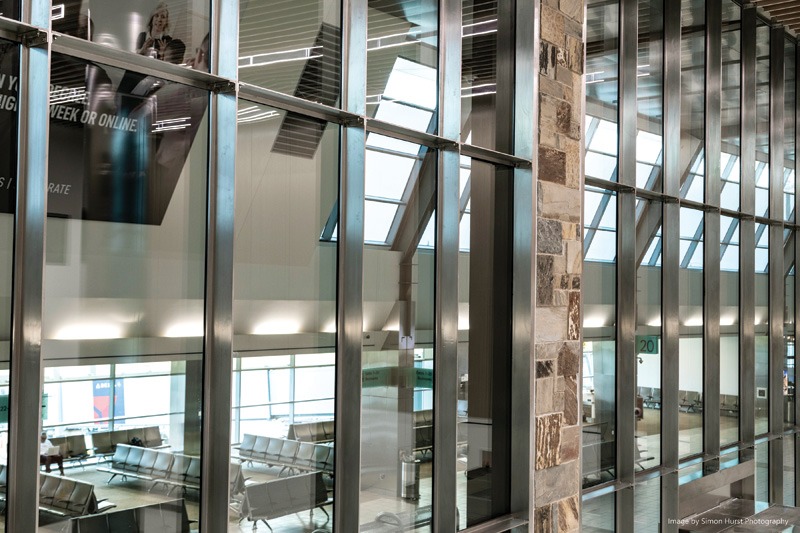
In addition to its size, the exterior curtain wall incorporates a unique concave bow that follows the terminal’s profile and drops below the interior floor line, giving it the appearance of floating. The exterior curtain wall system leverages a stainless-steel frame anchored to another steel system that is a part of the building’s structure. Both aspects of the curtain wall allow it to scale its impressive height and width without increasing mullion density. Without increased framing and support systems, the curtain wall’s large spans of unobstructed glazing provide greater access to natural light.
This natural light deeply penetrates the airport’s interior through the two glass curtain walls at the concourse’s security checkpoint. These glass barriers help to regulate the flow of passengers into the concourse without blocking daylight or sacrificing the visual connection between the two spaces, which can be key to creating an easily navigable space. Together, all three curtain walls strike a balance between necessary pre-flight precautions and an open design that allows passengers to see the next step in their journey.
Steel’s material potential enables multiple design goals
At Will Rogers World Airport, the three curtain wall systems do more than enable an open, transparent design. They also support multiple goals to enhance the comfort of travelers and employees. For instance, the low-emissivity (low-e) glazing units used in the curtain walls improve daylight access while minimizing solar heat gain. The assemblies’ steel framing systems support these large spans of high-performance glazing while significantly contributing to meeting design goals.
To make this possible, steel has nearly three times the inherent strength of aluminum, as determined by the tensile test ASTM E8, Standard Test Methods for Tension Testing of Metallic Materials. This allows curtain walls to be larger without increasing mullion size or number. For example, according to ASTM E330, Standard Test Method for Structural Performance of Exterior Windows, Doors, Skylights and Curtain Walls by Uniform Static Air Pressure Difference, an aluminum mullion measuring 63.5 x 190.5 mm (2.5 x 7.5 in.) with a 1.52 m (5 ft) mullion spacing at a 146.5-kg/m2 (30-lb/sf) wind load can span up to 3.8 m (12.5 ft), including the glass and exterior cap. A similarly sized steel profile measuring 61 x 193 mm (2.4 x 7.6 in.) would deflect only one-third as much as aluminum under the same test standard conditions, allowing a span of 5.2 m (17 ft) before exceeding its deflection capacity.
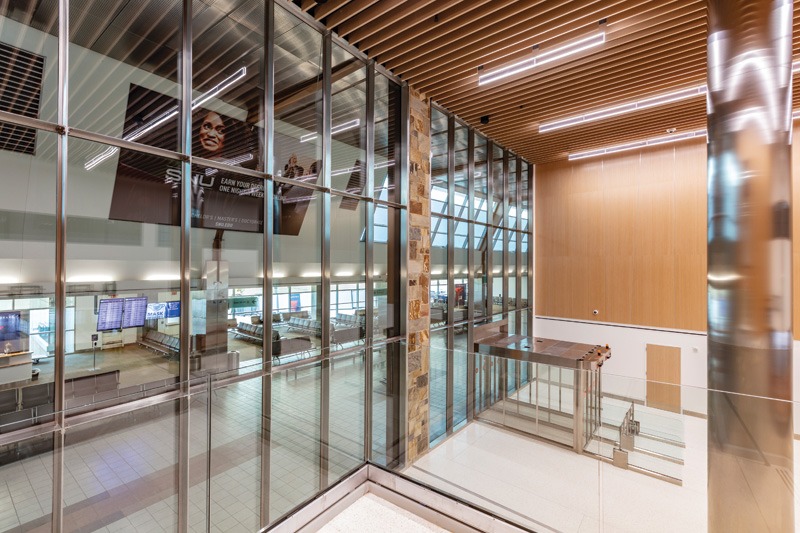
At Will Rogers World Airport, a stronger framing system, combined with the building’s structural components, enabled the exterior curtain wall to maximize glazing areas and minimize framing materials across its 10 m (33 ft) height and 26.8 m (88 ft) width. From a design perspective, this improved access to daylight and visual connection throughout the concourse. From an installation perspective, reducing framing reinforcement requirements and streamlining the anchoring system enabled the team to tackle the project efficiently.
Finally, steel’s low thermal conductivity supports efficient operation. The material’s conductivity is about 74 percent lower than aluminum (approximately 32,707 J/hr (31 Btu/hr) vs. 124,497 J/hr (118 Btus/hr), meaning steel framing heats and cools at slower rates than comparable aluminum systems. This also supports the glazing’s ability to provide daylight and a comfortable indoor atmosphere by reducing thermal bridging, improving overall efficiency. Further, it can be crucial when a system needs a fire rating.
Steel connects fire-rated and non-fire-rated assemblies
Although none of the curtain walls at Will Rogers World Airport required a fire rating, many transit hubs require building components to meet fire and life-safety requirements. In these instances, fire-rated glazing can help project teams ensure occupant safety while delivering an open and cohesive design. Fire-rated glazing provides utility and versatility for code-compliant fire-rated doors, wall panels, and curtain walls. It achieves fire-resistance ratings across full assemblies without compromising design cohesion.
This is partially due to the material’s strength. Depending on its rating, fire-rated glass can be nearly four times as heavy as architectural glass. To compensate for the added weight, framing systems may need to increase profile dimensions and/or reduce mullion spacing. Cold-formed fire-rated steel framing combines the material’s strength with a manufacturing process that yields slender profiles closer to those of non-rated frames. In turn, these fire-rated assemblies can be used in stairways, elevator shafts, and any other location where fire-rated and non-rated assemblies will be installed in proximity without creating glaring discrepancies between them.
Steel’s strength also works with its higher melting point—depending on the steel alloy, 1,371 to 1,538 C (2,500 to 2,800 F), compared to aluminum, which melts at approximately 660 C (1,220 F). This helps project teams design enclosures that can handle both the added weight of fire-rated glass and the risk of deformation and failure these systems must withstand during a fire.
Fulton Center blends glazing in NYC Transit Hub
The combination of performance and aesthetic possibilities offered by fire-rated steel framing helped the design team behind the Fulton Center create a light-filled, visually coherent, and code-compliant structure for those who live and visit New York City.
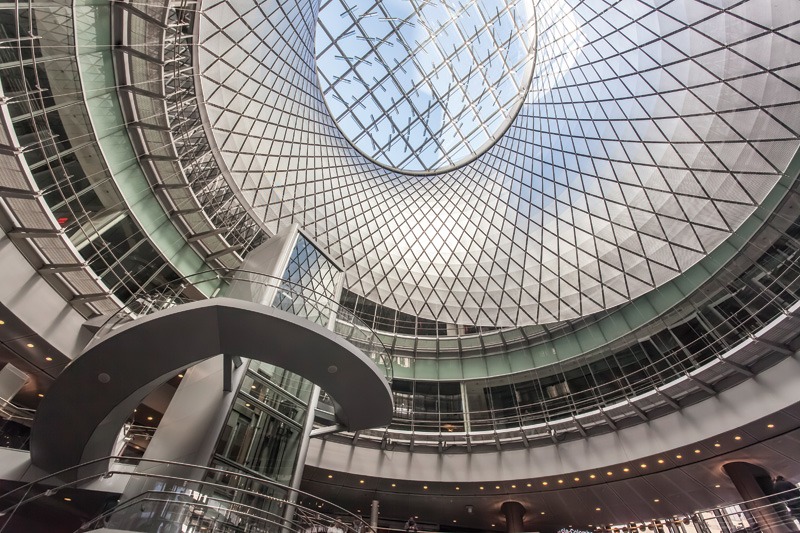
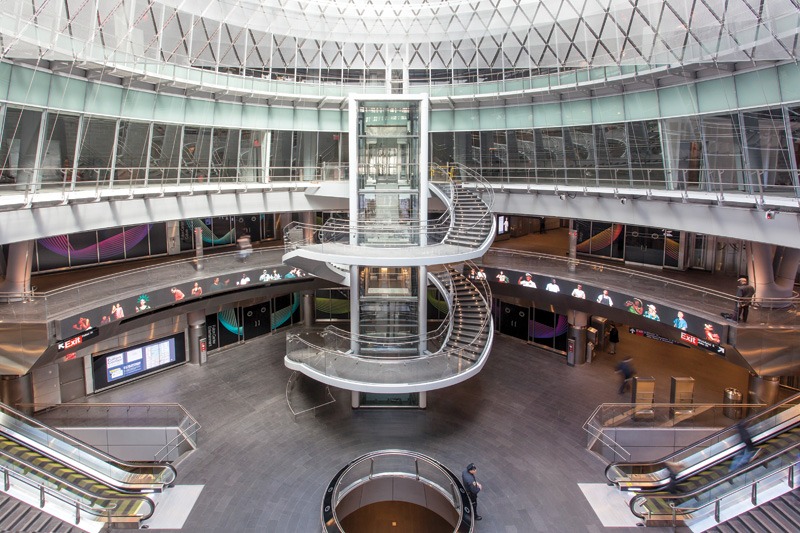
Construction began in 2005 and wrapped in 2014, creating a light-filled, open space—the Fulton Center now serves as more than just a stop for its more than 300,000 daily commuters. Most of the natural light in the transit hub comes from a massive glass oculus that makes up the bulk of the building’s roof, and a functional art installation called Sky Reflector Net Light. travels from these elements deep into the two-level enclosed space below it.
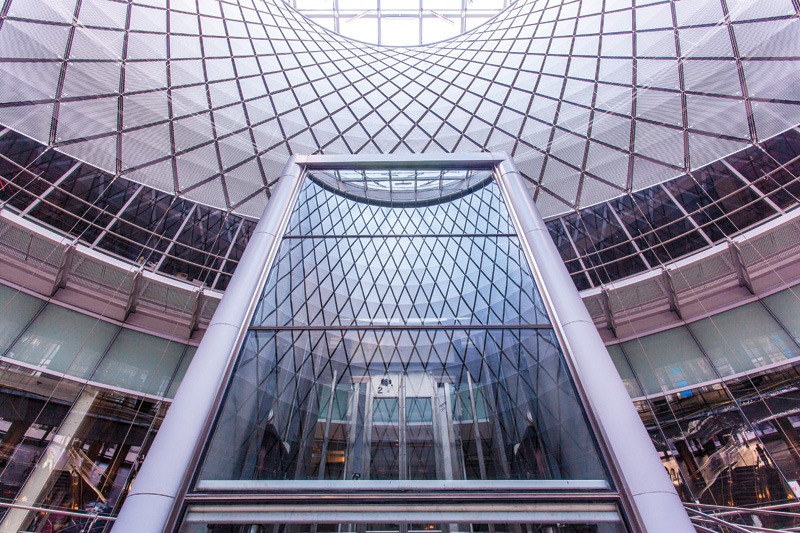
This circular, mixed-use environment was glazed to minimize light obstructions and enhance a more intuitive transit center. In addition to the complexities of its distinctive shape, the design team aimed to create a cohesive aesthetic between the fire-rated curtain walls on the upper level and the prominent elevator core, and the non-fire-rated curtain wall system on the lower level. These goals were achieved by using fire-rated steel framing with a high degree of strength within its narrow profiles.
The use of the same manufacturing method for fire-rated frames with steel back members allows the fire-rated curtain wall to match the slender frame profiles of the non-rated system below. Stressing the importance of clean sightlines, Andrew Anderson, associate principal, Grimshaw Architects, the firm behind the project, explains that the minimal framing details were “easy enough” to achieve with non-rated curtain wall assemblies, yet the fire-rated curtain walls provide the same crisp, modern look.
The fire-rated frames were made of heat-resistant carbon steel that could be roll-formed into profiles as narrow as 44.5 mm (1.75 in.) and featured precise, crisp edges. Spanning around 3 m (10 ft) high, the fire-rated frames visually matched the non-rated framing systems. The main elevator shaft underscored this match by physically and visually connecting the two assembly types.
Curtain wall design starts with material potential
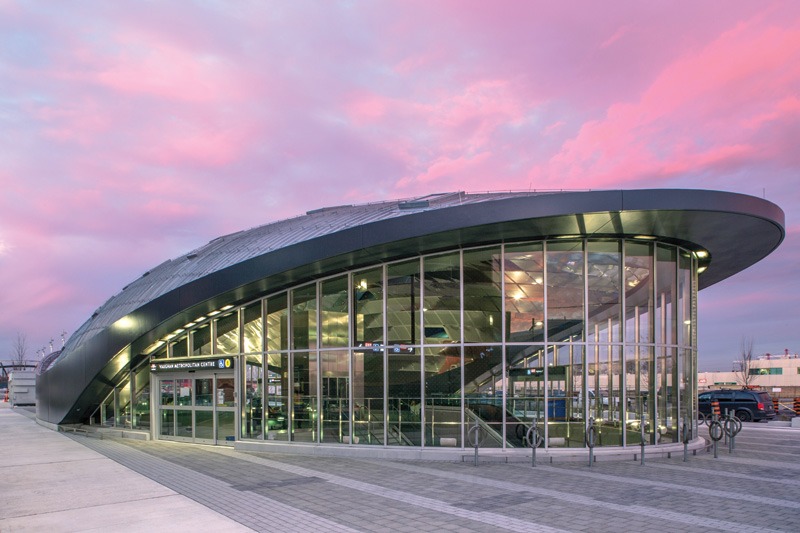
As these two projects show, the design of a transit hub, whether for subways, airplanes, or buses, often has complex requirements and goals. In terms of facilitating daylight access and openness, steel-framed glass curtain walls offer several distinct advantages.
The frame strength allows greater spans between mullions, increasing glazing area, even when a system must accommodate the added weight of fire-rated glass or other high-performance glazing. When manufactured using cold-forming techniques, it can also achieve profile dimensions closely resembling those of non-rated systems, resulting in a more cohesive design aesthetic.
Steel’s low thermal conductivity, high melting point, and compliance with fire-resistance rating requirements for curtain walls further enhance its versatility in transit hubs. Although not specific to these projects, stainless steel alloy frames can also enhance design flexibility and durability while streamlining cleaning requirements for exterior-facing applications.
With their versatility, steel-framed curtain walls increase the design freedom of project teams when planning airports, metro stations, and transit hubs—all without compromising functionality or building code compliance. This enables designers to address challenges in improving these spaces, both in terms of operational efficiency and in their ability to support occupant well-being through daylight access. As such, specifiers are encouraged to consider steel framing systems when planning glazing assemblies in transit hubs. Doing so can help improve the performance of these systems without compromising aesthetic goals.
Author

Devin Bowman is general manager of Technical Glass Products (TGP) and AD Systems. With more than 20 years of industry experience, Bowman is actively involved in advancing fire- and life-safety codes and sits on the Glazing Industry Code Committee (GICC). He can be reached by email at devin.bowman@allegion.com or at (800) 426-0279.
Key Takeaways
Advanced steel-framed glass curtain walls enhance transit hubs like Oklahoma City’s Will Rogers World Airport and New York’s Fulton Center. Steel’s superior strength and thermal properties enable expansive glazing, improving daylighting and navigation while seamlessly integrating essential fire-safety and security requirements into the design.
Sign up for our weekly newsletter
Architectural materials and methods delivered right to your inbox

- CSI News & Notes: CSI’s impact earns official recognition; celebrate leaders, mentors, and innovators; and more
- CSI News and Notes: CSI spring certification exams open; scholarships available; and more
- CSI News & Notes: CSI MSR heading to San Diego; spring certification exams open; and more
- To Be Specific: Why CDT Should Be Your First Move
- CSI News & Notes: CSI Fellows share member benefits; and a New Year’s Resolution to keep
Products

Read the Latest Issue